Bank stocks gain as RBI forex swap window lifts sentiment
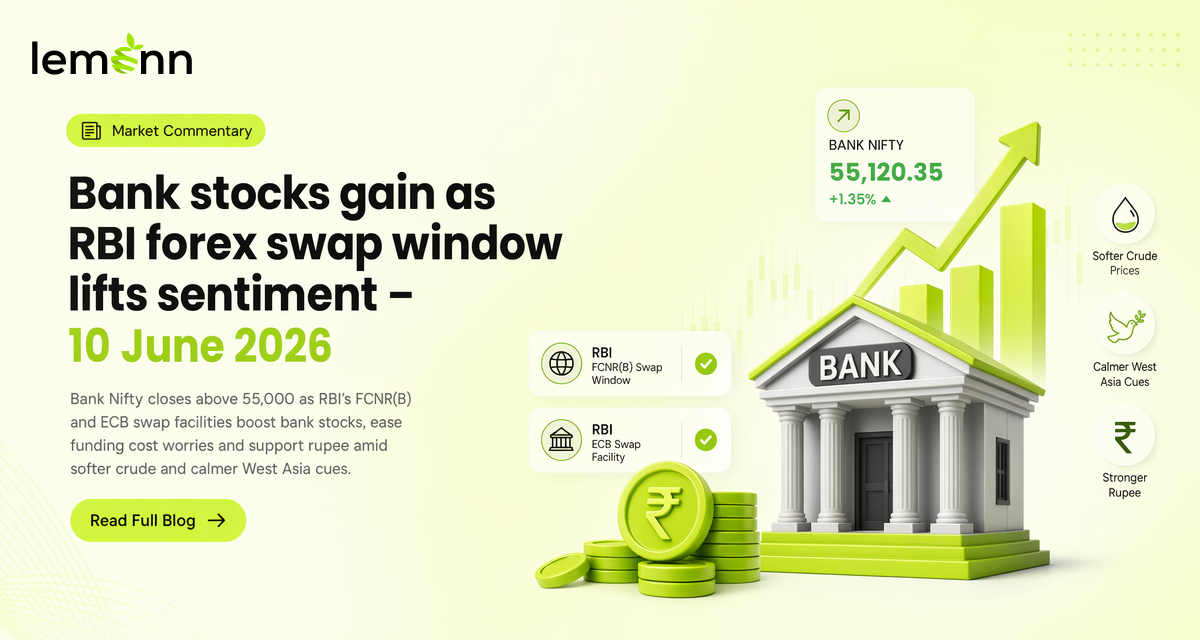
Bank shares rallied on Tuesday as the Reserve Bank of India’s new foreign currency swap facilities for FCNR(B) deposits and external commercial borrowings cut hedging costs and improved funding visibility, lifting Bank Nifty by 2.1% to 55,194.50. Public sector lenders led the move, with Bank of Baroda gaining about 5.5%, as investors priced in cheaper foreign currency funding and expectations of stronger deposit growth.
Market overview
| Index / Asset | 10 Jun Close | Move & % Change | Comments |
|---|---|---|---|
| Sensex | 73,919 | +395 pts (+0.5%) | Supported by bank rally and softer crude prices. |
| Nifty 50 | 23,242.10 | +119 pts (+0.5%) | Tracked gains in financials after RBI measures. |
| Bank Nifty | 55,194.50 | +approx. 1,140 pts (+2.1%) | Closed above 55,000 after two weeks, all 14 stocks higher. |
| Rupee vs USD | 95.36 | +35 paise (firmer) | Strengthened as forex inflow expectations improved. |
| Crude oil (global) | N.A. | down about 3% | Decline aided risk sentiment; West Asia seen calmer. |
Note: figures are approximate; final exchange data not available at time of publication.
- RBI unveiled operational guidelines for a special FCNR(B) swap window.
- Central bank also offered concessional swaps for eligible ECBs by public sector entities.
- Relatively calm West Asia steadied global markets and reduced risk aversion.
- Oil’s near 3% fall eased concerns on India’s external balances.
- Market participants expect improved foreign currency inflows to support the rupee.
RBI measures and funding impact
- RBI will swap fresh 3 to 5-year FCNR(B) deposits with banks at par.
- Central bank will absorb the entire hedging cost on these FCNR(B) deposits.
- Historical hedging costs were about 2.5% to 3.5% annually for such deposits.
- FCNR(B) deposits under this window are exempt from CRR and SLR.
- RBI set concessional swap cost for eligible ECBs at 1.5% per annum.
- Policy allows banks to expand dollar liabilities without bearing currency risk.
- Analysts expect cheaper cost of funds and a healthier deposit base for banks.
- If banks raise USD 50 billion, deposits could rise by nearly ₹5 lakh crore.
- Structure resembles quasi-sovereign borrowing as exchange risk sits with RBI.
- A large share of funding is expected from foreign banks via NRI channels.
- “The measures by RBI are likely to drive a healthy deposit base for banks and lead to cheaper cost of funds since the hedging cost on FCNRB is borne by the Central Bank while the hedging costs on ECB’s is subsidised,” — Dharmesh Kant, Head of Research, Cholamandalam Securities.
Key movers in banking
Top gainers
| Stock | Sector | Notable Factor |
|---|---|---|
| Bank of Baroda | Public sector bank | Rose about 5.5% on expectations of cheaper foreign funding. |
| Canara Bank | Public sector bank | Gained around 4.3 to 4.5% after RBI swap clarity. |
| Punjab National Bank | Public sector bank | Advanced about 3.5 to 3.7% on deposit growth hopes. |
| Federal Bank | Private sector bank | Climbed around 3.5% tracking sector-wide optimism. |
- All 14 Bank Nifty constituents ended higher.
- Public sector banks outperformed the broader market indices.
- Investors positioned for improved margins from lower hedging and reserve costs.
Technical and derivatives signals
- Bank Nifty broke above 55,100, marking a high-volume breakout.
- Index closed above 55,000 for the first time in about two weeks.
- Derivative traders covered bearish bets after policy clarity.
- Put-Call Ratio had dropped below 0.80, indicating an oversold zone before the news.
- Short covering contributed to the rapid intraday move in bank stocks.
- “The sudden fundamental clarity triggered massive technical short covering, catching derivative traders by surprise and sparking a rapid short squeeze since the Put-Call Ratio (PCR) had dropped into an oversold zone below 0.80 ahead of the news,” — Nishchal Jain, Quant Researcher, Share.
- Jain said the breakout shifted the regime from “sell on rallies” to “buy on dips”.
- He viewed 55,000 as a strong psychological support base for Bank Nifty.
Macro and sectoral backdrop
- RBI’s measures aim to boost foreign currency inflows and support the rupee.
- Concessional swaps are available until 16 October 2026 for FCNR(B) deposits.
- Policy is designed to ease domestic deposit constraints via offshore capital.
- Banks and analysts see relief where credit growth outpaced deposit growth.
- Framework lets banks offer more competitive rates to NRI depositors.
- Net interest margins are shielded as hedging and reserve costs fall.
- Global markets stabilised as West Asia tensions appeared contained.
- Softer crude and a firmer rupee improved the near-term macro backdrop.
Key market statistics
| Statistic | Value / Change | Context |
|---|---|---|
| Bank Nifty close | 55,194.50 | Regained 55,000 level, signalling renewed sector strength. |
| Sensex gain | +395 pts (+0.5%) | Banks led the index higher despite global uncertainties. |
| Rupee | 95.36 per USD | Strengthened by 35 paise on inflow expectations and lower oil. |
| Oil price move | down about 3% | Lower crude eased concerns on inflation and current account. |
Note: figures are approximate; final exchange data not available at time of publication.
- Market participants will track actual FCNR(B) inflows over coming months.
- Sustainability of the rally may hinge on global rates and risk sentiment.
FAQs
Q: What is the RBI’s FCNR(B) swap window and how does it help banks?
- RBI allows banks to swap new 3 to 5-year FCNR(B) deposits at par, absorbing hedging costs and exempting these deposits from CRR and SLR, which lowers funding costs and supports deposit growth.
Q: How did the RBI measures affect Bank Nifty on Tuesday?
- Bank Nifty rose 2.1% to 55,194.50, with all 14 constituents gaining and the index closing above 55,000 after two weeks, driven by short covering and improved funding visibility.
Q: Why are public sector banks reacting more to these measures?
- Public sector banks, including Bank of Baroda, Canara Bank and Punjab National Bank, can tap concessional FCNR(B) and ECB swaps to access low-cost foreign capital, easing deposit constraints and potentially improving margins.
Frequently Asked Questions
What is the RBI’s FCNR(B) swap window and how does it help banks?
RBI will swap new 3 to 5-year FCNR(B) deposits at par, bearing the hedging cost and exempting these deposits from CRR and SLR. This lowers banks’ effective funding costs and supports deposit growth without adding currency risk.
How did the RBI measures affect Bank Nifty on Tuesday?
Bank Nifty rose 2.1% to 55,194.50, closing above 55,000 after two weeks. All 14 constituents advanced as short covering and expectations of cheaper foreign currency funding lifted sentiment.
Why are public sector banks reacting more to these measures?
Public sector banks such as Bank of Baroda, Canara Bank and Punjab National Bank can use the concessional FCNR(B) and ECB swap facilities to access low-cost global capital, easing domestic deposit constraints and potentially supporting margins.
Disclaimer
The stocks mentioned in this article are not recommendations. Please conduct your own research and due diligence before investing. Investment in securities market are subject to market risks, read all the related documents carefully before investing. Please read the Risk Disclosure documents carefully before investing in Equity Shares, Derivatives, Mutual fund, and/or other instruments traded on the Stock Exchanges. As investments are subject to market risks and price fluctuation risk, there is no assurance or guarantee that the investment objectives shall be achieved. Lemonn (Formerly known as NU Investors Technologies Pvt. Ltd) do not guarantee any assured returns on any investments. Past performance of securities/instruments is not indicative of their future performance.