NPS (National Pension System): How It Works, Tax Benefits & Returns
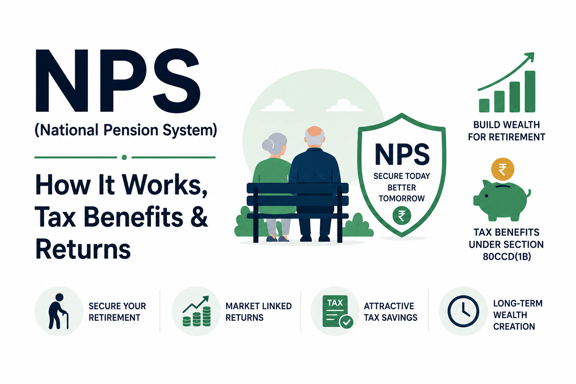
Planning for retirement is one of the most important financial goals, yet many people postpone it until later in life. The National Pension System (NPS) is a government-backed retirement savings scheme designed to help individuals build a retirement corpus through disciplined, long-term investing.
With attractive tax benefits, flexible investment choices, and the potential for market-linked returns, NPS has become a popular retirement planning option among salaried employees, self-employed professionals, and business owners.
In this guide, you’ll learn how NPS works, its tax benefits, expected returns, and whether it fits your retirement strategy.
What Is NPS?
The National Pension System (NPS) is a voluntary retirement savings scheme regulated by the Pension Fund Regulatory and Development Authority (PFRDA).
Under NPS:
- You contribute regularly during your working years.
- The money is invested in market-linked assets.
- A retirement corpus is accumulated over time.
- You receive pension benefits after retirement.
NPS was initially introduced for government employees but is now available to all eligible Indian citizens.
How Does NPS Work?
NPS follows a simple structure.
“Start investing with confidence! Explore
0 demat account
and grow your wealth.”
Step 1: Open an NPS Account
You can open an NPS account through:
- Banks
- Post offices
- Online platforms
- Registered Points of Presence (PoPs)
Step 2: Make Contributions
You contribute money periodically to your NPS account.
There is flexibility regarding:
- Contribution amount
- Frequency of contribution
- Investment allocation
Step 3: Funds Are Invested
Your contributions are invested in different asset classes such as:
- Equity (E)
- Corporate Bonds (C)
- Government Securities (G)
- Alternative Assets (A)
Step 4: Corpus Grows Over Time
The value of your NPS account grows based on:
- Contributions made
- Market performance
- Fund management
Step 5: Retirement and Withdrawal
At retirement, a portion of the accumulated corpus can be withdrawn, while the remaining amount is generally used to purchase an annuity that provides regular pension income.
Types of NPS Accounts
Tier I Account
This is the primary retirement account.
Features
- Tax benefits available
- Long-term retirement focus
- Withdrawal restrictions apply
- Mandatory for NPS participation
Tier II Account
This is a voluntary savings account linked to Tier I.
Features
- Flexible withdrawals
- No mandatory lock-in for most investors
- Acts like an investment account
Most tax benefits are associated with the Tier I account.
Who Can Invest in NPS?
NPS is open to:
- Indian citizens
- Resident Indians
- Non-Resident Indians (NRIs)
Eligibility
- Typically between 18 and 70 years of age
- Must comply with KYC requirements
Both salaried and self-employed individuals can participate.
NPS Investment Choices
NPS allows investors to choose how their money is invested.
Active Choice
You decide the allocation among:
- Equity
- Corporate debt
- Government securities
- Alternative assets
Suitable for investors who want more control.
Auto Choice
Asset allocation changes automatically based on age.
As retirement approaches:
- Equity exposure decreases
- Debt allocation increases
Suitable for investors who prefer a hands-off approach.
Asset Classes in NPS
| Asset Class | Investment Type |
|---|---|
| E | Equity Shares |
| C | Corporate Bonds |
| G | Government Securities |
| A | Alternative Investments |
Diversification helps balance risk and return over the long term.
Tax Benefits of NPS
One of NPS’s biggest advantages is its tax-saving potential.
Section 80CCD(1)
Contributions qualify for deduction within the overall Section 80C-related limit framework.
Section 80CCD(1B)
An additional deduction of up to:
₹50,000 per financial year
is available for eligible NPS contributions.
This benefit is over and above the standard Section 80C limit.
Section 80CCD(2)
Employer contributions to NPS may qualify for additional tax benefits subject to applicable conditions and limits.
This provision is especially beneficial for salaried employees.
Why NPS Is Popular Among Taxpayers
NPS offers a combination of:
- Retirement planning
- Long-term wealth creation
- Additional tax deductions
- Professional fund management
This makes it attractive for individuals seeking both tax efficiency and retirement security.
What Returns Can You Expect from NPS?
NPS does not guarantee fixed returns because it is a market-linked investment.
Returns depend on:
- Asset allocation
- Market performance
- Fund manager performance
- Investment duration
Historical Perspective
Over long periods, NPS equity and mixed portfolios have generally delivered competitive returns compared to many traditional retirement products.
However, past performance does not guarantee future results.
Factors Influencing Returns
- Equity allocation
- Interest rate environment
- Economic conditions
- Length of investment horizon
Longer investment periods generally help reduce the impact of short-term market fluctuations.
NPS vs PPF
Many investors compare NPS with the Public Provident Fund (PPF).
| Feature | NPS | PPF |
|---|---|---|
| Returns | Market-linked | Government-declared |
| Risk Level | Moderate | Low |
| Tax Benefits | Yes | Yes |
| Equity Exposure | Yes | No |
| Lock-In | Until retirement (with conditions) | Long-term lock-in |
| Pension Component | Yes | No |
Both can complement each other in a retirement portfolio.
NPS vs EPF
| Feature | NPS | EPF |
|---|---|---|
| Eligibility | All eligible individuals | Salaried employees under applicable rules |
| Return Type | Market-linked | Government-declared |
| Equity Exposure | Available | Limited through EPF structure |
| Tax Benefits | Yes | Yes |
| Retirement Income | Annuity component | Lump sum and pension benefits under applicable provisions |
NPS Withdrawal Rules
Partial Withdrawal
Partial withdrawals may be permitted for specific purposes such as:
- Higher education
- Marriage
- Home purchase
- Medical treatment
Conditions and limits apply.
Exit at Retirement
At retirement age:
- A portion of the corpus can generally be withdrawn as a lump sum.
- The remaining portion is typically used to purchase an annuity for pension income.
Applicable rules may change over time, so investors should review current regulations.
Advantages of NPS
Tax Savings
Multiple tax benefits make NPS attractive for long-term investors.
Professional Fund Management
Investments are managed by regulated pension fund managers.
Low Cost
NPS is known for relatively low fund management charges compared to many investment products.
Retirement Focus
The structure encourages disciplined retirement savings.
Flexible Investment Options
Investors can choose asset allocation based on their risk tolerance.
Limitations of NPS
Market Risk
Returns are not guaranteed.
Restricted Withdrawals
Access to funds is limited compared to regular investment accounts.
Mandatory Annuity Purchase
Part of the retirement corpus typically needs to be used for pension income generation.
Complexity
Some investors may find asset allocation and withdrawal rules difficult to understand initially.
Is NPS a Good Investment?
NPS may be suitable if you:
- Want to build a retirement corpus
- Need additional tax deductions
- Have a long investment horizon
- Are comfortable with market-linked returns
It may be particularly valuable for salaried employees already utilizing other tax-saving investments and looking for extra deductions.
Key Takeaways
- NPS is a government-regulated retirement savings scheme managed under PFRDA oversight.
- Investors can choose between active and automatic asset allocation options.
- Contributions qualify for significant tax benefits under various sections of the Income Tax Act.
- Returns are market-linked and depend on investment performance.
- NPS combines retirement planning, tax efficiency, and professional fund management.
- It is suitable for long-term investors focused on retirement wealth creation.
Frequently Asked Questions
Q. Is NPS safe?
NPS is regulated by the Pension Fund Regulatory and Development Authority (PFRDA), and investments are managed by licensed pension fund managers. However, returns are market-linked and not guaranteed.
Q. Can self-employed individuals invest in NPS?
Yes. NPS is available to both salaried and self-employed individuals who meet the eligibility criteria.
Q. What is the additional tax benefit available under NPS?
Eligible investors can claim an additional deduction of up to ₹50,000 under Section 80CCD(1B), subject to prevailing tax laws.
Q. Can I withdraw money from NPS before retirement?
Partial withdrawals are permitted under specific conditions such as education, marriage, home purchase, or medical needs.
Q. Does NPS provide a pension after retirement?
Yes. A portion of the accumulated corpus is generally used to purchase an annuity, which provides regular pension income after retirement.
Conclusion
The National Pension System (NPS) is one of India’s most effective retirement planning tools, combining market-linked growth potential with meaningful tax benefits. Its flexibility, low costs, and professionally managed investment options make it a strong choice for individuals looking to build long-term retirement wealth.
Whether you’re a salaried employee seeking additional tax savings or a self-employed professional planning for financial independence in retirement, NPS can play an important role in creating a secure and sustainable retirement income stream.
Disclaimer
The stocks mentioned in this article are not recommendations. Please conduct your own research and due diligence before investing. Investment in securities market are subject to market risks, read all the related documents carefully before investing. Please read the Risk Disclosure documents carefully before investing in Equity Shares, Derivatives, Mutual fund, and/or other instruments traded on the Stock Exchanges. As investments are subject to market risks and price fluctuation risk, there is no assurance or guarantee that the investment objectives shall be achieved. Lemonn (Formerly known as NU Investors Technologies Pvt. Ltd) do not guarantee any assured returns on any investments. Past performance of securities/instruments is not indicative of their future performance.
Related Posts



Download Lemonn
Download my app for share market trading, ipo investment, trading account, and all your investment needs.