GST Registration for Small Businesses: Who Needs It & How to Apply
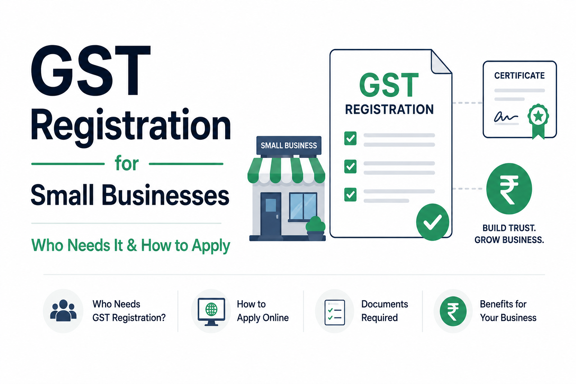
Starting a small business comes with several legal and tax responsibilities, and GST registration is one of the most important. Whether you’re running a local shop, offering professional services, selling online, or operating a startup, understanding GST registration can help you stay compliant and avoid penalties.
The good news is that the GST registration process is completely online and can be completed from anywhere. In this guide, you’ll learn who needs GST registration, its benefits, required documents, and how to apply step by step.
What Is GST Registration?
GST (Goods and Services Tax) registration is the process through which a business obtains a unique GST Identification Number (GSTIN) from the government.
Once registered, a business can:
- Collect GST from customers
- Claim Input Tax Credit (ITC)
- File GST returns
- Operate legally under GST regulations
A GSTIN is a 15-digit unique identification number assigned to every registered taxpayer.
Who Needs GST Registration?
Not every small business is required to register for GST. However, registration becomes mandatory under certain circumstances.
“Start investing with confidence! Explore
0 demat account
and grow your wealth.”
1. Businesses Exceeding the Turnover Threshold
GST registration is generally required when annual aggregate turnover exceeds prescribed limits.
For Goods Suppliers
- Up to ₹40 lakh in many states
For Service Providers
- Up to ₹20 lakh in most states
For special category states, lower thresholds may apply.
Always verify the latest turnover limits applicable to your state and business category.
2. E-Commerce Sellers
Businesses selling products through online marketplaces may need GST registration, depending on the applicable rules and nature of supplies.
Examples include:
- Amazon sellers
- Flipkart sellers
- Meesho sellers
- Other e-commerce platforms
3. Inter-State Suppliers
Businesses making taxable supplies across state borders may be required to obtain GST registration under applicable regulations.
4. Casual Taxable Persons
Individuals participating in exhibitions, trade fairs, or temporary business activities in another state may require GST registration.
5. Input Service Distributors and Certain Agents
Specific categories of businesses and representatives are required to register regardless of turnover.
Who May Not Need GST Registration?
You may not need GST registration if:
- Your turnover is below the applicable threshold.
- You exclusively deal in exempt goods or services.
- Your business activities fall outside GST regulations.
However, voluntary registration is also available.
Benefits of GST Registration
Even when not mandatory, GST registration can offer several advantages.
Legal Recognition
GST registration establishes your business as a compliant taxpayer.
Input Tax Credit (ITC)
Registered businesses can claim credit for GST paid on eligible business purchases.
Better Business Credibility
Many customers and corporate clients prefer dealing with GST-registered businesses.
Easier Expansion
GST registration helps when:
- Selling online
- Expanding across states
- Working with larger companies
Access to Government Tenders
Many government contracts require GST registration.
Documents Required for GST Registration
Keep the following documents ready before applying.
For Proprietorship Businesses
- PAN card of proprietor
- Aadhaar card
- Passport-size photograph
- Business address proof
- Bank account details
For Partnership Firms
- PAN card of partnership firm
- Partnership deed
- Identity proof of partners
- Address proof
- Bank account details
For Companies and LLPs
- PAN card of company or LLP
- Certificate of incorporation
- Memorandum and Articles of Association (where applicable)
- Director or designated partner details
- Registered office proof
- Bank account details
Information Required During Registration
You will typically need to provide:
- Legal business name
- PAN details
- Mobile number
- Email address
- Business activity type
- Principal place of business
- Bank account information
Ensure all information matches official records.
How to Apply for GST Registration Online
The GST registration process is entirely digital.
Step 1: Visit the GST Portal
Go to the official GST portal and select New Registration.
Step 2: Choose Taxpayer Type
Select the appropriate category:
- Taxpayer
- Casual Taxable Person
- Non-Resident Taxable Person
Most small businesses will select “Taxpayer.”
Step 3: Enter Basic Details
Provide:
- State
- District
- Business name
- PAN number
- Email address
- Mobile number
Step 4: Verify Through OTP
OTP verification will be sent to:
- Mobile number
- Email address
Complete the verification process.
Step 5: Receive Temporary Reference Number (TRN)
After successful verification, a Temporary Reference Number (TRN) is generated.
Use this TRN to continue your application.
Step 6: Complete the Application Form
Fill in details related to:
- Business information
- Promoter details
- Authorized signatory
- Principal place of business
- Additional business locations
- Goods and services supplied
- Bank account details
Step 7: Upload Documents
Upload the required supporting documents in the prescribed format.
Step 8: Submit Application
Submit the application using:
- Aadhaar authentication
- Electronic Verification Code (EVC)
- Digital Signature Certificate (DSC) where applicable
Step 9: Application Processing
The GST department reviews the application.
If additional clarification is required, you may receive a notice seeking further information.
Step 10: Receive GSTIN
Once approved:
- GSTIN is issued
- GST registration certificate becomes available for download
You can then start collecting GST and filing returns.
How Long Does GST Registration Take?
The timeline varies depending on document verification and application accuracy.
| Stage | Typical Time |
|---|---|
| Application Submission | Same Day |
| Verification | Few Working Days |
| GSTIN Approval | Usually Within Several Working Days |
Incomplete applications may take longer.
Voluntary GST Registration
Even if your turnover is below the threshold, voluntary registration may be beneficial.
Reasons to Register Voluntarily
- Claim Input Tax Credit
- Improve business credibility
- Sell through online marketplaces
- Work with larger clients
- Prepare for business growth
However, voluntary registration also means complying with GST return filing requirements.
Responsibilities After GST Registration
Obtaining GST registration is only the first step.
Registered businesses must:
File GST Returns
Returns must be filed within prescribed deadlines.
Maintain Records
Keep proper records of:
- Sales
- Purchases
- Tax invoices
- Input tax credits
Issue GST Invoices
Invoices should contain all mandatory GST details.
Pay GST Liability
Any tax due must be paid within the prescribed timelines.
Common GST Registration Mistakes to Avoid
Incorrect PAN Details
PAN mismatches can lead to application rejection.
Wrong Business Information
Ensure legal names and addresses match official documents.
Uploading Unclear Documents
Poor-quality uploads often delay processing.
Choosing the Wrong Business Category
Selecting the incorrect taxpayer category may create compliance issues later.
Ignoring Post-Registration Compliance
Registration alone is not enough. Return filing and record maintenance remain essential.
Key Takeaways
- GST registration is mandatory for businesses crossing prescribed turnover limits and certain categories of taxpayers.
- Registered businesses receive a GSTIN and can collect GST legally.
- Benefits include Input Tax Credit, business credibility, and easier expansion.
- The registration process is fully online through the GST portal.
- Proper documentation and accurate information help avoid delays.
- Voluntary registration may benefit growing businesses even below the threshold.
- Ongoing GST compliance includes return filing and record maintenance.
Frequently Asked Questions
Is GST registration mandatory for every small business?
No. Registration is generally required only when turnover exceeds prescribed limits or when specific GST rules apply to the business.
Can I register for GST voluntarily?
Yes. Businesses below the mandatory threshold can apply for voluntary GST registration.
How much does GST registration cost?
GST registration through the government portal does not involve a government registration fee. Professional service charges may apply if you use a consultant.
Can I operate without GST registration?
Yes, if your business is legally exempt from registration requirements. However, mandatory registration rules must be followed when applicable.
What happens after receiving GSTIN?
You can legally collect GST, issue tax invoices, claim eligible input tax credits, and file GST returns as required.
Conclusion
GST registration is an important milestone for any growing small business. It helps establish legal compliance, improves credibility, and enables access to benefits such as Input Tax Credit and wider business opportunities.
By understanding who needs GST registration and following the online application process carefully, small business owners can complete registration smoothly and focus on building and expanding their business with confidence.
Disclaimer
The stocks mentioned in this article are not recommendations. Please conduct your own research and due diligence before investing. Investment in securities market are subject to market risks, read all the related documents carefully before investing. Please read the Risk Disclosure documents carefully before investing in Equity Shares, Derivatives, Mutual fund, and/or other instruments traded on the Stock Exchanges. As investments are subject to market risks and price fluctuation risk, there is no assurance or guarantee that the investment objectives shall be achieved. Lemonn (Formerly known as NU Investors Technologies Pvt. Ltd) do not guarantee any assured returns on any investments. Past performance of securities/instruments is not indicative of their future performance.
Related Posts


Download Lemonn
Download my app for share market trading, ipo investment, trading account, and all your investment needs.