Bonus Shares vs Stock Split vs Dividend: What Actually Happens to Your Portfolio?
Why Corporate Actions Confuse Retail Investors
When a company announces a ‘bonus issue’ or ‘stock split’, many retail investors celebrate as if they received free money. In reality, these corporate actions are largely accounting adjustments. Understanding what actually happens helps you make better investment decisions and avoid common misconceptions.
Stock Split: Same Pie, More Slices
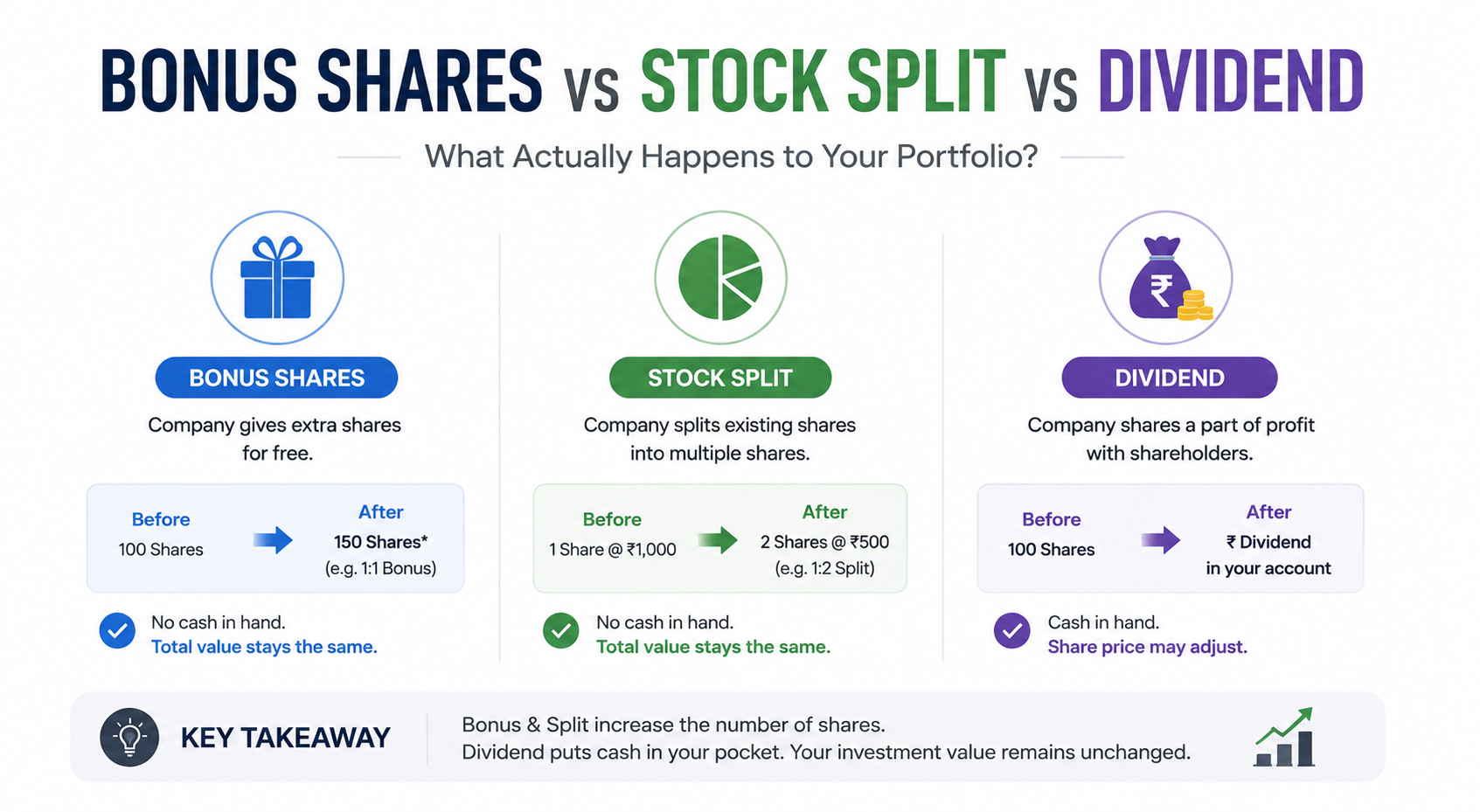
A stock split increases the number of shares by reducing the face value. Example: A 2:1 split means you receive 2 shares for every 1 share held. The share price halves automatically. Your total investment value is unchanged. Example: 100 shares at ₹1,000 = ₹1,00,000. After 2:1 split: 200 shares at ₹500 = ₹1,00,000.
“Start investing with confidence! Explore
0 demat account
and grow your wealth.”
Why Companies Do Stock Splits
- Make shares more affordable and accessible to retail investors
- Improve liquidity — more shares trading at lower prices
- Psychological: lower face value makes stock appear ‘cheaper’ even if market cap is same
Bonus Shares: Free Shares from Retained Earnings
In a bonus issue, the company issues additional shares to existing shareholders by capitalising reserves (retained earnings). Example: 1:1 bonus means 1 free share for every share held. Share price adjusts downward proportionally. Total market cap and your wealth value is unchanged immediately after the bonus.
| Corporate Action | What Changes | What Stays the Same | Investor Impact |
|---|---|---|---|
| Stock Split (2:1) | Share count doubles; price halves; face value halves | Market cap; your wealth | Nil (accounting only) |
| Bonus Issue (1:1) | Share count doubles; price halves; reserves reduce | Market cap; your wealth | Nil immediate; long-term positive signal |
| Cash Dividend | Cash leaves company; price falls by dividend | Share count | You receive cash; wealth transfer from company to you |
| Buyback | Company buys shares; fewer shares outstanding | Your share count (if not participating) | EPS increases; remaining shareholders benefit |
Which is Actually Better for Investors?
Cash dividend is the only corporate action that transfers real value to you immediately. Bonus and splits are non-events from a pure value perspective, though bonuses can signal management confidence in future earnings. Buybacks are the most tax-efficient form of returning capital — no immediate tax (unlike dividend).
Disclaimer
The stocks mentioned in this article are not recommendations. Please conduct your own research and due diligence before investing. Investment in securities market are subject to market risks, read all the related documents carefully before investing. Please read the Risk Disclosure documents carefully before investing in Equity Shares, Derivatives, Mutual fund, and/or other instruments traded on the Stock Exchanges. As investments are subject to market risks and price fluctuation risk, there is no assurance or guarantee that the investment objectives shall be achieved. Lemonn (Formerly known as NU Investors Technologies Pvt. Ltd) do not guarantee any assured returns on any investments. Past performance of securities/instruments is not indicative of their future performance.
Related Posts


Download Lemonn
Download my app for share market trading, ipo investment, trading account, and all your investment needs.