
F&O vs Intraday vs Swing Trading in India: Pros, Cons & How to Choose (2026)
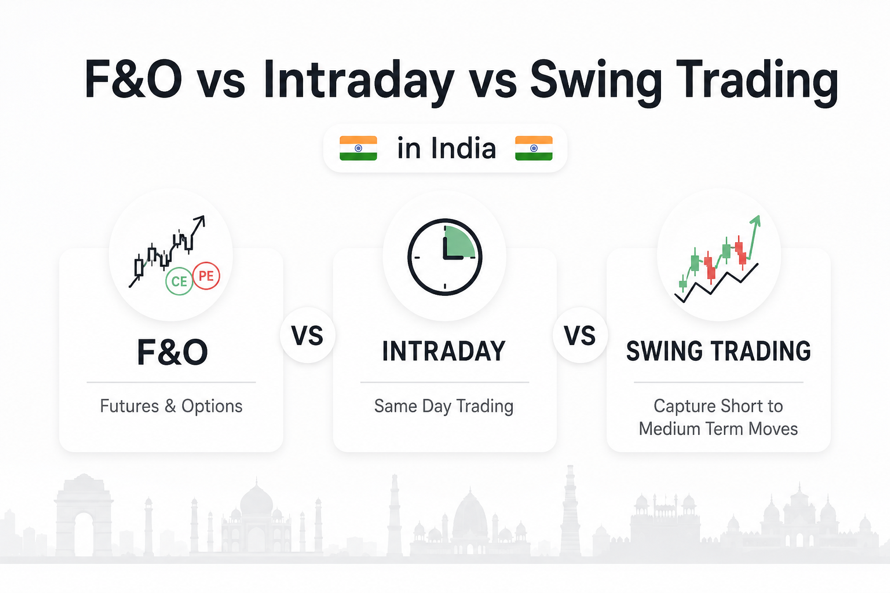
If you have just opened a Demat account in India and are wondering whether to trade Futures & Options (F&O), do intraday trades, or hold swing positions for a few days, you are not alone. Each style has very different risk, capital, and time requirements – and choosing the wrong one is the fastest way to lose money in the markets.
This guide compares F&O, intraday equity, and swing trading head-to-head, with a focus on Indian retail beginners using NSE/BSE through brokers like Lemonn, Zerodha, Groww, Angel One, or Upstox.
What each trading style actually means
Before comparing pros and cons, let us define the three styles clearly.
Intraday trading means buying and selling the same stock on the same day. All positions are squared off before market close (3:30 PM IST). You use Margin Intraday Square-off (MIS) orders and typically get leverage of 4x to 5x as per SEBI rules.
Swing trading means holding stocks for several days to a few weeks to capture short-to-medium term price moves. You take delivery (CNC) of the stock, so it sits in your Demat account.
F&O (Futures & Options) are derivatives – contracts whose value depends on an underlying asset like Nifty 50, Bank Nifty, or individual stocks. You pay only a margin (not the full contract value), which gives leverage but also magnifies losses. F&O is regulated by SEBI and traded on NSE/BSE.
Quick comparison table
| Factor | Intraday | Swing Trading | F&O |
| Holding period | Same day | 2 days to ~3 weeks | Up to monthly/weekly expiry |
| Minimum capital | ₹5,000+ | ₹10,000+ | ₹1.5 lakh+ (one Nifty lot) |
| Leverage | Up to 5x | None (1x delivery) | Built-in leverage |
| Time needed daily | 3–6 hours | 15–30 min/day | 2–6 hours |
| Skill level | High | Beginner-friendly | Advanced |
| Loss risk | High | Moderate | Very high (can exceed capital) |
| STT | 0.025% sell side | 0.1% both sides | 0.0125%–0.1% |
| Tax category | Speculative business income | STCG/LTCG | Non-speculative business income |
“Start investing with confidence! Explore
option trading
and grow your wealth.”
Intraday trading: Pros and Cons
Intraday is the style most beginners are drawn to because of fast results and low capital. But the same speed cuts both ways.
Pros of intraday trading:
- Quick feedback loop – you know if you made or lost money the same day
- Leverage of 4x–5x means small capital can take meaningful positions
- No overnight risk from global news, results, or gap-downs
- High liquidity in Nifty 50 stocks ensures tight spreads
Cons of intraday trading:
- Most studies suggest a vast majority of intraday traders lose money. SEBI’s 2023 study on equity F&O traders found that 89% of individual traders in the F&O segment made net losses in FY22 – and intraday equity traders fare similarly.
- Brokerage and STT eat into thin profit margins
- Requires sitting in front of the screen during market hours – incompatible with a 9-to-5 job
- Forced square-off at 3:20 PM can liquidate trades at bad prices
- Emotional discipline needed; revenge trading is common
Intraday makes sense if you have at least 6 months to learn, capital you can afford to lose, and the screen time. Start on the paper trading before risking real money.
Swing trading: Pros and Cons
Swing trading sits between intraday and long-term investing. You analyze charts on the daily timeframe and hold for days or weeks.
Pros of swing trading:
- Far less stressful than intraday – you check charts once or twice a day
- Compatible with a job, college, or a busy household schedule
- Lower brokerage frequency, so costs eat less of your returns
- Captures bigger moves than intraday – a single good swing trade can return 5–15%
- Lower psychological pressure; decisions are not rushed
Cons of swing trading:
- Overnight gap-down risk on bad news, results, or global cues
- Capital is blocked for days; no leverage means smaller absolute gains
- Profits face Short-Term Capital Gains tax of 20% if sold within 12 months
- Requires patience – most days the market does not give an entry
For beginners, swing trading is usually the safest first style. See our swing trading strategies guide for chart setups that work on Indian stocks.
F&O: Pros and Cons
Futures and Options offer the highest leverage and the most ways to profit – including from sideways markets. They are also where most beginners lose the most money.
Pros of F&O:
- Leverage of 5x–20x lets you control large positions with less capital
- You can profit in falling markets (short selling without restrictions)
- Options strategies like covered calls and protective puts can hedge a portfolio
- Weekly expiries on Bank Nifty and Nifty add many trading opportunities
- Lower STT on options than on intraday equity
Cons of F&O:
- Lot sizes are large – Nifty 50 lot is ₹1.5+ lakh in margin and Bank Nifty even more
- Time decay (theta) eats option-buying positions every day
- Option selling has unlimited theoretical risk
- SEBI now requires real-time loss disclosure on broker platforms because of how badly retail traders fare
- Complex Greeks (delta, gamma, theta, vega) take months to understand
- Treated as non-speculative business income – you must file ITR-3, maintain books if turnover crosses thresholds, and may need a tax audit
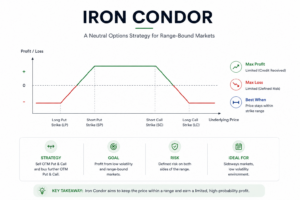
Do not start with F&O until you have at least 1–2 years of swing trading experience. If you must, start with cash-secured short puts on Nifty or covered calls – never with naked option buying. Modern broker apps like Lemonn bundle Basket Orders that let you execute multi-leg F&O strategies (iron condors, spreads) in one click instead of leg-by-leg – which reduces slippage but does not reduce the underlying risk.
Capital and risk side-by-side
A useful rule for retail traders: never risk more than 1–2% of your capital on a single trade.
- With ₹50,000 of capital, intraday means risking ₹500–₹1,000 per trade
- With ₹50,000, swing trading means buying 1–2 quality stocks with stop-loss
- With ₹50,000, F&O is dangerous – one Nifty lot move of 50 points loses ₹3,750
This is why ₹50,000 capital + F&O is a recipe for blow-ups. The same capital deployed in swing trades or index ETFs is far more survivable.
Taxation: a hidden differentiator
Tax treatment changes net returns dramatically.
- Intraday equity: treated as speculative business income, taxed at slab rates. Losses can offset only other speculative gains and carry forward 4 years.
- Swing trading (delivery): STCG at 20% if sold within 12 months, LTCG at 12.5% above ₹1.25 lakh per year if held longer.
- F&O: non-speculative business income at slab rates, but you can claim expenses (internet, software, advisory). Tax audit may apply once turnover crosses prescribed limits.
Always consult a chartered accountant for your filings – this is a simplified summary, not tax advice.
Which style should you start with?
For most Indian retail beginners, here is a sensible progression:
- Month 1–3: Learn the basics. Open a Demat, do paper trading, read about how to read stock charts.
- Month 3–9: Start swing trading with delivery in Nifty 50 stocks. Limit position size. Build a journal.
- Month 9–18: Add small intraday positions only if you have screen time. Keep them capped at 20% of capital.
- After 18+ months: Consider F&O – and only with strategies you understand fully, ideally option selling with defined risk.
The biggest mistake beginners make is skipping straight to F&O because of YouTube success stories. The 89% loss statistic exists for a reason.
FAQs
Q. Is intraday trading better than F&O for beginners?
Yes. Intraday equity has lower lot sizes and simpler instruments. F&O has built-in leverage and complex Greeks that overwhelm new traders. Even better: start with delivery-based swing trading.
Q. How much money do I need to start swing trading in India?
You can start swing trading with as little as ₹5,000–₹10,000, though ₹50,000+ gives more diversification. Use only money you do not need for 6–12 months.
Q. Can I do F&O part-time while having a full-time job?
Option selling on Nifty/Bank Nifty weekly expiries is theoretically possible part-time, but most working professionals are better served by swing trading or systematic investing. F&O requires constant risk monitoring.
Q. What is the tax on intraday vs swing trading profits?
Intraday profits are speculative business income taxed at your slab rate. Swing trading profits are STCG at 20% (if held under 12 months) or LTCG at 12.5% above ₹1.25 lakh (if held longer).
Q. Which is most profitable: intraday, swing, or F&O?
On paper, F&O offers the highest profit potential due to leverage. In practice, swing trading produces the most consistent results for retail traders because it avoids leverage-related blow-ups and overtrading.
Conclusion
F&O is not “better” than swing trading, and intraday is not “smarter” than F&O. Each style suits a different temperament, capital level, and time commitment. Most Indian retail traders should start with delivery-based swing trading, prove they can be consistently profitable for 6–12 months, and only then graduate to intraday or F&O.
Before you place your first trade, check whether your broker’s app shows real-time loss disclosure – SEBI mandates it for F&O, and the number is sobering. The market rewards patience far more than it rewards activity.Ready to start? You can open a zero-AMC Demat account on Lemonn in a few minutes with 100% digital KYC, then compare brokers in our Demat account comparison guide to pick the one that fits your style.
Disclaimer
The stocks mentioned in this article are not recommendations. Please conduct your own research and due diligence before investing. Investment in securities market are subject to market risks, read all the related documents carefully before investing. Please read the Risk Disclosure documents carefully before investing in Equity Shares, Derivatives, Mutual fund, and/or other instruments traded on the Stock Exchanges. As investments are subject to market risks and price fluctuation risk, there is no assurance or guarantee that the investment objectives shall be achieved. Lemonn (Formerly known as NU Investors Technologies Pvt. Ltd) do not guarantee any assured returns on any investments. Past performance of securities/instruments is not indicative of their future performance.
Related Posts

Download Lemonn
Download my app for option trading, IPO, 0 demat account, stocks, and dive into the stock market.



