Modi’s Speech Triggered a Market Shock. Here’s Why Investors Reacted So Strongly
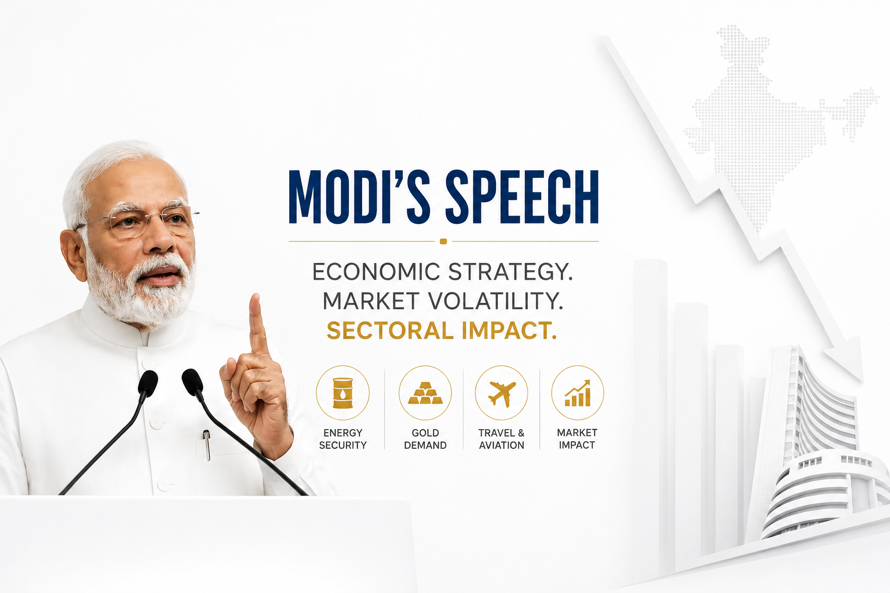
Prime Minister Narendra Modi’s speech on May 10, 2026, was not a budget announcement or a formal economic policy update. Yet within hours, it triggered one of the sharpest sentiment-driven reactions in Indian markets this year.
The Prime Minister urged Indians to reduce fuel consumption, avoid buying gold for a year, postpone foreign vacations, and adopt work-from-home practices wherever possible. The message was framed as a national responsibility during a period of rising geopolitical tensions and economic uncertainty.
By the next trading session, Dalal Street had already responded.
The Sensex fell more than 1,160 points intraday. The Nifty dropped over 330 points. India VIX, the market’s volatility index, surged nearly 10%. Jewelry, aviation, tourism, and financial stocks saw heavy selling pressure as investors rapidly repriced risk across discretionary sectors.
What made the reaction unusual was not just the market decline, but the reason behind it. Investors interpreted the speech as a signal that India may be entering a period of economic restraint driven by global energy risks and foreign exchange pressures.
The Global Crisis Behind Modi’s Speech
To understand the market reaction, it is important to look beyond domestic politics and focus on the global backdrop.
At the center of the crisis is the Strait of Hormuz, one of the world’s most important oil shipping routes. The region had already been under severe disruption for nearly 75 days, creating concerns about global energy supply chains.
The situation escalated further after diplomatic negotiations between the United States and Iran failed. Following strong remarks from former US President Donald Trump rejecting Iran’s response to peace proposals, crude oil prices surged sharply.
Brent crude crossed $105 per barrel almost immediately.
For India, this creates a serious economic challenge because the country imports close to 90% of its crude oil requirements.
Higher oil prices affect nearly every major economic indicator:
- Inflation rises
- Foreign exchange reserves come under pressure
- The rupee weakens
- Industrial costs increase
- Consumer spending slows
India’s forex reserves had already fallen significantly in recent months, while the rupee was trading near record lows against the US dollar.
Against this backdrop, Modi’s speech was widely interpreted as a preventive economic strategy designed to reduce pressure on imports and conserve foreign exchange.
The “Nine Suggestions” That Changed Market Sentiment
The most remarkable part of the speech was the government’s approach.
Instead of announcing new taxes, import restrictions, or monetary tightening measures, the Prime Minister directly appealed to household behavior and corporate practices.
This transformed the speech from a political address into a nationwide economic restraint message.
Key Suggestions From the Speech
- Use petrol, diesel, and gas with restraint
- Revive work-from-home wherever possible
- Use metro rail and public transport
- Encourage carpooling and EV adoption
- Shift freight movement toward railways
- Postpone foreign vacations for one year
- Avoid destination weddings abroad
- Pause non-essential gold purchases
- Reduce chemical fertilizer usage
Taken together, these recommendations targeted the largest pressure points on India’s external economy.
The goal was clear:
- Reduce dollar outflow
- Lower import dependency
- Protect foreign exchange reserves
- Stabilize the rupee
- Manage inflation risks
Why Markets Reacted So Aggressively
The speech immediately changed investor expectations around discretionary spending.
Markets interpreted the message as a warning that consumption-linked sectors could face slower growth if households cut spending on travel, luxury goods, and imported products.
The result was a broad-based sell-off.
Market Performance Snapshot
| Market Indicator | Performance |
|---|---|
| BSE Sensex | Fell over 1,160 points |
| Nifty 50 | Declined more than 330 points |
| India VIX | Surged nearly 10% |
| Nifty Bank | Down 1.31% |
| Nifty Financial Services | Down 1.66% |
Analysts described the move as a “repricing of geopolitical and consumption risk” rather than normal profit booking.
Jewelry Stocks Were Hit the Hardest
The jewelry sector became the biggest casualty of the speech.
The Prime Minister’s direct appeal to avoid buying gold for one year created immediate concerns about demand destruction in one of India’s largest consumer categories.
India’s gold market depends heavily on:
- Wedding demand
- Festive buying
- Household savings behavior
A public request to postpone gold purchases directly challenged those demand drivers.
Major Declines in Jewelry Stocks
| Company | Stock Movement |
|---|---|
| Titan Company | Nearly -6% |
| Senco Gold | Around -4.5% |
| Sky Gold and Diamonds | Nearly -11% |
| Kalyan Jewellers | Sharp decline |
Gold imports already account for a major share of India’s import bill. Reducing gold consumption is viewed as one way to conserve foreign exchange during periods of elevated crude oil prices.
However, investors quickly realized that this could also slow revenue growth across the jewelry industry.
Aviation and Tourism Faced a Double Blow
The aviation and tourism sectors also witnessed heavy selling pressure.
Airlines were already struggling with rising fuel costs due to higher crude prices. Modi’s appeal to postpone foreign vacations added a second layer of pressure by threatening outbound travel demand.
Aviation and Travel Sector Impact
| Company | Stock Movement |
|---|---|
| IndiGo | -4.73% |
| ixigo | Significant decline |
| Yatra Online | Sharp losses |
| Lemon Tree Hotels | Fell up to 3% |
| Chalet Hotels | Declined sharply |
The timing amplified concerns because the speech came during the peak summer holiday season, one of the strongest periods for travel demand.
Banking and Financial Stocks Also Declined
Financial stocks fell because investors began pricing in the possibility of:
- Higher inflation
- Slower economic growth
- Reduced credit demand
- Potential policy tightening
State Bank of India led the decline among major banking stocks as broader risk sentiment weakened.
The market recognized that prolonged geopolitical instability could eventually impact lending activity and consumer borrowing patterns.
IT and Defensive Sectors Showed Resilience
Not every sector declined sharply.
Technology companies demonstrated relative stability because the work-from-home recommendation aligns naturally with the IT industry’s operational model.
Healthcare and essential consumption stocks also held up better than discretionary sectors.
Some FMCG companies even gained due to strong earnings performance and defensive investor positioning.
The Bigger Economic Shift Behind the Speech
Beyond the immediate market reaction, the speech may represent a broader shift in India’s economic strategy.
1. Economic Patriotism as Policy
The government appears to be using behavioral economics alongside traditional policymaking tools.
Instead of relying only on interest rates or import restrictions, the strategy encourages voluntary consumer restraint through public messaging and national responsibility.
2. Structural Pressure on Discretionary Consumption
Markets are now questioning whether sectors tied to imported luxury spending could face longer-term pressure.
Jewelry, outbound tourism, and aviation may remain vulnerable if global energy prices stay elevated.
3. Green Energy Is Becoming an Economic Priority
The speech strongly reinforced themes around:
- Electric vehicles
- Public transportation
- Renewable energy
- Fuel efficiency
- Domestic manufacturing
These sectors could become major long-term beneficiaries if India accelerates efforts to reduce energy dependence.
Infrastructure Remains the Long-Term Growth Story
Despite the short-term volatility, the government also announced major infrastructure and industrial projects aimed at strengthening long-term economic growth.
Key projects included:
- Highway expansion projects
- Railway freight infrastructure
- Industrial manufacturing zones
- Textile parks
- Petroleum handling facilities
These investments support India’s broader strategy of improving logistics efficiency and boosting domestic manufacturing capacity.
What Investors Should Watch Next
The next phase for markets will largely depend on global energy developments and geopolitical stability.
Key indicators to monitor include:
- Brent crude oil prices
- Movement in the Indian rupee
- Inflation trends
- RBI policy stance
- Foreign institutional investor flows
- Consumer spending patterns
Until geopolitical tensions ease, sectors tied to discretionary spending are likely to remain volatile.
Final Thoughts
Modi’s speech became a defining market event because it connected geopolitics, consumer behavior, and economic policy in a way rarely seen in India.
The market’s reaction was not simply panic. It was a rapid reassessment of which sectors benefit during periods of economic caution and which sectors struggle when households begin reducing discretionary spending.
For investors, the message from Dalal Street was clear:
Markets are now treating energy security, import dependence, and consumer behavior as central themes shaping India’s economic outlook in 2026.
Disclaimer
The stocks mentioned in this article are not recommendations. Please conduct your own research and due diligence before investing. Investment in securities market are subject to market risks, read all the related documents carefully before investing. Please read the Risk Disclosure documents carefully before investing in Equity Shares, Derivatives, Mutual fund, and/or other instruments traded on the Stock Exchanges. As investments are subject to market risks and price fluctuation risk, there is no assurance or guarantee that the investment objectives shall be achieved. Lemonn (Formerly known as NU Investors Technologies Pvt. Ltd) do not guarantee any assured returns on any investments. Past performance of securities/instruments is not indicative of their future performance.