Currency Risk in International Investing: How USD/INR Affects Your Returns
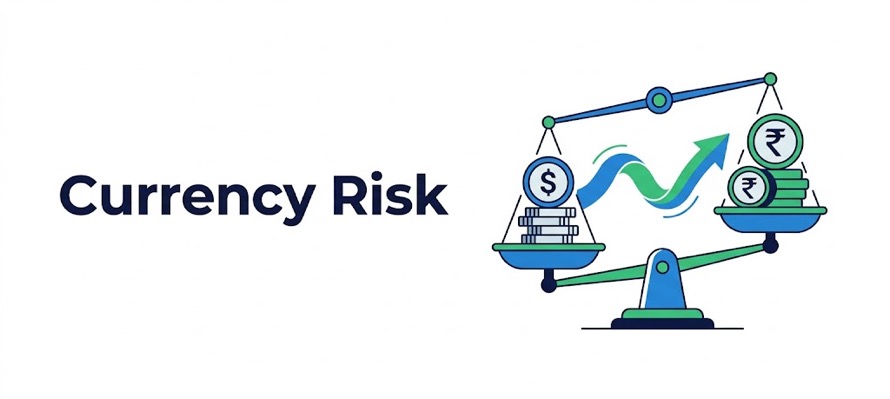
What Is Currency Risk in International Investing?
When an Indian investor buys US stocks, they convert INR to USD. When they sell, they convert USD back to INR. Any change in the USD/INR exchange rate during the holding period affects the final INR return, independent of the stock’s performance in USD terms.
How Currency Moves Affect Your Returns
| Scenario | USD Return | USD/INR Change | INR Return (approx) |
|---|---|---|---|
| Rupee depreciation (common) | +10% | +5% (USD stronger) | +15.5% |
| Neutral currency | +10% | 0% | +10% |
| Rupee appreciation (rare) | +10% | -5% (USD weaker) | +4.5% |
| US stock falls, INR depreciates | -10% | +5% | -5.5% |
| US stock falls, INR appreciates | -10% | -5% | -14.5% |
“Start investing with confidence! Explore
0 demat account
and grow your wealth.”
Historical USD/INR Trend: The Structural Tailwind
Over the past 30 years, the Indian Rupee has depreciated against the US Dollar at approximately 3–4% per year on average. This structural depreciation means Indian investors in US assets have historically received a meaningful currency boost to their USD returns when measured in INR.
| Period | USD/INR (Start) | USD/INR (End) | INR Depreciation |
|---|---|---|---|
| 2000–2010 | 44.9 | 45.7 | ~0.2% pa |
| 2010–2020 | 45.7 | 75.7 | ~5.2% pa |
| 2020–2026 | 75.7 | ~84.5 | ~1.9% pa |
When Currency Risk Can Hurt
- Short holding periods: Currency moves are more volatile short-term, increasing risk
- Large single investments: Better to stagger via systematic transfer to average currency rate
- Near withdrawal: If INR strengthens sharply before you repatriate, returns shrink
- Overconcentration: If most of your wealth is USD-denominated, a strong INR event hurts
How to Manage Currency Risk
Systematic Investment (INR DCA)
Invest fixed INR amounts regularly (monthly) rather than a lump sum. This averages your USD purchase rate over time, reducing the impact of any single unfavourable exchange rate.
Use Indian Index ETFs for Core US Exposure
Mirae Nasdaq 100 ETF, Motilal S&P 500 ETF on NSE: these INR-denominated products hold US assets but trade in INR. Currency risk exists but you avoid active remittance timing decisions.
Avoid Trying to Time Currency
Retail investors rarely predict currency moves accurately. Focus on consistent investment rather than attempting to time USD/INR for remittances. Transaction costs of waiting for a ‘better rate’ typically exceed the benefit.
Currency Risk vs Market Risk: Which Is Larger?
For US stocks, currency risk (USD/INR standard deviation ~5% annually) is much smaller than equity risk (S&P 500 standard deviation ~15% annually). Currency risk is real but secondary to choosing the right assets. Don’t let currency uncertainty prevent you from gaining US equity exposure.
Tax Note: Calculating Gains After Currency Conversion
The Indian Income Tax department requires you to convert your USD purchase price and sale price to INR using the RBI telegraphic transfer rate (or SBI TT rate) on the respective dates. Your taxable capital gain is the INR difference, incorporating actual currency rates used.
Disclaimer
The stocks mentioned in this article are not recommendations. Please conduct your own research and due diligence before investing. Investment in securities market are subject to market risks, read all the related documents carefully before investing. Please read the Risk Disclosure documents carefully before investing in Equity Shares, Derivatives, Mutual fund, and/or other instruments traded on the Stock Exchanges. As investments are subject to market risks and price fluctuation risk, there is no assurance or guarantee that the investment objectives shall be achieved. Lemonn (Formerly known as NU Investors Technologies Pvt. Ltd) do not guarantee any assured returns on any investments. Past performance of securities/instruments is not indicative of their future performance.
Related Posts

Download Lemonn
Download my app for share market trading, ipo investment, trading account, and all your investment needs.