How to Buy S&P 500 and Nasdaq 100 ETFs from India in 2026
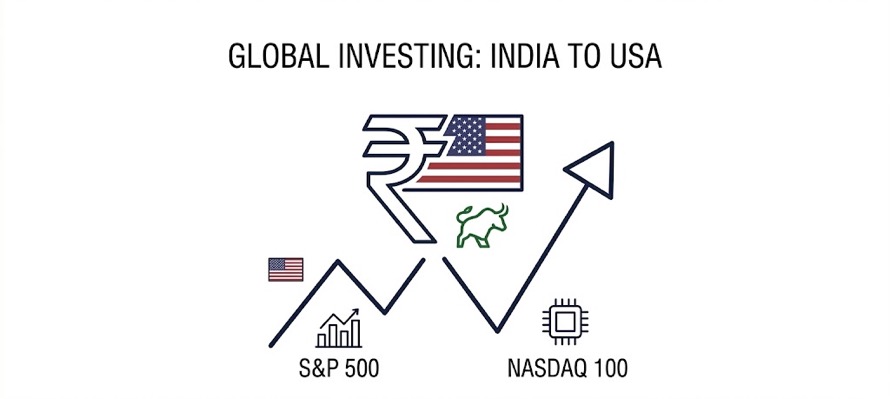
Why S&P 500 and Nasdaq 100 Are the Most Popular US Investments for Indians
The S&P 500 has delivered approximately 10% annualised returns over 30+ years in USD terms. The Nasdaq 100, technology-heavy, has outperformed with higher volatility. For Indian investors seeking US equity exposure, these two indices are the natural starting point.
Three Ways to Invest in S&P 500 from India
“Start investing with confidence! Explore
0 demat account
and grow your wealth.”
Route 1: Direct US ETFs via LRS
Buy SPY (SPDR S&P 500 ETF), VOO (Vanguard S&P 500 ETF), or IVV (iShares S&P 500 ETF) directly on US exchanges through an international broker account. This requires using LRS quota and completing wire transfer to the broker.
Route 2: Indian Mutual Funds (FOFs)
Several Indian AMCs offer Fund of Funds that invest in US index ETFs. Examples include Motilal Oswal S&P 500 Index Fund, ICICI Prudential US Bluechip Equity Fund. No LRS required; invest in INR directly.
Route 3: NSE/BSE Listed ETFs
Mirae Asset NYSE FANG+ ETF, Motilal Oswal Nasdaq 100 ETF, and similar products trade on Indian exchanges. Buy via your existing demat account with no LRS documentation needed.
| Factor | Direct US ETFs | Indian FOF | Indian Listed ETF |
|---|---|---|---|
| Currency | USD (via wire) | INR | INR |
| LRS Required | Yes | No | No |
| Expense Ratio | 0.03%–0.20% | 0.8%–1.5% | 0.5%–0.8% |
| LTCG Tax Rate | Slab rate | 12.5% (36m) | 12.5% (12m) |
| Minimum Investment | $1 (fractional) | ₹500 SIP | 1 unit (~₹50-₹500) |
| Dividend Tax | 25% US WHT + India | Fund level | Fund level |
Direct US ETFs: Step-by-Step for Indian Investors
- Open account with broker offering US market access (international broker or GIFT City route)
- Complete LRS formalities with your AD bank
- Wire USD to broker account
- Search for SPY, VOO, QQQ, or QQQM on platform
- Place market or limit order during US market hours (9:30 PM – 4:00 AM IST)
- Settlement: T+1 for US equities as of 2024
Indian Mutual Fund Route: Key Funds in 2026
| Fund Name | Index Tracked | Expense Ratio (approx) | Min SIP |
|---|---|---|---|
| Motilal Oswal S&P 500 Index Fund | S&P 500 | 0.57% | ₹500 |
| ICICI Pru US Bluechip Equity | S&P 500 (active) | 1.15% | ₹1,000 |
| Motilal Oswal Nasdaq 100 FOF | Nasdaq 100 | 0.57% | ₹500 |
| Franklin India Feeder US Opp. | US opportunities | 1.30% | ₹500 |
Tax Comparison: Direct vs FOF
For Indian investors, the FOF route now has a significant tax disadvantage versus direct ETFs for long-term holdings. Since 2023, Indian debt funds and FOFs investing abroad are taxed at slab rates for all holding periods. However, some India-listed international ETFs qualify for 12.5% LTCG after 12 months.
| Holding Period | Direct US ETF (LRS) | Indian FOF | India-listed Intl ETF |
|---|---|---|---|
| < 12 months | Slab rate | Slab rate | 20% STCG |
| 12–36 months | Slab rate | Slab rate | 12.5% LTCG |
| > 36 months | Slab rate | Slab rate | 12.5% LTCG |
Which Route Is Best for You?
- Small amounts (< ₹10,000/month SIP): Indian listed ETF or FOF: simpler, no forex hassle
- Larger amounts (> $5,000): Direct US ETFs for lower expense ratio
- Maximising tax efficiency: Indian listed ETFs tracking US indices
- GIFT City route: For high-net-worth individuals wanting no LRS consumption
Disclaimer
The stocks mentioned in this article are not recommendations. Please conduct your own research and due diligence before investing. Investment in securities market are subject to market risks, read all the related documents carefully before investing. Please read the Risk Disclosure documents carefully before investing in Equity Shares, Derivatives, Mutual fund, and/or other instruments traded on the Stock Exchanges. As investments are subject to market risks and price fluctuation risk, there is no assurance or guarantee that the investment objectives shall be achieved. Lemonn (Formerly known as NU Investors Technologies Pvt. Ltd) do not guarantee any assured returns on any investments. Past performance of securities/instruments is not indicative of their future performance.
Related Posts

Download Lemonn
Download my app for share market trading, ipo investment, trading account, and all your investment needs.