REITs vs InvITs in India: Key Differences and Which Is Better?
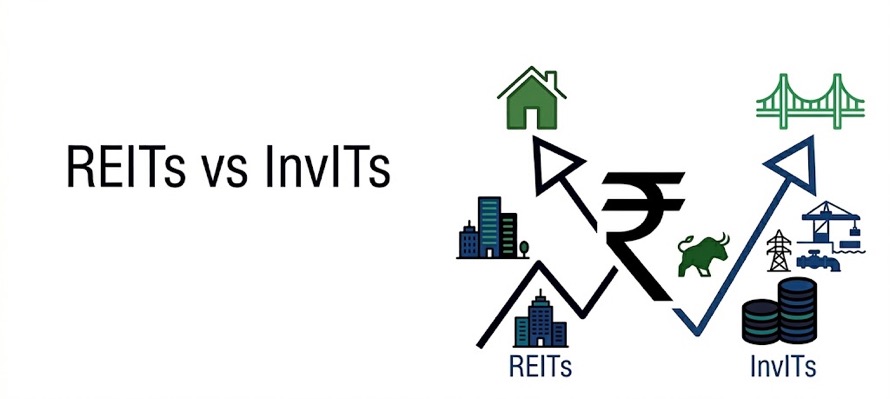
Infrastructure Investment Trusts (InvITs) are structurally similar to REITs but focus on infrastructure assets , toll roads, power transmission lines, gas pipelines, and renewable energy projects. Both offer regular income distributions, but they have important differences in risk, return, and asset type.
What Is an InvIT?
An InvIT owns operational infrastructure assets with long concession agreements , typically 25 to 35 years , from the government. Revenue comes from toll collections, transmission charges, or pipeline tariffs. Like REITs, InvITs distribute 90%+ of distributable cash to unit holders. They trade on NSE and BSE.
REITs vs InvITs: Full Comparison
| Feature | REIT | InvIT |
|---|---|---|
| Assets Owned | Commercial real estate (office, retail, industrial) | Infrastructure (roads, power lines, pipelines) |
| Income Source | Rental income from tenants | Toll revenue, transmission charges, tariffs |
| Distribution Mandate | 90%+ of net distributable cash flows | 90%+ of net distributable cash flows |
| Typical Yield | 6 to 8% per year | 9 to 12% per year (higher risk premium) |
| Leverage Allowed | Up to 49% of asset value | Up to 49% of asset value |
| Asset Permanence | Properties owned indefinitely | Concession expires after 25 to 35 years |
| Key Risk | Office vacancy, rent resets downward | Traffic/revenue risk, concession expiry risk |
| India Examples | Embassy, Mindspace, Brookfield, Nexus | IndiGrid, IRB, PowerGrid InvIT, Bharat Highways |
| Tax Treatment | Interest/dividend/return of capital | Interest/dividend/return of capital (similar) |
“Start investing with confidence! Explore
0 demat account
and grow your wealth.”
Types of InvITs in India 2026
| InvIT | Infrastructure Type | Key Assets | Sponsor |
|---|---|---|---|
| India Grid Trust (IndiGrid) | Power transmission | 40+ transmission lines across India | KKR |
| IRB Infrastructure Trust | Toll roads | 20+ NH projects across India | IRB Infrastructure |
| PowerGrid InvIT | Power transmission | PGCIL transmission assets | Power Grid Corporation (Govt) |
| Bharat Highways InvIT | Toll roads | NHAI projects | NHAI (Govt-backed) |
| Highways Infrastructure Trust | Toll roads | NH projects across 8 states | Cube Highways (Abu Dhabi Investment Authority) |
Why InvITs Offer Higher Yields (and More Risk)
InvITs typically yield 10 to 12% per year versus REITs at 6 to 8%. The higher yield reflects higher risks: concession expiry (assets revert to government), traffic risk on toll roads (fewer vehicles = lower revenue), and the fact that assets depreciate over the concession period rather than appreciating like real estate.
Tax Treatment of Distributions
| Distribution Component | Tax Treatment | Notes |
|---|---|---|
| Interest income portion | Taxed at income tax slab rate | Largest component for most REITs/InvITs |
| Dividend portion | Taxed at slab rate above Rs.5,000 threshold | TDS of 10% deducted at source |
| Return of capital | Not taxable , reduces your cost basis | Affects capital gains calculation on eventual sale |
| Capital gains on sale | LTCG if held > 36 months: 12.5% (no indexation) | STCG if held < 36 months: slab rate |
FAQs
Which is better for passive income , REIT or InvIT?
InvITs offer higher yields (10 to 12%) making them better for pure income. REITs (6 to 8%) offer better capital appreciation potential. A mix of both optimises income and growth.
Can I hold both REITs and InvITs in my Lemonn demat account?
Yes. REITs and InvITs are held in your demat account exactly like equity shares. You can buy and hold multiple REITs and InvITs simultaneously.
Are government-backed InvITs safer?
PowerGrid InvIT and Bharat Highways InvIT have government backing (Power Grid Corp and NHAI respectively), making them among the lowest-risk InvIT options , though yields are accordingly lower.
How often are distributions paid?
Most Indian REITs and InvITs pay quarterly distributions , typically in January, April, July, and October. Some may vary.
What is WALE and why does it matter for REITs?
WALE (Weighted Average Lease Expiry) is the average time remaining on all tenant leases. Higher WALE (4+ years) means more stable, predictable income. Falling WALE increases near-term re-leasing risk.
Disclaimer
The stocks mentioned in this article are not recommendations. Please conduct your own research and due diligence before investing. Investment in securities market are subject to market risks, read all the related documents carefully before investing. Please read the Risk Disclosure documents carefully before investing in Equity Shares, Derivatives, Mutual fund, and/or other instruments traded on the Stock Exchanges. As investments are subject to market risks and price fluctuation risk, there is no assurance or guarantee that the investment objectives shall be achieved. Lemonn (Formerly known as NU Investors Technologies Pvt. Ltd) do not guarantee any assured returns on any investments. Past performance of securities/instruments is not indicative of their future performance.
Related Posts

Download Lemonn
Download my app for share market trading, ipo investment, trading account, and all your investment needs.