LTCG vs STCG Tax on Stocks in India 2026: Rates, Rules & How to Pay Less
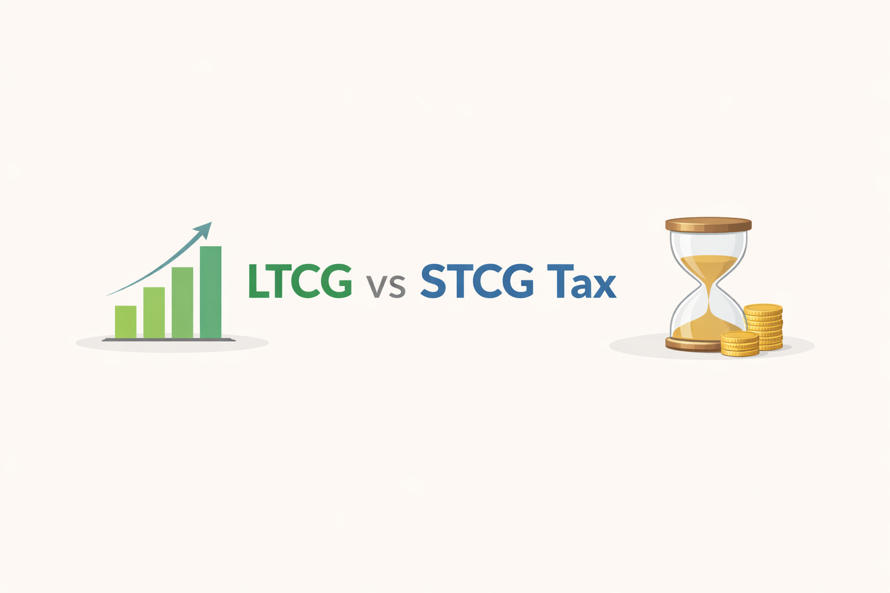
Sold stocks this year? The tax you pay depends on one number: how many months you held those shares before selling. Hold for more than 12 months – Long-Term Capital Gain (LTCG), taxed at 12.5%. Hold for 12 months or less – Short-Term Capital Gain (STCG), taxed at 20%.
What Is Capital Gains Tax and When Does It Apply?
Long-Term vs Short-Term: The 12-Month Rule for Stocks
For listed equity shares and equity-oriented mutual funds traded on Indian exchanges:
- Held > 12 months: Long-term capital asset → LTCG
- Held <= 12 months: Short-term capital asset → STCG
“Start investing with confidence! Explore
0 demat account
and grow your wealth.”
LTCG vs STCG Tax Rates for 2026 (Full Comparison Table)
| Asset Type | Holding Period | Type | Tax Rate |
|---|---|---|---|
| Listed equity shares | > 12 months | LTCG | 12.5% (above Rs.1.25L exemption) |
| Listed equity shares | <= 12 months | STCG | 20% |
| Equity mutual funds | > 12 months | LTCG | 12.5% (above Rs.1.25L exemption) |
| Equity mutual funds | <= 12 months | STCG | 20% |
| Debt mutual funds (post Apr 2023) | Any | Slab Rate | As per income slab |
| Hybrid funds (>=65% equity) | > 12 months | LTCG | 12.5% |
| Property | > 24 months | LTCG | 12.5% |
| Gold (physical) | > 24 months | LTCG | 12.5% |
What Changed in Budget 2026?
Share Buyback Now Taxed as Capital Gains
From April 1, 2026, share buyback proceeds are taxed in the hands of the shareholder as capital gains – STCG at 20% or LTCG at 12.5% depending on holding period. Previously the company paid buyback tax and shareholders received proceeds tax-free.
LTCG Rate Unchanged at 12.5%
Budget 2026 kept the LTCG rate at 12.5% and the exemption at Rs.1.25 lakh. Pre-budget expectations of a rate cut or exemption hike were not met.
STT Hike on F&O
The STT increase on futures and options does not affect equity delivery investors directly, but it raises trading costs for those who hedge their equity portfolios using F&O instruments.
The Rs.1.25 Lakh LTCG Exemption: How to Use It Every Year
Grandfathering Rule: No Longer Relevant
Until July 23, 2024, a grandfathering provision protected gains accrued before January 31, 2018. That provision was removed in Budget 2024. All LTCG on equity now uses actual purchase price as the cost basis.
Strategic Booking: Reset Your Cost Basis Annually
If you have long-term equity holdings sitting on unrealised gains of more than Rs.1.25 lakh, consider booking up to Rs.1.25 lakh in gains before March 31 each year – and immediately rebuying the same shares. You pay zero tax on the booked gain, and your new purchase price resets to the current market price.
How to Calculate LTCG Tax – Step by Step With Real Numbers
Step 1: Determine Holding Period
Check your purchase date and sale date. If the gap is more than 12 months (365 days), it qualifies as long-term.
Step 2: Calculate Sale Value Minus Cost of Acquisition
LTCG = Sale Price – Purchase Price – Brokerage/STT on Sale. No indexation benefit is available for equity LTCG.
Step 3: Apply Exemption and Tax Rate
Example: LTCG in the year = Rs.2,00,000. Exemption = Rs.1,25,000. Taxable LTCG = Rs.75,000. Tax = 12.5% x Rs.75,000 = Rs.9,375.
How to Calculate STCG Tax – Examples for Stocks
STCG Calculation With a Real Portfolio Example
Bought 50 shares at Rs.500 on November 1, 2025. Sold at Rs.620 on March 15, 2026 (4.5 months later – short-term). STCG = (Rs.620 – Rs.500) x 50 = Rs.6,000. Tax = 20% x Rs.6,000 = Rs.1,200.
The 20% Flat Rate: No Exemption, No Indexation
A Rs.1 lakh STCG = Rs.20,000 tax. A Rs.1 lakh LTCG = Rs.0 tax (within exemption limit). The difference is stark – a strong argument for holding equity investments for at least 12 months wherever possible.
LTCG and STCG on Mutual Funds (Updated for 2026)
Equity Funds (12-Month Rule)
Same as direct equity – held over 12 months: LTCG at 12.5% above Rs.1.25 lakh. Held under 12 months: STCG at 20%. The Rs.1.25 lakh exemption is shared across all equity investments (direct stocks + equity funds) – it is a combined annual limit, not per fund.
Debt Funds (Slab Rate Regardless of Holding)
Debt mutual funds purchased after April 1, 2023 have no long-term benefit. All gains – regardless of holding period – are added to your income and taxed at your applicable slab rate.
Hybrid Funds (The 35%/65% Equity Threshold Rule)
- Equity allocation >= 65%: Taxed like equity funds (12-month LTCG/STCG rule)
- Equity allocation 35%–65%: 24-month holding for LTCG at 12.5%; under 24 months is STCG
- Equity allocation < 35%: Taxed like debt funds (slab rate, no LTCG benefit)
5 Legal Ways to Reduce Capital Gains Tax in India
1. Tax Loss Harvesting: Book Losses Before March 31
Sell underperforming stocks before year-end to crystallise the loss. Set off against capital gains. Immediately rebuy.
2. LTCG Exemption Harvesting (Book Up to Rs.1.25L/Year)
Book up to Rs.1.25 lakh of long-term profit every financial year. Pay zero tax. Reset your cost basis. Over 10 years, this strategy can save lakhs in taxes.
3. Invest in ELSS to Offset Tax Under 80C
ELSS mutual funds give a tax deduction of up to Rs.1.5 lakh under Section 80C (old tax regime), saving Rs.30,000–Rs.46,800 per year.
4. Use Section 54F for Equity Gains (Reinvest in Residential Property)
Under Section 54F, if you reinvest LTCG from selling listed equity shares into a new residential property, the gain is exempt.
5. Capital Gains Bonds (Section 54EC) – For Property Gains
For LTCG from property sale, you can invest up to Rs.50 lakh in capital gains bonds (NHAI, REC) within 6 months and claim full exemption. Not applicable to equity LTCG.
How to Report Capital Gains in Your ITR
Which ITR Form to Use
- Only capital gains, no business income (no F&O): ITR-2
- Capital gains + F&O trades: ITR-3
Downloading Your Capital Gains Statement from Lemonn
- Open Lemonn app → Profile → Reports
- Select Capital Gains Report
- Choose FY April 1, 2025 – March 31, 2026
- Download – distinguishes STCG and LTCG, equity vs mutual fund gains
Frequently Asked Questions
Q. Is LTCG tax applicable if my total income is below Rs.4 lakh?
If total income (including LTCG) is below the basic exemption limit, LTCG tax does not apply. However, LTCG above the exemption limit is always taxable regardless.
Q. Do I pay STCG tax even if my total income is low?
Yes. STCG on listed equity is taxed at a flat 20% regardless of your income level. There is no exemption for STCG.
Q. Are dividends taxed differently from capital gains?
Yes. Dividends are taxed as income from other sources at your slab rate. TDS applies at 10% above Rs.5,000 from a single company.
Disclaimer
The stocks mentioned in this article are not recommendations. Please conduct your own research and due diligence before investing. Investment in securities market are subject to market risks, read all the related documents carefully before investing. Please read the Risk Disclosure documents carefully before investing in Equity Shares, Derivatives, Mutual fund, and/or other instruments traded on the Stock Exchanges. As investments are subject to market risks and price fluctuation risk, there is no assurance or guarantee that the investment objectives shall be achieved. Lemonn (Formerly known as NU Investors Technologies Pvt. Ltd) do not guarantee any assured returns on any investments. Past performance of securities/instruments is not indicative of their future performance.
Related Posts

Download Lemonn
Download my app for share market trading, ipo investment, trading account, and all your investment needs.