How Market Capitalization Defines Large, Mid, and Small- Cap Stocks
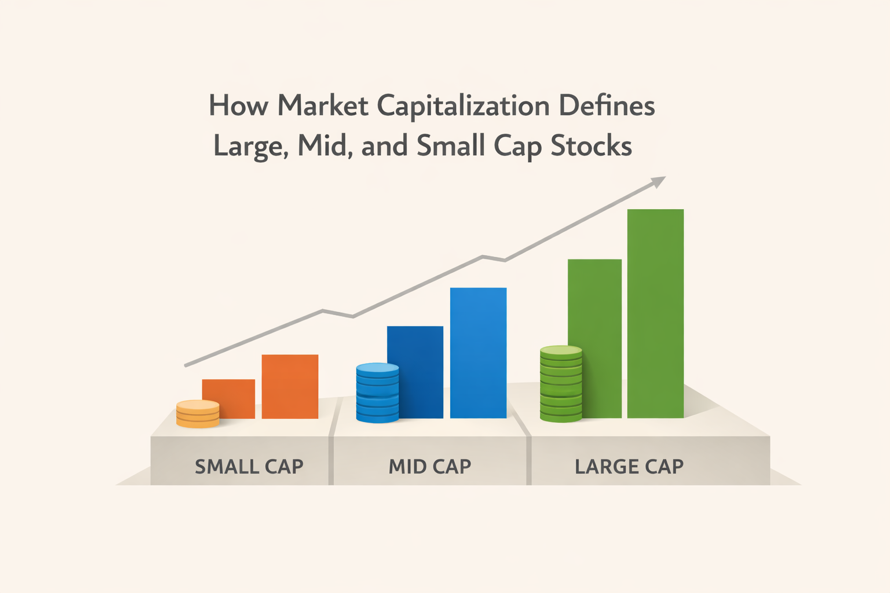
Understanding Market Capitalization
Every investor sees price first. It is unavoidable. A number flashes next to a company name. ₹275. ₹1,820. ₹3,540. Numbers move constantly. They move even when nothing dramatic seems to happen. Sometimes slowly. Sometimes all at once. But price alone never explains scale. It never explains size. It never explains how large the business actually is.
A ₹200 share can belong to a giant. A ₹2,000 share can belong to something much smaller. The price sits on the surface. The real measurement sits underneath.
That metric is called market capitalization.
Market capitalization refers to the total market value of a company’s outstanding shares. Multiply the share price by the number of shares in existence. That single multiplication reveals the company’s size in market terms. Simple formula. Massive implications.
This number breathes constantly. Every trade shifts it. Every rally expands it. Every correction shrinks it. When Reliance Industries rises 2 percent, tens of thousands of crores appear instantly in market capitalization. When banking stocks correct, massive chunks of value disappear just as quickly.
Nothing physical changes overnight. No factories vanish. No employees disappear. Yet valuation shifts. That shift reflects collective belief. Collective confidence. Collective expectation.
In India, market capitalization also carries regulatory meaning. SEBI ranks all listed companies based on market capitalization. The top 100 become large-cap companies. Companies ranked between 101 and 250 become mid-caps. Everything beyond that becomes small-caps.
These rankings evolve continuously. A strong earnings cycle pushes companies upward. A slowdown pulls others downward. No company remains permanently fixed in one category.
India’s stock market itself has reached an enormous scale. As of 2026, the total market cap of NSE-listed companies is around ₹460 lakh crore. Thousands of businesses contribute to that number. Banks. Software exporters. Telecom operators. Manufacturing firms. Pharmaceutical innovators.
Market capitalization provides clarity within that vastness. It gives investors orientation. It tells them who dominates. It tells them which company is rising. It tells them who still stands early in the journey.
Without market capitalization, size remains invisible. With it, scale becomes undeniable.
Large-Cap Companies
Large-cap companies represent the giants. These companies have a massive presence in the market. They impact millions of lives, directly or indirectly. But the most important part? Their market value, expansion, and growth are significant.
Reliance Industries is one such example. Its market capitalization is around ₹19 lakh crore in 2026. That number alone feels difficult to grasp! In fact, it’s bigger than the GDP of some small African countries! Reliance operates in a variety of sectors, including oil refineries, telecom networks through Jio, massive retail chains, and more. This makes it extremely influential.
HDFC Bank follows with a market capitalization of over ₹15 lakh crore. Every day, millions of transactions pass through its systems. Salaries arrive. Loans disburse. Businesses operate using their financial infrastructure. Its market capitalization reflects trust accumulated slowly and steadily.
Tata Consultancy Services has a market capitalization close to ₹11 lakh crore. Most people never interact directly with TCS. But this IT behemoth is the one that powers global banks, governments, and corporations with software and IT services.
ICICI Bank, with a market capitalization above ₹9 lakh crore, continues expanding aggressively in retail and corporate lending. Bharti Airtel, valued at over ₹8 lakh crore, connects hundreds of millions of users across telecom networks. State Bank of India, operating for generations, remains among India’s largest companies by market capitalization.
Large-cap companies rarely appear suddenly. Their rise takes time. Years of execution. Years of competition. Years of reinvestment.
Their defining trait remains stability. Revenue flows from multiple segments. Risk spreads across industries and customers.
Liquidity remains extremely high. Large-cap stocks trade constantly. Massive volumes change hands every day. Investors enter positions. Investors exit positions. Execution remains smooth.
Institutional investors concentrate heavily in large-caps. Mutual funds allocate significant portions of capital here. Pension funds rely on large-cap stability. Foreign investors often begin their exposure to India through large-cap companies.
Price volatility still exists. Markets never stay perfectly calm. But large-cap swings often remain more controlled compared to smaller companies.
Large-caps anchor market indices. When Reliance moves, the index moves. When HDFC Bank rallies, the market feels stronger.
Large caps represent maturity. Scale already achieved. Position firmly established.
“Start investing with confidence! Explore
0 demat account
and grow your wealth.”
Mid-Cap Companies
Mid-cap companies exist in motion. Not small anymore. Not yet giants. Somewhere in between. That in-between stage creates momentum.
SEBI defines mid-caps as companies ranked between 101 and 250 based on market capitalization. Their valuations often range from ₹20,000 crore to ₹1.5 lakh crore, though the range shifts as markets expand.
Britannia Industries provides a good example. Its market capitalization sits near ₹1.4 lakh crore. Its products appear everywhere. Grocery stores. Convenience shops. Kitchens across India. Yet compared to Reliance or HDFC Bank, it still remains smaller.
Punjab National Bank has a market capitalization of about ₹1.3 lakh crore. After difficult periods earlier in the decade, improving asset quality and profitability restored investor confidence. Market Capitalization followed.
Union Bank of India also operates in this territory, carrying a market capitalization above ₹1.3 lakh crore. Banking expansion and credit growth continue to support its rise.
Samvardhana Motherson, supplying automobile manufacturers globally, has a market capitalization of ₹1.4 lakh crore. Its business expands alongside global automotive demand.
Mid-caps often grow faster than large-caps. Their smaller base allows expansion to reflect more dramatically in market capitalization. A new contract. A new product line. A new export market. Each development can shift valuation meaningfully.
Volatility increases slightly. Earnings surprises influence prices quickly. Investors react faster.
Institutional investors monitor mid-caps closely. Many companies dominating large-cap indices today once existed quietly in mid-cap territory.
Mid-caps represent transformation. Growth is already visible. Future still unfolding.
Small-Cap Companies
Small-cap companies form the broadest category. Hundreds of companies exist here. Many remain unfamiliar. Their market capitalization remains smaller. Their stories are yet to evolve.
BEML Ltd operates in the heavy engineering and defense manufacturing sectors. Its market capitalization places it firmly within small-cap territory. Yet India’s infrastructure expansion and defense modernization create long-term opportunities.
Poly Medicure manufactures medical devices used globally. Its market capitalization remains smaller compared to mid-caps, yet healthcare demand continues to expand steadily.
eClerx Services provides outsourcing and analytics solutions. Its market capitalization reflects its specialized niche, yet global service demand continues to support expansion.
Small-caps behave differently. Liquidity sometimes feels thinner. Fewer buyers. Fewer sellers. Price movement feels sharper.
A strong earnings report can trigger rapid rallies. A weak outlook can trigger sudden corrections.
Institutional ownership often remains limited. Retail investors dominate participation.
Some small-caps remain small permanently. Others expand steadily into mid-cap territory. A few eventually reach large-cap scale.
Market capitalization reflects the current reality. It never fixes future potential.
Small-caps represent possibility more than certainty.
Differences Between Large, Mid, and Small-Cap Funds
Mutual funds organize investments by market capitalization. Regulations require funds to invest in defined segments.
Large-cap funds focus on companies like Reliance Industries, HDFC Bank, and TCS. These funds emphasize stability. Liquidity remains strong. Portfolio movement feels smoother.
Mid-cap funds invest in companies like Britannia Industries and Union Bank. Growth becomes the objective. Volatility increases slightly. Return potential increases alongside it.
Small-cap funds invest in companies ranked beyond 250. These funds pursue aggressive growth opportunities. Volatility increases significantly. Returns can accelerate rapidly during favorable market cycles.
Investor flows shift constantly. During uncertainty, investors prefer large-caps. During a strong economic expansion, mid-caps and small-caps attract greater attention.
Each category plays a role.
Large-caps stabilize portfolios. Mid-caps expand portfolios. Small-caps accelerate portfolios.
Market capitalization determines a company’s position within that system.
Key Takeaways
Market capitalization defines company size clearly. It removes confusion created by the share price alone. SEBI classification ensures consistency across Indian markets. For investors, it’s important to understand that companies with higher market capitalizations are generally considered safer.
On the contrary, small-cap companies with lower market caps are considered riskier. But then there is a question of growth! Large-cap companies generally don’t show explosive growth, but small-cap and mid-cap stocks do!
Make sure you, as an investor or a trader, analyze the company’s valuation before getting into the game.
FAQs:
Q. How are large-cap, mid-cap, and small-cap defined?
SEBI has a clear definition for this. The top 100 companies by market capitalization are considered large-caps. Companies ranked 101–250 are mid-cap, and those ranked below 251 are small-cap.
Q. What is the market capitalization of a mid-cap stock?
Mid-cap stocks usually have a market capitalization between about ₹20,000 crore and ₹1.5 lakh crore. But this depends a lot on market conditions and ranking.
Q. Is Nifty 50 a large-cap or mid-cap index?
Nifty 50 is a large-cap index. It includes the 50 biggest companies in India by market capitalization.
Disclaimer
The stocks mentioned in this article are not recommendations. Please conduct your own research and due diligence before investing. Investment in securities market are subject to market risks, read all the related documents carefully before investing. Please read the Risk Disclosure documents carefully before investing in Equity Shares, Derivatives, Mutual fund, and/or other instruments traded on the Stock Exchanges. As investments are subject to market risks and price fluctuation risk, there is no assurance or guarantee that the investment objectives shall be achieved. Lemonn (Formerly known as NU Investors Technologies Pvt. Ltd) do not guarantee any assured returns on any investments. Past performance of securities/instruments is not indicative of their future performance.
Related Posts



Download Lemonn
Download my app for share market trading, ipo investment, trading account, and all your investment needs.