MTF: A Complete Guide to Margin Trading Facility
Leverage attracts traders because it magnifies opportunity. It also magnifies consequences. In Indian stock markets, one structured way to access leverage is through Margin Trading Facility. SEBI regulates it. Brokers offer it under defined risk frameworks. Traders use it to increase buying power without deploying full capital upfront.
MTF changes how capital behaves. Instead of buying shares entirely with your own funds, you contribute a portion and borrow the rest from your broker. That borrowed amount carries interest. The purchased shares act as collateral.
This mechanism sounds simple. The implications are layered. Profits scale faster when trades move favorably. Losses deepen quickly when prices move against you.
Understanding how the margin trading facility works in India requires clarity on structure, cost, risk management, and regulation. Let’s unpack it properly.
What is Margin Trading Facility?
Margin trading facility allows investors to buy stocks by paying only a part of the total trade value. The broker funds the remaining portion. SEBI regulates this system under strict compliance norms. Not all stocks qualify for MTF. Exchanges publish an approved list based on liquidity and risk parameters.
When you use MTF, you effectively take a loan from your broker to buy shares. The shares remain in your demat account but are marked under lien in favor of the broker until repayment.
For example, if you want to purchase ₹1,00,000 worth of shares and the margin requirement stands at 25 percent, you contribute ₹25,000. The broker funds ₹75,000. You pay interest on the borrowed portion.
Unlike intraday leverage, MTF positions can remain open beyond a single trading session, subject to margin maintenance and broker policy. This flexibility appeals to positional traders.
SEBI mandates upfront margin collection. Brokers must collect initial margin and maintain required maintenance levels. If the stock price falls and a margin shortfall arises, the broker may issue a margin call.
At its core, margin trading facility expands capital capacity. But expansion without discipline often leads to stress. That is why understanding mechanics matters.
How Does MTF Trading Work?
MTF trading follows a defined cycle. You open an account with a broker offering a margin trading facility. You sign additional agreements acknowledging the leverage risk. The broker activates MTF eligibility for your trading account.
You identify an eligible stock from the approved list. You place an order selecting MTF mode. The broker calculates the required margin contribution. You fund that portion. The broker funds the balance.
Once executed, the shares are credited to your demat account but remain pledged to the broker as collateral. Interest accrues daily on the funded amount.
As long as your position maintains the required margin levels, you can hold the shares. If the stock price declines sharply, your margin coverage shrinks. The broker may demand additional funds. This is the margin call.
If you fail to provide additional margin, the broker may liquidate shares partially or fully to recover the loan. This process protects the broker’s exposure.
On the upside, if the stock rises, your returns magnify because you invested only a partial capital. When you square off the position, the broker deducts the funded amount plus interest. The remaining profit or loss is reflected in your account.
MTF therefore amplifies outcomes. It requires active monitoring. Passive holding under leverage rarely works.
“Start investing with confidence! Explore
0 demat account
and grow your wealth.”
Lemonn offers the lowest interest rate for MTF
Cost defines leverage efficiency. In margin trading facility, the interest structure directly affects net returns. Lemonn stock broking app currently offers MTF at 12.99% per annum, which equals 0.03% per day interest on the funded amount. You pay interest only for the days you hold the position.
Leverage goes up to 4x on 1400+ eligible stocks. Order execution remains simple. You just switch from Delivery to the MTF tab, and the required margin adjusts automatically.
Let’s use the NBCC example.
NBCC trades at ₹98.08. Your available fund is ₹11,209.14. The applied leverage is 3.5x.
That allows a total buying power of ₹39,232. You buy 400 shares.
Your contribution: ₹11,209.14
Funded by Lemonn: ₹28,022.86
Now assume the stock rises 5% in 10 days.
Sell value: ₹41,193.60
Gross profit: ₹1,961.60
Interest for 10 days: ₹84.07
Transaction charges: ₹278.01
Net profit: ₹1,599.52
Without a margin trading facility, the same 5% move would generate ₹560.46. With MTF, your return becomes ₹1,599.52, translating to 14.27% instead of 5%.
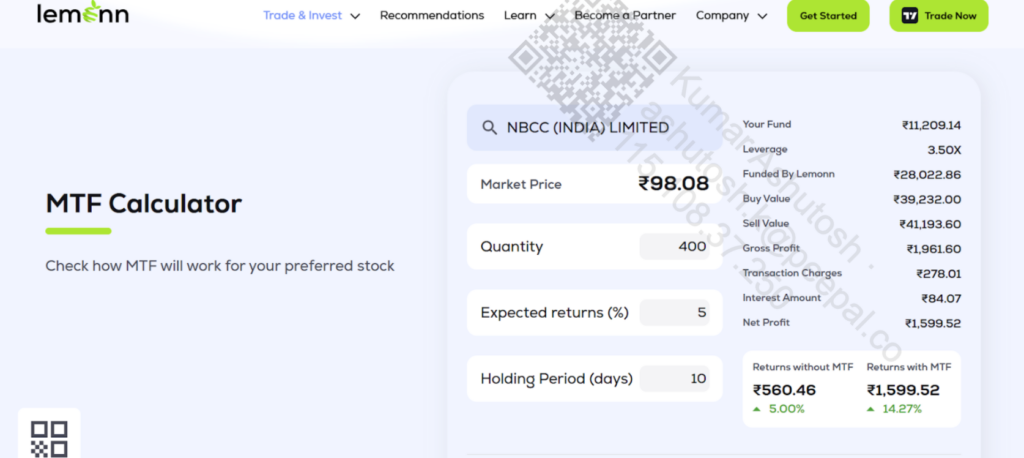
The difference shows how leverage enhances capital efficiency. The interest cost remains modest relative to amplified gains in this scenario.
However, the same math applies if the price falls. Losses scale up just as quickly. Interest accrues regardless of direction.
Lemonn also provides an integrated MTF calculator to estimate the funded amount, interest, and net outcome before placing trades. The platform operates under SEBI registration and follows pledge-based margin norms through the depository system.
Leverage works best when combined with clear entry logic and risk discipline. In your NBCC example, the structure rewards timing. In volatile conditions, it demands control.
That is the true nature of a margin trading facility.
Advantages of Margin Trading Facility
Leverage expands strategic flexibility. Used correctly, it enhances capital efficiency.
First, margin trading facility increases buying power. Traders can participate in larger opportunities without deploying full capital. This flexibility allows diversification across positions.
Second, MTF supports positional strategies. Unlike intraday margin, you can hold shares beyond one session. This enables swing trading based on multi-day or multi-week technical setups.
Third, capital rotation improves. Instead of locking the entire capital into one stock, traders allocate margin across opportunities.
Fourth, gains amplify when trades move favorably. A 10 percent price increase on a leveraged position generates a higher percentage return on invested capital.
Fifth, traders retain ownership benefits. Corporate actions such as dividends and bonuses are reflected proportionally, though operational adjustments may apply depending on broker policy.
These advantages make margin trading facility attractive for disciplined traders who actively monitor markets.
Risks to Keep in Mind
Every advantage of leverage carries a mirror risk.
The primary risk of Margin Trading Facility lies in magnified losses. If a stock declines sharply, your capital erodes faster than in cash trades.
Interest accrues daily. Even if price stagnates, cost accumulates. Holding leveraged positions without momentum can reduce net returns.
Margin calls create pressure. During volatile sessions, sudden price swings can trigger forced liquidation. Emotional decisions often follow.
Liquidity risk also matters. In illiquid stocks, price gaps can widen losses before margin adjustments occur.
Another critical factor involves compounding stress. Traders sometimes average down leveraged positions, increasing exposure during weakness. That behavior intensifies risk dramatically.
The Integrated Advantage
Modern brokerage platforms integrate Margin Trading Facility within trading apps. Traders view funded amount, margin utilization, interest cost, and available limits in real time.
This transparency improves decision-making. Integrated dashboards allow active tracking of margin health. Automated alerts warn of margin shortfall before forced liquidation.
Some brokers allow pledging existing holdings as collateral to enhance MTF limits. This integration increases flexibility while maintaining compliance.
Technology enhances leverage efficiency. But technology cannot eliminate market risk.
The integrated advantage lies in visibility. Traders who closely monitor leverage metrics manage exposure more effectively. Those who ignore dashboard signals invite volatility shock.
MTF works best when combined with defined risk management, position sizing discipline, and clear exit rules.
Leverage amplifies discipline. It also amplifies mistakes.
Conclusion
Margin Trading Facility offers structured leverage within India’s regulated market framework. It allows traders to expand buying power by contributing partial capital while borrowing the rest.
When trades move favorably, returns accelerate. When prices reverse, losses deepen quickly. Interest costs accumulate regardless of direction.
SEBI regulations, broker risk controls, and margin monitoring systems create safeguards. Yet responsibility ultimately rests with the trader.
MTF suits active market participants who track positions daily and respect volatility. It rarely suits passive investors.
Used wisely, Margin Trading Facility enhances capital efficiency. Used casually, it magnifies stress.
Understanding structure, cost, and risk transforms MTF from a temptation into a strategic tool.
Leverage does not create skill. It reveals it.
FAQs:
Q. How does MTF margin work?
In Margin Trading Facility, you contribute a portion of the trade value, and the broker funds the remaining amount. The purchased shares act as collateral. If the stock price falls and the margin drops below the required levels, the broker may issue a margin call or liquidate the position.
Q. How does MTF work with an example?
Suppose you have ₹10,000 and use Margin Trading Facility with 4x leverage. You control ₹40,000 worth of shares. If the stock rises 5%, your return on deployed capital increases significantly. If it falls 5%, losses amplify in the same proportion.
Q. What is the charge of MTF per day?
MTF interest depends on the broker. For example, a 12.99% annual rate equals 0.03% per day on the funded amount. Interest accrues only for the days you hold the position and applies only to the borrowed portion.
Q. What are the disadvantages of MTF trading?
Margin Trading Facility magnifies losses just as it magnifies gains. Daily interest adds to the cost. Margin calls can force liquidation during volatility. Emotional decision-making under leverage often increases risk exposure.
Disclaimer
The stocks mentioned in this article are not recommendations. Please conduct your own research and due diligence before investing. Investment in securities market are subject to market risks, read all the related documents carefully before investing. Please read the Risk Disclosure documents carefully before investing in Equity Shares, Derivatives, Mutual fund, and/or other instruments traded on the Stock Exchanges. As investments are subject to market risks and price fluctuation risk, there is no assurance or guarantee that the investment objectives shall be achieved. Lemonn (Formerly known as NU Investors Technologies Pvt. Ltd) do not guarantee any assured returns on any investments. Past performance of securities/instruments is not indicative of their future performance.
Related Posts



Download Lemonn
Download my app for share market trading, ipo investment, trading account, and all your investment needs.