
What Is Rolling Settlement in the Indian Stock Market?
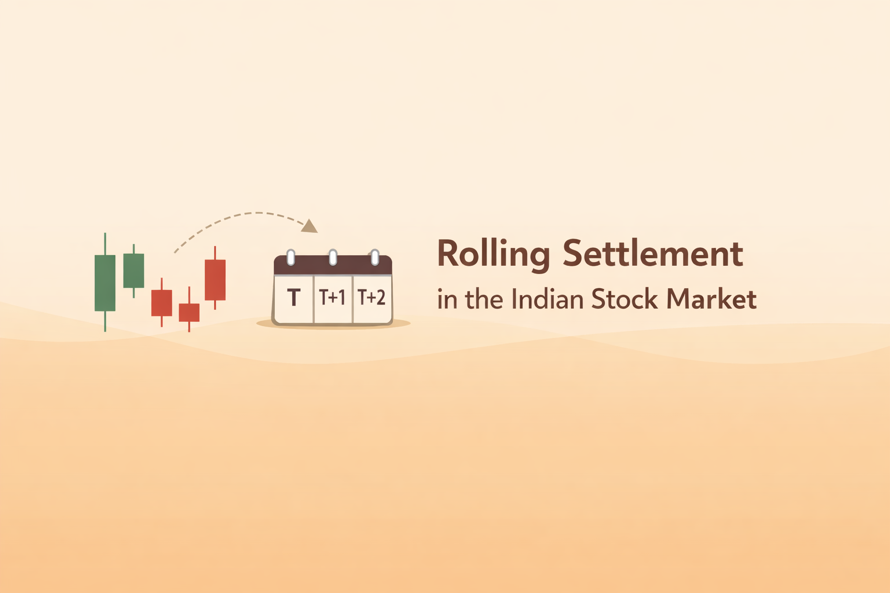
Every time an investor buys or sells shares on the NSE or BSE, a silent process begins behind the scenes. The trade appears complete on your screen within seconds. Funds reflect. Shares show in your demat. Yet the actual transfer of securities and money follows a defined cycle. That cycle is called rolling settlement.
For many retail participants, the term sounds technical. For active traders and long-term investors, it shapes liquidity, risk exposure, and fund planning. In India, rolling settlement brought discipline, transparency, and speed to equity markets. It replaced older systems that allowed delays and increased settlement risk.
Understanding rolling settlement is essential for anyone investing in Indian stocks, ETFs, or derivatives-linked securities. Let us explore it deeply, clearly, and with full context.
What is rolling settlement?
Rolling settlement is a mechanism in which trades are settled on a fixed number of days after the trade date. In India’s equity segment, the system operates on a T+1 cycle. “T” represents the trade date. “+1” represents one working day after the trade date.
If you purchase shares on Monday, the settlement completes on Tuesday. Funds move. Securities transfer. Ownership updates officially.
Before rolling settlement, Indian markets followed an account settlement system. Trades accumulated for a specific period and were settled together at the end of that cycle. That method created higher counterparty risk and settlement delays.
Rolling settlement introduced discipline. Each trading day now has its own settlement timeline. Trades do not accumulate over weeks. They settle individually and continuously.
This system applies across equity cash markets. Derivatives follow separate expiry and margin structures, though clearing corporations handle them within a structured framework.
Today, India stands among the few major markets operating on a T+1 rolling settlement cycle. It reflects technological advancement, strong clearing infrastructure, and regulatory focus on risk containment.
How does rolling settlement work?
The functioning of rolling settlement unfolds in structured steps.
“Start investing with confidence! Explore
0 demat account
and grow your wealth.”
Trade Day (T Day)
On the trade day, investors place buy or sell orders through brokers. Exchanges match orders electronically. Once matched, the trade becomes legally binding.
Your broker blocks required funds or securities depending on whether you buy or sell. Clearing corporations record obligations.
T+1 Day
On the next working day, settlement takes place.
For buyers:
Funds move from the broker’s clearing account to the clearing corporation. In return, securities move from the seller’s demat to the buyer’s demat.
For sellers:
Shares move to the clearing corporation on the trade day. On T+1, funds transfer to the seller.
The clearing corporation acts as a central counterparty. It guarantees settlement completion even if one side defaults. This mechanism significantly reduces systemic risk.
Pay-In and Pay-Out
Settlement includes two processes:
- Pay-in: Transfer of funds and securities to the clearing corporation.
- Pay-out: Transfer from the clearing corporation to the receiving party.
All transactions follow strict timelines. Failure to deliver securities may lead to auction penalties. Failure to pay funds attracts margin consequences.
The structured timeline improves transparency. Investors clearly understand when ownership transfers and when funds become usable.
Benefits of rolling settlement for investors
Rolling settlement transformed the Indian stock market. It delivered tangible advantages to retail participants, institutional investors, and brokers.
Faster Ownership Transfer
Under T+1, buyers receive shares quickly. Investors gain legal ownership faster than earlier settlement systems. Quick transfer reduces uncertainty.
Reduced Counterparty Risk
Each trade settles independently. Risk does not accumulate across weeks. Clearing corporations guarantee settlement, strengthening trust in the system.
Improved Liquidity
Faster settlement cycles free up capital quickly. Investors can redeploy funds sooner. Active traders benefit from quicker fund rotation.
Greater Market Stability
Shorter cycles reduce speculative build-up and systemic exposure. Market discipline improves as obligations close daily rather than accumulating.
Transparency and Predictability
Investors know exactly when funds or securities move. Clear timelines support better cash management and margin planning.
Global Competitiveness
India’s move to T+1 positioned its markets among technologically advanced exchanges. Faster settlement enhances investor confidence domestically and internationally.
Rolling settlement thus strengthened operational integrity while improving investor experience.
Rolling settlement vs. account settlement: Key differences
Before rolling settlement, Indian markets operated on an account settlement system. Understanding the contrast clarifies why reform became necessary.
Settlement Timeline
Under account settlement, trades executed during a fixed period were settled together at the end of that cycle. In rolling settlement, each trade settles individually on T+1.
Risk Exposure
Account settlement allowed obligations to accumulate. If a participant defaulted, exposure could span multiple trading days. Rolling settlement limits exposure to a single day’s trades.
Capital Efficiency
Rolling settlement enables quicker release of funds and securities. Account settlement locked capital until cycle completion.
Operational Discipline
Rolling settlement enforces daily obligation management. Brokers and participants maintain tighter margin controls. The earlier system allowed broader settlement windows.
Market Volatility Containment
Shorter settlement cycles reduce leverage build-up and speculative carry-forward practices. This strengthens overall market stability.
The shift marked a structural evolution. It modernized Indian exchanges and aligned them with global best practices.
| Basis of Comparison | Rolling Settlement (T+1) | Account Settlement (Earlier System) |
|---|---|---|
| Settlement Cycle | Each trade settles individually on T+1 | Trades accumulated and settled at the end of the fixed cycle |
| Risk Exposure | Limited to one trading day | Exposure builds across the entire settlement period |
| Capital Lock-in | Funds and securities are released quickly | Funds blocked until cycle completion |
| Counterparty Risk | Lower due to daily clearing | Higher due to accumulated obligations |
| Liquidity | Higher liquidity due to faster settlement | Lower liquidity due to delayed fund rotation |
| Speculation Scope | Reduced carry-forward opportunities | Greater carry-forward and speculative buildup |
| Operational Discipline | Strict daily pay-in and pay-out | Broader window for meeting obligations |
| Market Stability | Stronger systemic stability | Higher systemic risk during volatility |
| Transparency | Clear settlement date for every trade | Settlement date tied to overall trading cycle |
| Current Status in India | Active system (T+1 cycle) | Discontinued |
Conclusion
Rolling settlement forms the backbone of India’s modern equity market structure. It ensures that trades settle quickly, transparently, and securely. Under the T+1 system, investors receive securities and funds within one working day of trade execution.
This framework enhances liquidity, reduces counterparty risk, and strengthens market integrity. It replaced older systems that allowed delayed settlement and higher exposure.
For investors, the mechanism may operate quietly in the background. Yet it shapes how quickly capital rotates, how efficiently ownership transfers, and how securely transactions conclude.
As markets globally evolve toward faster clearing cycles, India’s adoption of rolling settlement underscores regulatory foresight and technological readiness. Every buy and sell order triggers this structured process. It works consistently. It protects participants. It powers daily trading confidence.
Understanding rolling settlement equips investors with deeper insight into how the Indian stock market truly functions beyond price charts and order books.
FAQs:
What is the rolling settlement in India?
Rolling settlement in India means every stock market trade settles individually after a fixed number of days. Currently, equities follow a T+1 cycle. If you trade today, funds and shares transfer on the next working day.
What is meant by T-2 rolling settlement?
T-2 rolling settlement refers to a system where trades settle two working days after the trade date. Earlier, Indian markets followed T+2 before moving to the faster T+1 cycle.
Disclaimer
The stocks mentioned in this article are not recommendations. Please conduct your own research and due diligence before investing. Investment in securities market are subject to market risks, read all the related documents carefully before investing. Please read the Risk Disclosure documents carefully before investing in Equity Shares, Derivatives, Mutual fund, and/or other instruments traded on the Stock Exchanges. As investments are subject to market risks and price fluctuation risk, there is no assurance or guarantee that the investment objectives shall be achieved. Lemonn (Formerly known as NU Investors Technologies Pvt. Ltd) do not guarantee any assured returns on any investments. Past performance of securities/instruments is not indicative of their future performance.
Related Posts

Download Lemonn
Download my app for share market trading, ipo investment, trading account, and all your investment needs.



