Understanding Share Split vs Bonus Issue: Key Differences
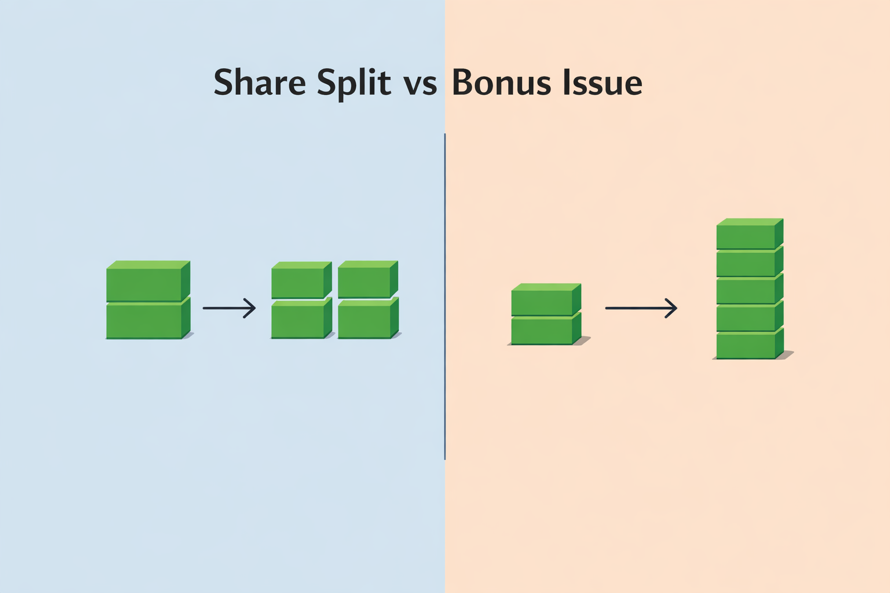
Corporate actions often create excitement in the stock market. Investors suddenly see announcements about additional shares, revised face values, and adjustments in stock prices. Among the most discussed topics in Indian equity markets are share split vs bonus issue. Both increase the number of shares held by investors. Both adjust market prices. Both aim to improve liquidity. Yet their structure, accounting treatment, and intent differ in meaningful ways.
In this blog post, we will take a look at the difference between a share split vs bonus issue. We will also examine the implications of these corporate actions for investors and traders.
Difference Between Bonus Issue and Stock Split
When comparing share split vs bonus issue, the seeming similarity often creates confusion. In both cases, shareholders receive additional shares. The total market capitalization of the company remains broadly aligned with pre-announcement levels after price adjustment. Yet the mechanics vary significantly.
A bonus issue distributes additional shares to existing shareholders by capitalizing the company’s accumulated reserves. The face value of each share remains the same. The number of shares increases according to a fixed ratio, such as 1:1 or 2:1. Reserves reduce, while share capital increases proportionately.
A stock split divides existing shares into smaller denominations. The face value changes. For example, a ₹10 face value share may become a ₹5 share after a 1:2 split. The total share capital remains aligned, as the number of shares expands.
In simple terms, a bonus issue reallocates internal reserves into share capital. A stock split restructures the nominal value of each share.
Both actions enhance liquidity by making shares appear more affordable in the market. Yet the accounting treatment and underlying rationale differ.
What is a Bonus Issue?
A bonus issue represents a corporate action where a company issues additional shares to existing shareholders free of cost. These shares come out of accumulated profits or reserves. Companies with strong retained earnings often use this method to reward long-term investors.
Suppose a company announces a 1:1 bonus issue. An investor holding 100 shares receives 100 additional shares. The total holding becomes 200 shares. The price adjusts proportionately in the market once the shares trade ex-bonus.
The key feature here lies in the capitalization of reserves. The company transfers funds from reserves into share capital. This reflects confidence in sustained profitability. The action signals management’s comfort with earnings strength and balance sheet depth.
In India, bonus issues require shareholder approval. The record date determines eligibility. Investors holding shares on that date qualify for additional shares.
Although the total investment value remains aligned after adjustment, investors often perceive bonus issues as a sign of corporate strength. It reflects disciplined capital management and long-term earnings visibility.
Well-known Indian companies have used bonus issues during expansion phases. Such announcements often generate renewed investor interest and higher trading volumes.
“Start investing with confidence! Explore
0 demat account
and grow your wealth.”
What is a Stock Split?
A stock split divides existing shares into multiple shares with a lower face value. The overall investment value remains aligned, yet the number of shares increases.
Imagine a company with shares having a face value of ₹10 trading at ₹2,000. A 1:2 stock split changes the face value to ₹5. Each existing share turns into two shares. The market price adjusts proportionately, aligning near half of the earlier level after the split.
Unlike a bonus issue, a stock split does not involve reserves. The company simply alters the share denomination. Share capital remains proportionate, though the number of outstanding shares increases.
Companies typically announce stock splits when share prices rise significantly. A high trading price may limit retail participation. By reducing the per-share price, management enhances accessibility for small investors.
Stock splits often increase liquidity. Higher floating shares allow smoother price discovery. Market participation broadens. Volumes often rise after implementation.
In Indian markets, stock splits require board approval and shareholder consent. Exchanges announce ex-split dates, and investors holding shares on the record date receive split shares automatically.
Bonus Issue vs Stock Split: What Happens to Share Price?
One of the most frequent investor questions around share split vs bonus issue concerns price movement. Many assume these actions create instant wealth. In practice, the total investment value aligns with pre-announcement levels once the adjustment occurs.
During a bonus issue, the share price adjusts in proportion to the ratio. In a 1:1 bonus, the price generally aligns near half of the earlier level. Market capitalization remains consistent after adjustment.
In a stock split, price alignment follows the split ratio. A 1:5 split divides the earlier price by five. The number of shares increases accordingly.
Short-term price movements may vary due to sentiment, liquidity, and demand. Increased participation often brings greater trading activity. Retail investors may find lower absolute prices psychologically attractive.
Over the long term, price appreciation depends on earnings growth, cash flows, industry position, and capital efficiency. Corporate actions alone do not create intrinsic value. They restructure the share count and trading dynamics.
Investors who understand this alignment interpret announcements calmly and evaluate the underlying fundamentals rather than reacting solely to headline ratios.
Share Split vs Bonus Issue: What Does it Mean for You?
For individual investors, the practical impact of share split vs bonus issue decisions revolves around portfolio structure and liquidity.
Your total investment value aligns proportionately after implementation. Yet the number of shares increases. This often improves flexibility. Selling partial holdings becomes easier. Smaller ticket participation improves accessibility.
Bonus issues may strengthen investor confidence when supported by consistent profitability. They reflect accumulated reserves and disciplined capital allocation.
Stock splits enhance trading comfort when prices rise sharply. Lower face values often encourage broader participation across retail segments.
Dividend per share may adjust proportionately after both actions since the total number of shares increases. However, the total dividend payout remains aligned with company policy and profitability.
Tax treatment in India depends on acquisition cost and holding period. Bonus shares receive a fresh cost allocation as per Income Tax guidelines. Split shares adjust proportionately under capital gains rules. Investors benefit from consulting tax professionals for clarity on holding periods and indexation where applicable.
Ultimately, these corporate actions serve as structural adjustments. Long-term wealth creation still depends on earnings quality, governance standards, competitive advantage, and growth trajectory.
What is the company’s rationale?
Companies choose between bonus issues and stock splits based on strategic objectives, balance sheet composition, and investor profile.
A bonus issue works well when accumulated reserves reach significant levels. Management may prefer capitalizing reserves to present a balanced capital structure. It communicates confidence in sustained profitability and signals shareholder friendliness.
A stock split often follows strong price appreciation. Management may aim to improve affordability and trading liquidity. Enhanced participation supports efficient price discovery and broader investor ownership.
Both actions may align with long-term brand positioning. Companies seeking inclusion in retail portfolios often use these tools to encourage wider market reach.
In Indian markets, strong-performing midcap and large-cap companies frequently adopt such strategies during growth phases. Announcements often attract media coverage and renewed investor attention.
Boards evaluate capital adequacy, earnings consistency, market perception, and long-term expansion plans before making such decisions.
Remember, both actions can be an opportunity. Just analyze how it impacts you as an investor or a trader and make the right choice.
FAQs:
Which is better, bonus issue or share split?
The answer depends on the company’s objective. A bonus issue reflects accumulated profits and strengthens the equity base by converting reserves into share capital. A stock split focuses on improving liquidity by reducing the face value and making shares more accessible. Investors evaluate fundamentals such as earnings growth, cash flow, and governance rather than choosing one action as universally better.
Does the share price fall after a bonus issue?
The market price adjusts proportionately after a bonus issue. For example, in a 1:1 bonus, the share price generally aligns near half of its earlier level once it trades ex-bonus. This adjustment reflects the increased number of shares. The total investment value remains aligned, subject to market sentiment and demand.
Is there any benefit of a share split?
A share split improves liquidity and enhances market participation. Lower per-share prices often attract wider retail interest and increase trading volumes. It also improves affordability and flexibility for partial selling. However, long-term value creation still depends on the company’s performance and earnings strength.
Is a bonus issue good for shareholders?
A bonus issue signals management confidence in sustained profitability and strong reserves. It increases the number of shares held by investors without requiring additional investment. While immediate wealth remains aligned after price adjustment, the announcement often reflects healthy financial positioning and shareholder-friendly capital management.
Disclaimer
The stocks mentioned in this article are not recommendations. Please conduct your own research and due diligence before investing. Investment in securities market are subject to market risks, read all the related documents carefully before investing. Please read the Risk Disclosure documents carefully before investing in Equity Shares, Derivatives, Mutual fund, and/or other instruments traded on the Stock Exchanges. As investments are subject to market risks and price fluctuation risk, there is no assurance or guarantee that the investment objectives shall be achieved. Lemonn (Formerly known as NU Investors Technologies Pvt. Ltd) do not guarantee any assured returns on any investments. Past performance of securities/instruments is not indicative of their future performance.
Related Posts



Download Lemonn
Download my app for share market trading, ipo investment, trading account, and all your investment needs.