Silver Price Crash Explained: What Caused the February 2026 Collapse-and What Happens Next
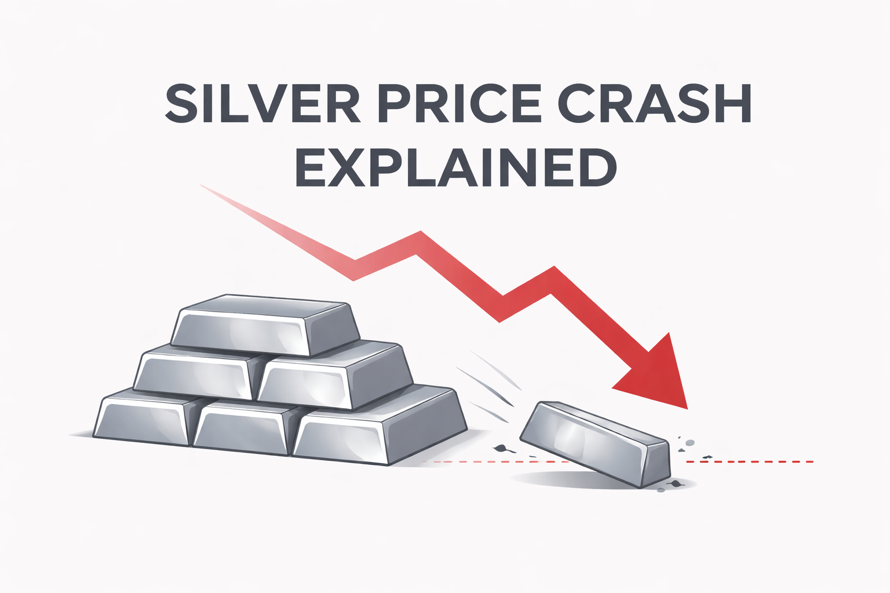
Silver shocked global markets on February 5, 2026, with one of the sharpest single-day drops in commodity history. After soaring to record highs just weeks earlier, prices collapsed at breathtaking speed-leaving investors asking the same question:
Was this the end of silver’s bull run, or just a brutal reset?
The short answer: this was not a demand collapse. It was a market regime shift, driven by policy clarity, easing geopolitical fear, and forced liquidations in the paper market.
What Happened to Silver Prices on February 5, 2026?
Silver fell up to 18% in a single session across global benchmarks.
- Spot silver (COMEX) dropped from around $90 to near $73
- MCX silver futures (India) plunged roughly 13% in one day
- Retail physical prices fell far less, revealing a major disconnect
This wasn’t a slow correction. It was a violent deleveraging event after weeks of speculative excess .
“Start investing with confidence! Explore
0 demat account
and grow your wealth.”
The Real Triggers Behind the Silver Crash
1. The “Warsh Shock”: A Sudden Shift in Fed Expectations
The biggest catalyst was the nomination of Kevin Warsh as the next U.S. Federal Reserve Chair.
Why it mattered:
- Markets had priced in a politically pressured, ultra-dovish Fed
- Warsh is seen as institutionally credible and policy-disciplined
- The “currency debasement” trade unraveled almost instantly
The result:
- U.S. dollar strengthened sharply
- Treasury yields surged
- Non-yielding assets like silver lost their appeal overnight
2. Rising Bond Yields Crushed Silver’s Advantage
On the same day:
- The 10-year U.S. Treasury yield jumped toward 4.3%
- The Dollar Index (DXY) moved higher
Silver pays no interest. When safe yields rise, large funds rebalance-fast.
This alone was enough to trigger heavy selling.
3. Geopolitical Fear Evaporated Almost Overnight
January’s silver rally was fueled by U.S.–Iran war fears.
By early February:
- Both sides signaled de-escalation
- Diplomatic talks were scheduled in Oman
- The “safe-haven premium” disappeared
When fear leaves the room, leveraged trades are the first to exit .
The Hidden Accelerator: Margin Calls and Forced Selling
Fundamentals explain the direction.
Margin mechanics explain the speed.
- CME and MCX raised margin requirements after January’s volatility
- Traders suddenly needed more cash to hold positions
- Many couldn’t meet margin calls
That triggered:
- Forced liquidations
- Stop-loss cascades
- Algorithmic selling into thin liquidity
This is how corrections turn into crashes.
Why Physical Silver Didn’t Collapse the Same Way
One of the most important signals came from India.
- MCX futures fell near ₹2.8 lakh/kg
- Physical retail silver stayed near ₹3.2 lakh/kg
That ₹40,000 gap is a classic sign of stress in paper markets-not collapsing real-world demand .
In simple terms:
- Speculators sold contracts
- Long-term buyers kept buying metal
Industrial Demand Has Not Disappeared
Silver is not just a precious metal. It’s an industrial necessity.
Key demand drivers remain intact:
- Solar panels (one of the largest silver consumers)
- Electric vehicles
- AI data centers and advanced electronics
- 5G and energy infrastructure
At the same time:
- Global silver supply remains in structural deficit
- Most silver is mined as a byproduct, limiting rapid supply growth
That’s why many institutions see this move as a cool-down, not a collapse.
What Are Major Institutions Saying Now?
Despite the chaos, longer-term forecasts remain bullish:
- Some banks still project $120–$150 silver later in 2026
- The gold-to-silver ratio remains historically stretched
- Physical inventory drawdowns continue globally
The narrative has shifted from euphoria to realism-but not to abandonment.
Key Takeaways for Investors
- This crash was driven by policy clarity + margin mechanics, not collapsing demand
- The paper market broke faster than the physical market
- Industrial fundamentals remain strong
- Volatility is likely to continue before a true bottom forms
For long-term investors, February 2026 may be remembered less as “the end” and more as the reset that shook out excess leverage.
FAQs
Q. Is the silver bull market over?
Not necessarily. The speculative phase ended, but structural demand and supply constraints remain.
Q. Why did futures fall more than retail prices?
Because futures are leveraged and margin-dependent. Physical silver is not.
Q. Could silver fall further?
Yes, short-term volatility remains high. Markets often overshoot in both directions.
Q. Is this similar to past commodity crashes?
Yes. Sharp deleveraging after parabolic moves is a repeating pattern in commodities.
Disclaimer
The stocks mentioned in this article are not recommendations. Please conduct your own research and due diligence before investing. Investment in securities market are subject to market risks, read all the related documents carefully before investing. Please read the Risk Disclosure documents carefully before investing in Equity Shares, Derivatives, Mutual fund, and/or other instruments traded on the Stock Exchanges. As investments are subject to market risks and price fluctuation risk, there is no assurance or guarantee that the investment objectives shall be achieved. Lemonn (Formerly known as NU Investors Technologies Pvt. Ltd) do not guarantee any assured returns on any investments. Past performance of securities/instruments is not indicative of their future performance.
Related Posts


Download Lemonn
Download my app for share market trading, ipo investment, trading account, and all your investment needs.