What Is a Dividend?
 Written by Kumar Ashutosh
 Reviewed by Gaurav Garg, SEBI-registered Research Analyst
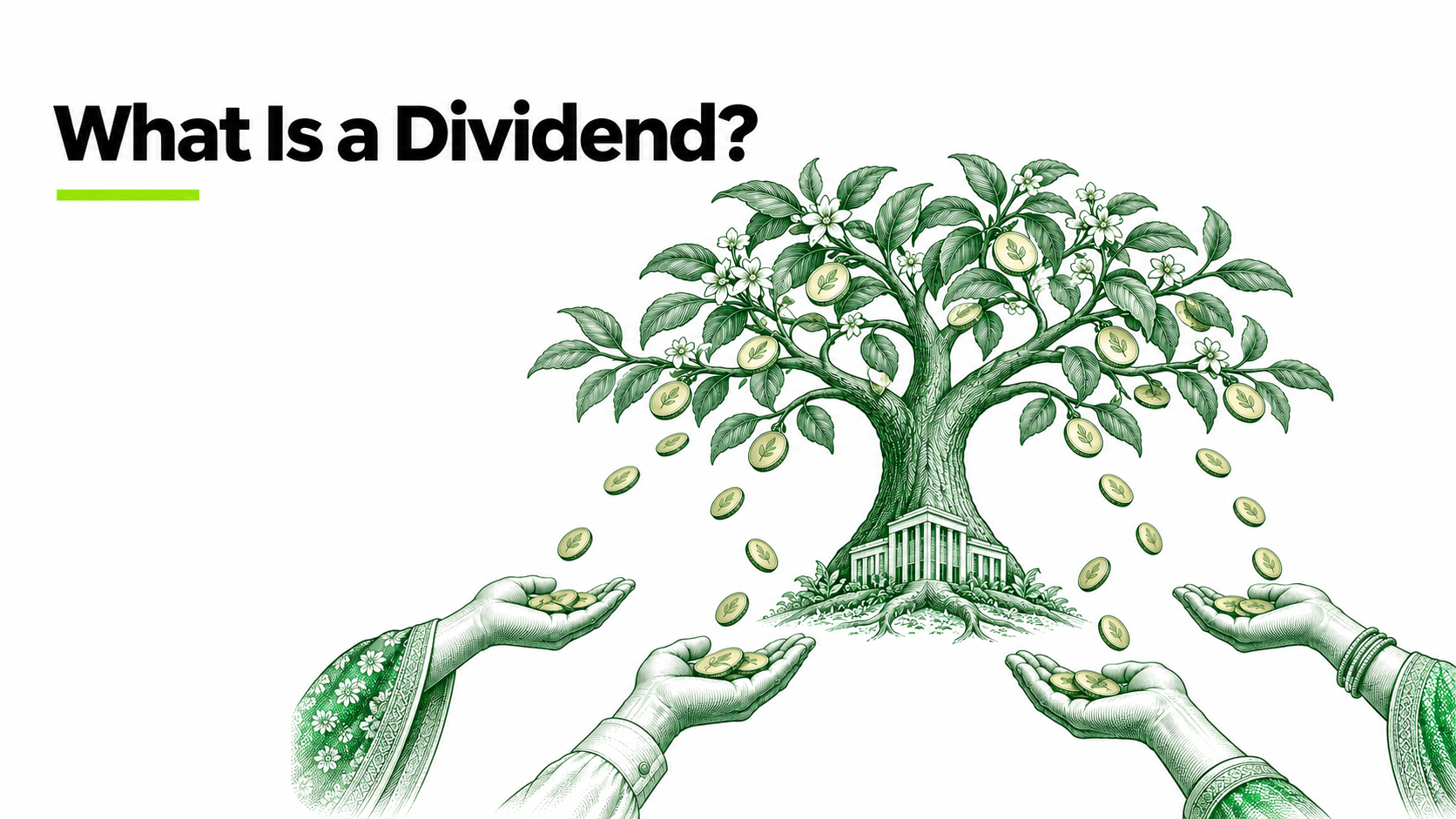
One morning, you wake up and discover that your company has declared a dividend of ₹8 per share, so a few weeks later, you have money in your bank account despite not selling any of your 200 shares.
So how did you get this money? Why do some profitable companies not pay out anything?
Understanding what a dividend is will help us. Knowing what types of dividends there are, along with dates, share prices and taxes, will help us understand.
Dividend meaning
A dividend is a distribution paid out by a company to shareholders. This will be based on the amount of profit the company has available and will have been considered by the board.
If a business made ₹500 crore in profit for the year, it may wish to invest in expanding its factories, repaying debt or creating new products. It may then decide to pay out some of its profits.
If you have 200 shares and the company declares a dividend of ₹8 per share, your total gross dividend will be:
200 × ₹8 = ₹1,600
Gross here means that you don’t take into account any movement in the share price. You may receive a dividend whilst the price is going down. You may also hold shares in a company whose share price has gone up significantly but has paid no dividend.
Are all companies paying dividends?
Not all companies will pay out dividends. Growing companies may wish to reinvest their cash rather than distribute it. Some established companies may pay regular dividends, but the board can choose to reduce them or not pay them.
Dividends also may not give you any extra free cash. Once a share goes ex-dividend, the market price may drop to reflect this. This can be hidden due to market forces.
Most dividends are cash-based, but companies can distribute them in other forms (if allowed). Bonus shares are a different corporate action and should not be confused with a regular dividend.
Interim vs final dividend
Sometimes, you may notice that companies pay out dividends. Some companies pay during their quarterly results, whereas others may pay a proposed dividend after releasing their annual results.
Interim Dividend
An interim dividend is declared by the board of directors and generally paid out during the financial year or before the AGM. This means shareholders will not have to wait for the company to go through the approval process.
A company may declare an interim dividend of ₹4 in October. It can then declare further dividends (as long as it meets legal criteria).
Final Dividend
A final dividend is typically recommended by the board after the financial year has ended. It will be approved by shareholders at the AGM. Generally, the amount cannot exceed the amount recommended by the board.
A company may recommend a final dividend of ₹10 per share. Investors should note that this is just a recommendation until approved.
| Feature | Interim Dividend | Final Dividend |
|---|---|---|
| When declared | During financial year or before AGM | Usually after financial year |
| Approved by | Board of Directors | Shareholders |
| Declared | Can be declared multiple times | Usually relates to annual results |
| When paid | Subject to legal criteria | Subject to legal criteria |
Companies can declare both, but there is no guarantee they will pay in the future.
Record date and ex-dividend date
This is a common area where investors can get caught out and lose money. You see that a company is paying a dividend, so you purchase shares on the record date.
Generally, you will be too late.
The record date shows who will receive the dividend. The ex-dividend date is when the share will start trading without the entitlement to this particular dividend.
In India, we generally operate on a T+1 settlement cycle. This means they generally fall on the same day. However, they can differ if there are holidays or special settlements.
Example of dates
If a company declares:
| Event | Example Date |
|---|---|
| Last normal day to buy in | Tuesday 17th Nov |
| Ex-dividend date | Wednesday 18th Nov |
| Record date | Wednesday 18th Nov |
| Dividend paid | As declared by the company |
If you bought on Tuesday, the trade will generally have settled by the record date. If you buy on Wednesday, then you will be buying the shares ex-dividend and generally will not qualify.
If you sell on Wednesday, you can generally keep the entitlement as you had the shares for the correct record process.
When will I receive the money?
The record date will show who will receive the dividend. The company will declare when it will pay the dividend. Generally, the eligible dividend will be paid within 30 days of declaration (subject to statutory criteria).
You will generally receive the dividend into the bank account you have registered with your depository or registrar. If you don’t receive the dividend, double-check the company announcement, your bank details and any information regarding unpaid dividends.
Dividend yield
A dividend of ₹20 sounds better than a dividend of ₹5. However, consider if the first stock is trading at ₹2,000 and the second at ₹100.
Investors will often look at the dividend yield.
Dividend Yield = (Annual Dividend Per Share / Current Share Price) × 100
If company A is trading at ₹2,000 and pays ₹20 per year, the yield will be 1%.
If company B is trading at ₹100 and pays ₹5 per year, the yield will be 5%.
However, this does not mean that company B is a better investment. We need to look at whether the dividend is sustainable.
Why high yields can be misleading
Imagine a company is paying out ₹10 per year, but the share price has dropped from ₹250 to ₹100 due to poor results. This will increase the dividend yield to 10% (from 4%).
Whilst 10% sounds good, the company may reduce its dividend next time due to lower earnings.
If a company has a surprisingly high yield, take a closer look.
Ensure you look at the history of how much it has paid out, cash flow, debt and profitability. Also, ensure you know the difference between trailing yield (based on historical data) and indicated yield (based on the assumption that it will be paid again).
Also, remember that the share price may fall more than the amount of dividend received.
How dividends are taxed
This part is important to know as there may be a difference between what gets announced and what arrives in your bank account.
Dividends received by resident individual investors in India are generally taxable under the Income from Other Sources heading. They will be taxed at the applicable income tax slab rates. The company will not pay Dividend Distribution Tax on any dividends declared from April 2020 onwards.
TDS on Dividend Income
In 2026/27, most dividends paid to resident shareholders by domestic companies will be subject to 10% TDS. For eligible individual shareholders, the ₹10,000 annual threshold will apply for non-cash payments.
If you received ₹12,000 from one company during the year, assuming no special circumstances, ₹1,200 will be deducted, and you will receive ₹10,800.
This is not necessarily your final tax. If you’re in a higher slab, you may have to pay more. If you’re an eligible taxpayer, you may get a refund when you file.
Less than ₹10k?
If an eligible individual receives non-cash dividends from this company that are less than the threshold, there may be no TDS. However, this income may still be taxable.
Non-residents will have different tax treatment. Look at which treaties apply. Some interest expenses may be allowable against ordinary dividend income (up to 20% of ordinary dividend income). Generally, other expenses will not be allowable.
Ensure you keep a record of your dividend statements. Ensure the tax information is showing against your PAN and there are no discrepancies.
FAQs
When is dividend credited?
The company will declare when it will pay. Eligible dividends will generally be paid within 30 days of declaration (subject to legal circumstances and bank processes).
What is the ex-dividend date?
This is when the share will start to trade without any entitlement to the dividend. If you buy the share on this date, generally, you will not qualify.
Is dividend income taxable?
Yes. For resident individuals, dividends are generally taxable. They will be taxed at the applicable slab rates. TDS may also apply.
What is a good dividend yield?
There is no set amount. Compare the yield to the company’s earnings, cash generation, debt, payment history and risk factors.
Conclusion
Dividends can prove to be an additional source of income for shareholders. Some companies are well-known for providing good dividends for years.
But the issue is, dividends are not guaranteed. They fluctuate over time and depend on market conditions. So if you are buying a share only for the purpose of claiming dividends, please keep these points in mind.
And once you have made up your mind, you can start buying good dividend-yielding stocks on Lemonn. With Lemonn, you can enjoy seamless investing and trading at highly competitive brokerages.
So don’t wait, check out our platform now.
Disclaimer
The stocks mentioned in this article are not recommendations. Please conduct your own research and due diligence before investing. Investment in securities market are subject to market risks, read all the related documents carefully before investing. Please read the Risk Disclosure documents carefully before investing in Equity Shares, Derivatives, Mutual fund, and/or other instruments traded on the Stock Exchanges. As investments are subject to market risks and price fluctuation risk, there is no assurance or guarantee that the investment objectives shall be achieved. Lemonn (Formerly known as NU Investors Technologies Pvt. Ltd) do not guarantee any assured returns on any investments. Past performance of securities/instruments is not indicative of their future performance.