What Is a Demat Account? Meaning, Types and Benefits
 Written by Ipsita Baishya
 Reviewed by Gaurav Garg, SEBI-registered Research Analyst
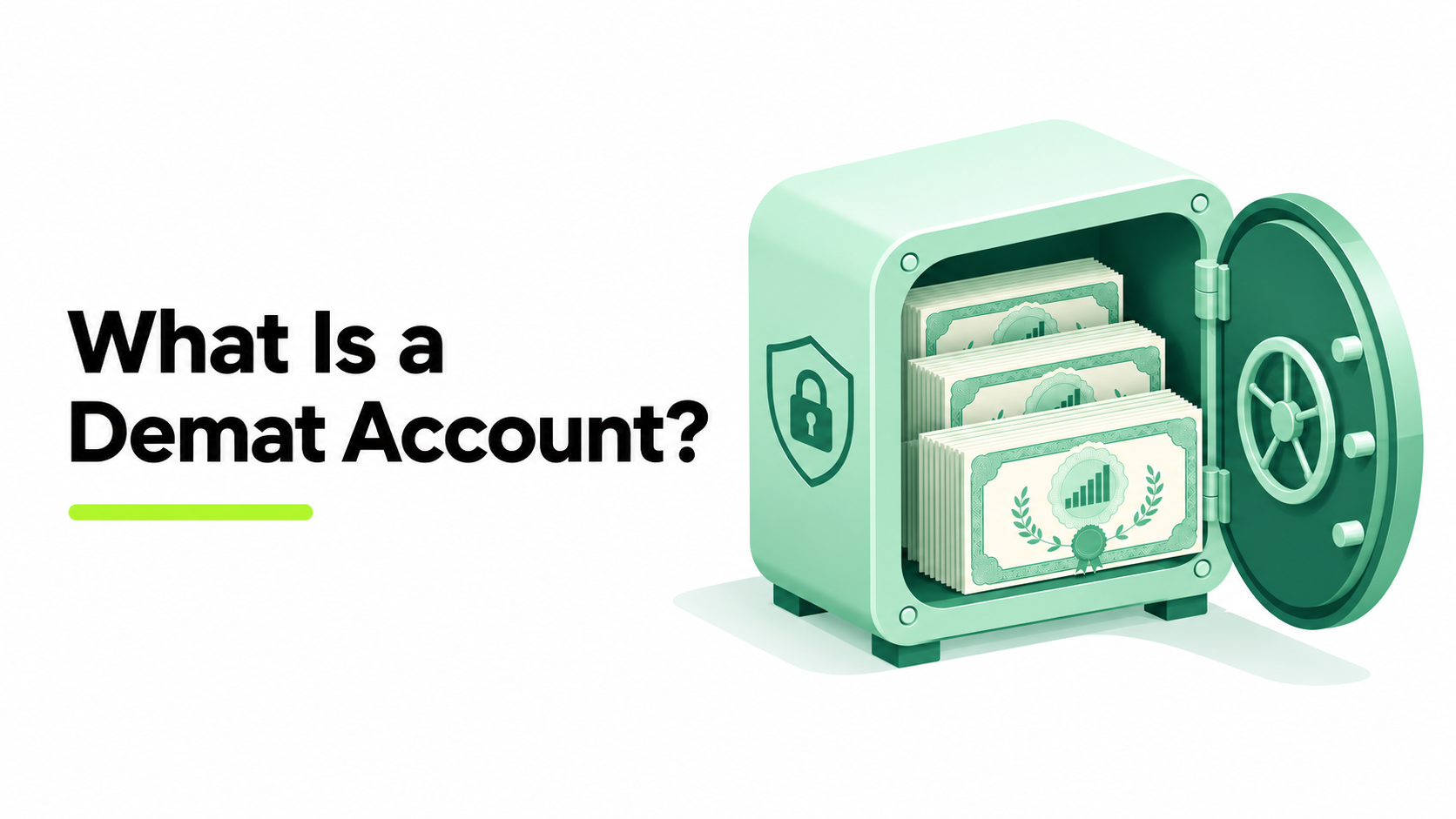
You buy 20 shares of a company. The payment goes through. The exchange confirms the trade.
But where do those 20 shares actually go?
Before the stock market was digitized, investors bought physical share certificates whenever they bought shares. Problem? They had to protect their certificates and had to submit paperwork if they wanted to sell the shares. There was always a risk of lost or damaged certificates.
Enter the electronic system, and today the whole process is handled digitally, via something called a demat account.
So, what is a demat account, and why do Indian investors need one?
Well, that’s exactly what we are going to find out here.
Demat Account Meaning
Demat stands for dematerialised. It refers to securities that exist as electronic records.
Think about your bank account for a moment.
It shows how much money you have. A Demat account shows how many shares and other eligible securities you own.
Suppose you purchase 15 shares of a company at ₹600 each.
Your total purchase value comes to ₹9,000, excluding charges.
Once the trade settles, your Demat account reflects those 15 shares. If you sell five later, the account balance falls to 10 shares.
That’s the basic process.
A Demat account can hold several types of investments, subject to their eligibility:
- Equity shares
- Bonds and debentures
- Exchange-traded funds (ETFs)
- Mutual fund units held in Demat form
- Government securities and other eligible instruments
Demat Account vs Trading Account
People often confuse these two accounts.
A trading account lets you place orders to buy or sell securities. Your Demat account records the securities you hold.
| Feature | Demat Account | Trading Account |
|---|---|---|
| Main purpose | Holds securities electronically | Places buy and sell orders |
| Records | Securities holdings | Trading activity |
| Used for | Custody and transfer of securities | Exchange transactions |
| Connected to | NSDL or CDSL through a DP | Registered stockbroker |
You generally need both accounts to buy and hold listed shares through the stock market.
How It Works With NSDL/CDSL
You’ve purchased shares. Your Demat account displays them after settlement.
Who maintains those electronic ownership records?
India has two securities depositories:
- National Securities Depository Limited (NSDL), established in 1996.
- Central Depository Services (India) Limited (CDSL), established in 1999.
Both operate under SEBI’s regulatory framework.
You cannot open a Demat account directly with either depository. You open it through a registered Depository Participant (DP).
A DP acts as the link between you and the depository.
What Happens After You Buy Shares?
Let’s say you buy 10 shares of a listed company.
First, you place a purchase order through your trading account.
The stock exchange matches your order with a seller’s order.
Next comes settlement. The clearing and depository systems process the transaction, and the shares reach your Demat account according to the applicable settlement cycle.
You can then view the updated holdings.
When you sell shares, the process works in reverse. The required number of securities leaves your account after the applicable authorisation and settlement procedures.
NSDL vs CDSL
| Feature | NSDL | CDSL |
|---|---|---|
| Established | 1996 | 1999 |
| Main function | Electronic securities custody | Electronic securities custody |
| Demat account identifier | Begins with IN | 16-digit numeric ID |
| Regulator | SEBI | SEBI |
Investors can hold securities through either depository. The services and charges they experience depend partly on their Depository Participant.
One more detail: your Demat account does not need a minimum securities balance. It can remain empty.
Types of Demat Accounts (Regular, BSDA, Repatriable)
Based on the investors’ risk profile, trading interests, holdings and residential statuses, the demat account types vary.
Let’s take a look at the various types of demat accounts.
Regular Demat Account
A regular Demat account is perfect for Indian residents who want to invest and hold Indian securities in electronic form. Resident Indian investors who want to hold securities electronically.
If you open this account, you can hold shares, ETFs, bonds and more.
Your depository may charge you a certain AMC or annual maintenance charge, along with other transactional charges.
Basic Services Demat Account (BSDA)
This is a limited utility Demat account which incurs less maintenance cost. SEBI revised the BSDA structure in September 2024. As of today, here’s how its charges look:
| Value of Securities Held | Annual Maintenance Charges |
|---|---|
| Up to ₹4 lakh | Nil |
| Above ₹4 lakh and up to ₹10 lakh | Maximum ₹100 |
| Above ₹10 lakh | Regular account charges may apply |
But one important point: your eligibility depends on the account ownership and many other regulatory conditions.
Repatriable Demat Account
If you are a Non-Resident Indian (NRI) and want to invest in Indian markets, this is the demat account you need to have.
Repatriation means transferring permitted investment proceeds outside India under applicable foreign exchange regulations.
You have to use designated NRE banking arrangements and must comply with relevant rules.
But if you are an NRI who holds investments on a non-repatriable basis, you need a separate Demat account for those holdings.
Quick Comparison of Demat Account Types
| Account Type | Suitable For | Main Feature |
|---|---|---|
| Regular | Resident investors | Standard securities holdings |
| BSDA | Eligible individual investors | Reduced annual maintenance costs |
| Repatriable | Eligible NRIs | Permitted overseas transfer of investment proceeds |
Benefits of a Demat Account
Imagine keeping share certificates from 15 companies inside a cupboard.
Now imagine you need to sell shares from three of those companies.
You would have to deal with certificates, transfer documents, and the possibility of errors.
A Demat account makes that process far simpler.
No Physical Share Certificates
Your securities exist as electronic records. You don’t have to worry about misplaced, torn, or stolen paper certificates.
Easier Share Transfers
Depository transfers your securities electronically once you have completed all the necessary steps initially.
Multiple Securities in One Account
You can hold shares, bonds, ETFs, and other eligible investments in the same Demat account.
Corporate Benefits
If you are holding a share that offers bonus shares and other eligible securities entitlements, they reach your demat account easily.
Convenient Portfolio Records
You can easily check your portfolio with a few simple clicks. You can also avail Demat statements any time, anywhere.
Nomination and Transmission Facilities
Demat accounts offer nomination facilities. So in case of the holder’s death, their securities can be easily transferred to their successors without much hassle.
No Minimum Holdings Requirement
You can maintain a Demat account without any securities in it.
However, electronic custody cannot protect you from share price losses. Your investments still carry market risks.
How to Open a Demat Account
You want to purchase your first share.
You have the money ready. You’ve selected a company.
Now you need a Demat account.
Here’s the usual process.
Step 1: Choose a Depository Participant
Select a SEBI-registered Depository Participant associated with NSDL or CDSL.
Check its services, charges, and account features.
Step 2: Complete the Application
Enter the required personal details.
You’ll generally need:
- PAN
- Identity and address details
- Bank account information
- Mobile number and email address
- Other documents or declarations, where applicable
Step 3: Complete KYC Verification
The Depository Participant verifies your identity through the applicable KYC procedures.
This may involve digital verification, document checks, or additional steps.
Step 4: Review the Charges
Check annual maintenance charges, transaction charges, and other applicable costs. Lemonn offers very competitive charges that make trading easy and affordable for beginners.
Step 5: Receive Your Demat Account Details
Once the account becomes active, you will get a unique account identification number.
The account connects to either NSDL or CDSL through your Depository Participant.
Step 6: Link Your Trading Account
You need a trading account to buy and sell listed shares. Once you complete the necessary steps and link your trading and demat accounts, you can place your first order.
But before you get started, make sure all your account details are accurate.
A small mistake can create unnecessary trouble later.
FAQs
Is a demat account free?
Opening a Demat account generally carries no charge, but annual maintenance and transaction fees may apply. Eligible BSDA accounts offer lower charges.
Can I have two demat accounts?
Yes. You can hold multiple Demat accounts with the same or different Depository Participants, subject to applicable requirements.
What is BSDA?
BSDA stands for Basic Services Demat Account. It offers eligible investors reduced annual maintenance charges.
What is a BO ID?
BO ID means Beneficial Owner Identification Number. It uniquely identifies your Demat account and combines the DP and client identifiers.
Conclusion
You buy shares. The exchange processes the trade. Your Demat account records the securities you own.
That’s the process.
Indian securities market offers multiple investment and trading opportunities. And the demat account is the first step you’ll take towards it. Today, there are numerous options for creating demat accounts as the number of stock brokers is on the rise.
But before you pick one, make sure you have compared the charges, benefits and support they offer. If you are ready to explore the stock market, feel free to check out our platform and services. Lemonn offers excellent customer support services, highly competitive charges and a glitch-free trading experience.
Visit our website to learn more.
Disclaimer
The stocks mentioned in this article are not recommendations. Please conduct your own research and due diligence before investing. Investment in securities market are subject to market risks, read all the related documents carefully before investing. Please read the Risk Disclosure documents carefully before investing in Equity Shares, Derivatives, Mutual fund, and/or other instruments traded on the Stock Exchanges. As investments are subject to market risks and price fluctuation risk, there is no assurance or guarantee that the investment objectives shall be achieved. Lemonn (Formerly known as NU Investors Technologies Pvt. Ltd) do not guarantee any assured returns on any investments. Past performance of securities/instruments is not indicative of their future performance.