What Is a Share? Types of Shares Explained
 Written by Kumar Ashutosh
 Reviewed by Gaurav Garg, SEBI-registered Research Analyst
When people talk about investing in the stock market, the first thing that usually comes up is shares. Buy shares of a good company, hold them for a few years and hope the value grows. Sounds familiar?
But what are you actually purchasing?
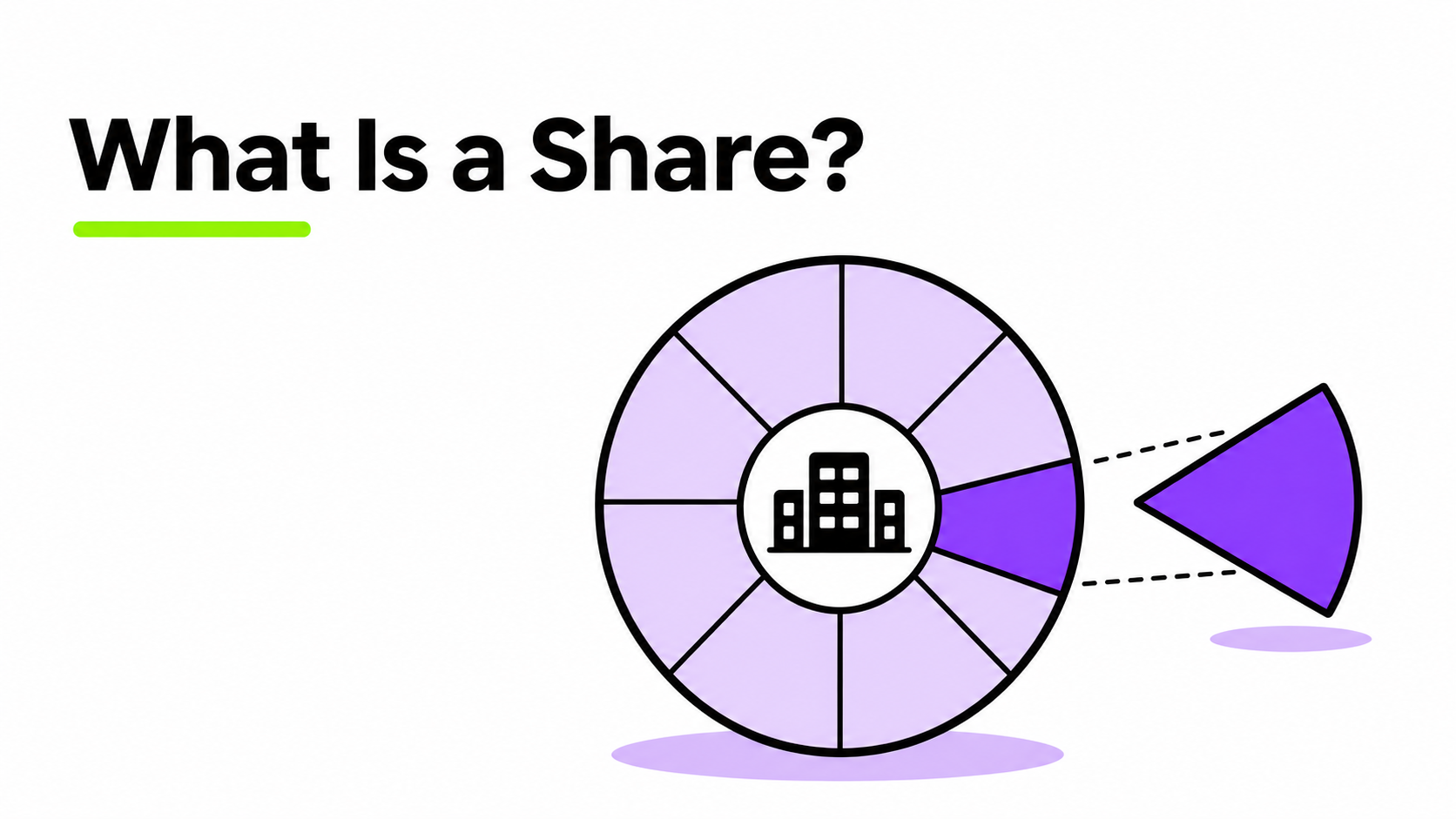
A small part of a business. That’s what a share represents. And depending on the type of shares you own, you may get voting rights, dividends and certain other benefits.
Now, there’s a lot that goes into this. Why does a share with a face value of ₹10 trade at ₹800? Do all shareholders have the same rights? And how does a company create and issue shares in the first place?
Let’s understand what is share, its types and a few important things investors should know.
Meaning of a Share
A share represents a unit of a company’s share capital. When you purchase equity shares, you acquire a small ownership interest in that company.
How small? Well, that depends.
Say a company has issued 10 lakh equity shares. You purchase 1,000.
Your ownership percentage would be:
(1,000 ÷ 10,00,000) × 100 = 0.1%
That’s 0.1% ownership. This means you do not have major influence over any company’s decisions. But you still have rights that are attached to those shares.
Now let’s say the company’s profit is hitting higher and higher from the last couple of years. And if the business is expanding too and demand improves, the company’s share prices may rise. And this will raise your profit.
But a company can also struggle. If the sales are poor or the debt is rising and the shareholders see poor future prospects, the company shares might fall.
How Do Shareholders Earn Returns?
There are two common sources of returns:
- Capital gains: This happens when you sell your shares at higher prices as compared to the price you bought them.
- Dividends: It’s a portion of profit, in proportion to your shareholding, that the company distributes amongst its shareholders.
Equity vs Preference Shares
A shareholder is a shareholder, right? Well, the rights can differ considerably.
Under the Companies Act, 2013, share capital generally falls into two categories: equity shares and preference shares.
Equity Shares
These are the shares most people purchase through NSE and BSE.
Equity shareholders generally receive voting rights, subject to the share class and applicable regulations. They may also receive dividends if the company declares them.
There’s no fixed return attached to ordinary equity shares.
A company might earn excellent profits and still see its share price decline. It may also decide to retain those profits for future projects.
Preference Shares
Preference shares carry priority rights concerning dividends and repayment of share capital.
Suppose a company has both equity and preference shareholders. If dividends become payable under the relevant terms, preference shareholders receive their specified entitlement before equity shareholders.
Something similar happens if the company goes into liquidation. Preference shareholders rank ahead of equity shareholders for repayment of capital.
But even that priority has limitations. Creditors and higher-ranking obligations come first.
Equity vs Preference Shares
| Feature | Equity Shares | Preference Shares |
|---|---|---|
| Main feature | Ownership participation | Preferential financial rights |
| Dividend | Variable | Usually specified by issue terms |
| Voting rights | Generally available | Usually restricted |
| Return | Depends on price and dividends | Depends on issue terms |
| Liquidation priority | Lower | Higher than equity |
Preference shares also have different categories, including cumulative and non-cumulative shares. The specific terms determine how their dividend entitlements work.
Face Value vs Market Value
Here’s a question.
A share has a face value of ₹10, but investors are purchasing it at ₹750. Where did that extra ₹740 come from?
To understand this, we need to look at two different values.
Face Value
Face value is the nominal value assigned to a share by the company.
Take a company that issues 10 lakh shares, each with a face value of ₹10.
Its nominal issued share capital comes to:
10,00,000 × ₹10 = ₹1 crore
Companies use face value for share capital accounting and certain corporate actions. It usually remains unchanged unless the company undertakes an action such as a stock split or consolidation.
Market Value
Market value is the actual price at which any share is trading at in the stock market.
It’s possible that the face value of a share might stay ₹10 for years but its market price might reach ₹150 to ₹400 and then fall to ₹280.
Why? Well, the price reacts to the investors’ behavior. And the investors react to market macros, business prospects and prevailing marketing conditions.
Face Value vs Market Value
| Feature | Face Value | Market Value |
|---|---|---|
| Meaning | Nominal value | Trading price |
| Determined by | Company and corporate actions | Demand and supply |
| Frequent changes | No | Yes |
| Used for | Share capital accounting | Trading and valuation |
Also, don’t assume a ₹20 stock is cheap simply because another trades at ₹2,000.
The number of outstanding shares matters. So do earnings, debt and the company’s overall valuation.
Rights of Shareholders
Suppose you purchase 100 equity shares of a listed company.
Can you vote on company matters? Receive dividends? Access its financial reports?
Generally, yes, although the exact rights depend on the shares you hold and applicable laws.
Voting Rights
Equity shareholders generally have voting rights on matters requiring shareholder approval.
For instance, certain director appointments and important corporate resolutions may require shareholder votes.
But voting power matters. An investor holding 100 shares will generally have much less influence than someone holding 10 lakh shares.
Dividend Rights
Eligible shareholders get dividends when a company declares them. But there is an important caveat. Not all companies distribute all their profits amongst the shareholders.
Sometimes, companies keep a portion or the entire profit to themselves as they are looking for business expansion. And for that, they might need more funds.
Access to Information
As a shareholder, you can have access to annual reports and financial statements, and prescribed disclosures about the company’s operations.
Shareholders can access these documents under applicable rules.
Corporate Actions
You may also receive entitlements through bonus issues or rights issues.
Consider a 1:1 bonus issue. If you hold 100 shares, you receive another 100, subject to eligibility.
Your number of shares doubles. The company’s total share count also increases, so your percentage ownership generally stays the same.
Rights During Liquidation
If a company shuts down, creditors and other higher-priority claims are settled before equity shareholders receive any remaining assets.
And sometimes, there’s nothing left.
How Companies Issue Shares
Companies require capital for many reasons. A new manufacturing plant, product development, expansion into another country or simply strengthening their finances.
Issuing shares is one way to raise it.
There are several methods, and each works a little differently.
Initial Public Offering (IPO)
An IPO allows a company to offer shares to the public as part of the listing process.
Suppose a company announces an IPO at ₹250 per share. Investors submit applications, and eligible applicants may receive allotments.
After listing, those shares can trade on the exchange.
An IPO may contain fresh shares, an offer for sale by existing shareholders or both. In a fresh issue, the company receives the proceeds. In an offer for sale, the selling shareholders receive them.
Follow-on Public Offer (FPO)
A company is already listed and wants to raise additional capital through another public issue.
It may conduct an FPO.
Rights Issue
A rights issue allows eligible existing shareholders to purchase additional shares under specified terms.
Let’s say you own 50 shares, and the company announces a 1:5 rights issue.
You may become entitled to apply for 10 additional shares.
Bonus Issue
Under a 1:1 bonus issue, an investor holding 100 shares receives another 100.
There are now more outstanding shares, but the investor’s percentage ownership generally remains unchanged.
One final point. When you buy shares from someone on NSE or BSE, the money generally goes to that seller. The company doesn’t receive fresh capital from your purchase.
FAQs
What is face value of a share?
Face value is the nominal value assigned to a share by the company. It may differ considerably from its market price.
Do shareholders own the company?
Equity shareholders collectively hold ownership interests in a company. Individual ownership depends on the number and class of shares held.
What are preference shares?
Preference shares provide priority rights concerning specified dividends and repayment of capital over equity shares, subject to their terms.
Can a share price go to zero?
Yes. A company’s shares can lose their entire market value, particularly during insolvency. Shareholders may lose their full investment.
Conclusion
So, a share represents a small ownership interest in a company. But before purchasing one, there are several things worth understanding.
Equity shares, preference shares, voting rights, dividends, face value and market price. Then comes the company’s financial condition, which can affect the value of your investment over time.
Now that you understand what is share, you can start exploring companies and their financial reports.
Interested in the Indian stock market? Explore listed shares and learn about investing with Lemonn. Check the business, understand the risks and make your decisions carefully.
Till then, happy and safe investing!
Disclaimer: This is specifically for educational purposes only. Make sure you take financial advice from your financial planner before investing.
Disclaimer
The stocks mentioned in this article are not recommendations. Please conduct your own research and due diligence before investing. Investment in securities market are subject to market risks, read all the related documents carefully before investing. Please read the Risk Disclosure documents carefully before investing in Equity Shares, Derivatives, Mutual fund, and/or other instruments traded on the Stock Exchanges. As investments are subject to market risks and price fluctuation risk, there is no assurance or guarantee that the investment objectives shall be achieved. Lemonn (Formerly known as NU Investors Technologies Pvt. Ltd) do not guarantee any assured returns on any investments. Past performance of securities/instruments is not indicative of their future performance.