Stock Split vs Bonus Issue: What Happens to Your Shares
 Written by Prateek Desai
 Reviewed by Gaurav Garg, SEBI-registered Research Analyst
If you have been in the stock market for some time, you probably have heard about dividends and stock splits.
Whenever any one of the above events happens, the stock prices drop. But why? What exactly happens behind the curtain that results in the price drop?
Let’s find out!
Stock split explained
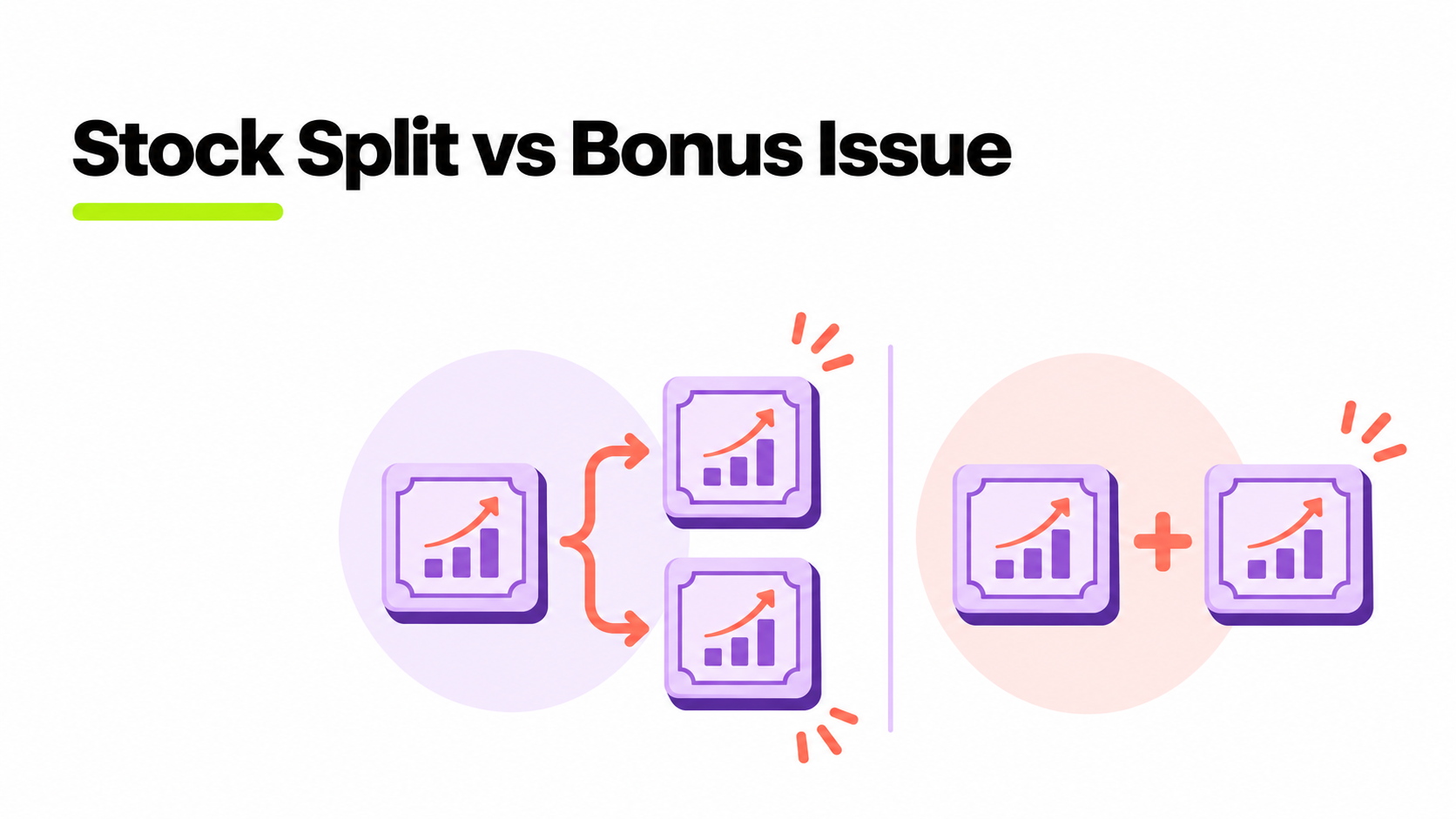
Whenever a company undergoes a stock split, the number of shares available increases. But the share price is automatically adjusted to keep the market cap equal to what it was before the split.
Confusing? Let’s take an example.
Let’s say you currently have 100 shares of a company and the share price is ₹2,000 each.
So your total investment will be ₹2,00,000.
But what happens when the company announces a 1:5 split? Well, if you are holding one share before the split, you will get 5 shares after the split.
But now the share prices cannot stay at ₹2,000, as it will be 5 times more than what your holdings were valued at before the split! That’s the share price fall to ₹400. Result? Your total holding value remains ₹2,00,000.
You now own more shares, but your percentage ownership of the company remains the same.
What about face value?
The face value of the shares will decrease.
For example, if one share with a face value of ₹10 is split into 5 shares, the new face value will be ₹2.
This is important to note. The face value is different from the market price.
Face value is the nominal value of a share, whilst the market price is how much people are willing to buy and sell a share for.
When a company performs a stock split, the face value will change in line with the split. However, the market price will adjust based on the split.
Bonus issue explained
A bonus issue is another type of corporate action that companies perform to increase the number of shares an investor owns.
Unlike a stock split, the company will issue new fully paid-up shares to shareholders.
The shares are issued by capitalising eligible reserves.
For example, suppose you own 100 shares of a company that is trading at ₹600 per share, and it announces a 1:1 bonus issue.
You will receive an extra share for each share you already own.
This increases your number of shares to 200. However, the price will theoretically halve to ₹300.
Overall, your investment value will remain the same.
What is a bonus ratio?
Companies may announce different bonus ratios.
A 1:1 ratio means for each share you own, you receive one extra share. A 2:1 ratio means for each share you own, you receive 2 extra shares. A 1:2 ratio means for every 2 shares you own, you will receive 1 extra share.
Bonus shares are not the same as dividends.
A dividend is a cash payment investors receive. A bonus issue simply increases the number of shares.
Impact on price and holdings
Whenever a company announces a stock split or bonus issue, investors will usually notice an increase in the number of shares they own. The price of the shares will also be affected.
Below is a table showing how each corporate action would impact an investment of ₹1,00,000.
| Particulars | Stock Split (1:5) | Bonus Issue (1:1) |
|---|---|---|
| Shares | 100 | 100 |
| Price per share | ₹1,000 | ₹1,000 |
| New number of shares | 500 | 200 |
| Theoretical new price | ₹200 | ₹500 |
| Total value | ₹1,00,000 | ₹1,00,000 |
| Face value | Decreases | Stays the same |
The key point to remember here is that your investment value will not increase.
Does it affect your holdings?
No, your percentage ownership will remain the same. But the total number of shares that are circulating in the market will increase.
One more thing to note: the EPS of that share will change too, and the earnings will be divided across a larger number of shares.
What about the record date?
Companies will announce a record date. This means only shareholders who own shares on the record date will receive the bonus.
The ex-date will also be announced. This is the date the shares will start trading without entitlement to the corporate action.
In India, you generally need to buy the shares before the ex-date. You will then be entitled to the corporate action.
Once the corporate action has been processed, you should see your new number of shares in your demat account. Please check the dates set out in the company’s announcement.
Also, the price of the shares will be theoretical. Depending on demand, the price may go up or down.
Why companies do them
If they don’t automatically increase your wealth, why would companies perform a stock split or bonus issue?
There are a few reasons.
Cheaper to buy
If a company’s share price is ₹15,000, it may be difficult for investors to buy shares if they are only investing ₹5,000 per month.
A stock split can reduce the price of the shares significantly. This means more investors will be able to afford to invest in individual shares.
Increased turnover
A lower price may encourage more retail investors to invest. This could increase the turnover and liquidity of the shares. However, this is not guaranteed.
More shares
A stock split or bonus issue increases the number of shares in circulation.
With a bonus issue, eligible reserves are converted into share capital. With a stock split, the share capital is split into smaller pieces. However, the total paid-up capital will not increase.
Company confidence
Sometimes, these corporate actions are seen positively by investors.
A company announcing a bonus issue may be seen as confident in its financial situation. However, you shouldn’t assume it is doing well based on the announcement.
Neither action will improve revenue, profit or cash flow.
Examples from the Indian market
Many Indian companies have performed stock splits and bonus issues. Some have done both.
Below are 3 examples.
Reliance Industries
In September 2024, Reliance Industries announced a 1:1 bonus issue.
Eligible shareholders would receive an extra fully paid-up share for each share they already owned.
The record date was set as 28 October 2024.
If you had 100 eligible shares, you would receive another 100 shares. Your total holdings would be 200.
The price would theoretically be halved, ignoring any other price movement.
Wipro
In October 2024, Wipro also announced a 1:1 bonus issue.
The record date was set as 3 December 2024. The bonus shares were allotted on 4 December 2024.
If you owned 50 eligible shares, you would receive another 50 shares.
The number of shares doubled, but you wouldn’t automatically make a profit.
Bajaj Finance
Bajaj Finance is an interesting example. In June 2025, it performed a stock split and bonus issue.
It split its shares so that each share with a face value of ₹2 became 2 shares with a face value of ₹1 each. It then issued bonus shares in the ratio of 4:1.
The record date was set as 16 June 2025.
If you owned 10 shares:
- Your shareholding would double to 20 due to the stock split.
- You would then receive 80 shares due to the 4:1 bonus issue.
- Overall, you would have 100 shares.
Your shareholding would have increased 10 times. However, the price would also theoretically be reduced. There is no tenfold increase in investment value.
This is why it’s important to understand what a stock split is and how bonuses work.
FAQs
Is a stock split good for investors?
Stock splits can make shares more affordable. However, they do not automatically increase an investor’s wealth. Your returns will depend on company performance, valuation and market conditions.
Does a bonus increase my wealth?
No. A bonus issue will increase the number of shares you own. However, the price will theoretically change in line with the increase. The total value of your investment won’t change.
When do split shares get credited?
Split shares will generally be added to your demat account around the effective date. Please check the dates set out in the official announcement. If you don’t see your new quantity, please contact your broker.
Split vs bonus difference?
A stock split means the company is splitting its shares into smaller pieces. The face value will decrease. A bonus issue means the company is issuing extra shares by capitalising eligible reserves. The face value will not change. Neither will automatically increase your total investment.
Conclusion
We hope now you clearly understand the difference between a stock split and a bonus issue. You must understand such basic concepts when you start investing in the stock market.
Both of these events increase the number of shares you hold, without increasing your investment value.
So before investing, always take a look at the company’s financial performance, valuation, growth potential and the reason behind the corporate action.
Want to learn more about investing in Indian stocks? Explore stock market concepts and investment opportunities with Lemonn. Understand how corporate actions affect your holdings and consider the risks before investing.
Disclaimer
The stocks mentioned in this article are not recommendations. Please conduct your own research and due diligence before investing. Investment in securities market are subject to market risks, read all the related documents carefully before investing. Please read the Risk Disclosure documents carefully before investing in Equity Shares, Derivatives, Mutual fund, and/or other instruments traded on the Stock Exchanges. As investments are subject to market risks and price fluctuation risk, there is no assurance or guarantee that the investment objectives shall be achieved. Lemonn (Formerly known as NU Investors Technologies Pvt. Ltd) do not guarantee any assured returns on any investments. Past performance of securities/instruments is not indicative of their future performance.