Market Capitalisation: Meaning, Formula and Why It Matters
 Written by Ipsita Baishya
 Reviewed by Gaurav Garg, SEBI-registered Research Analyst
Market capitalization is one of the most important elements of a share market that a trader or an investor should learn first.
The reason is pretty simple. When you are getting started, a share worth ₹50 looks cheaper as compared to a share worth ₹2,000.
But that’s not how the stock market works! It’s possible that a company with lower share prices might have higher market capitalisation!
But what exactly is the market capitalisation or market cap? Well, it’s time to understand.
Market cap formula
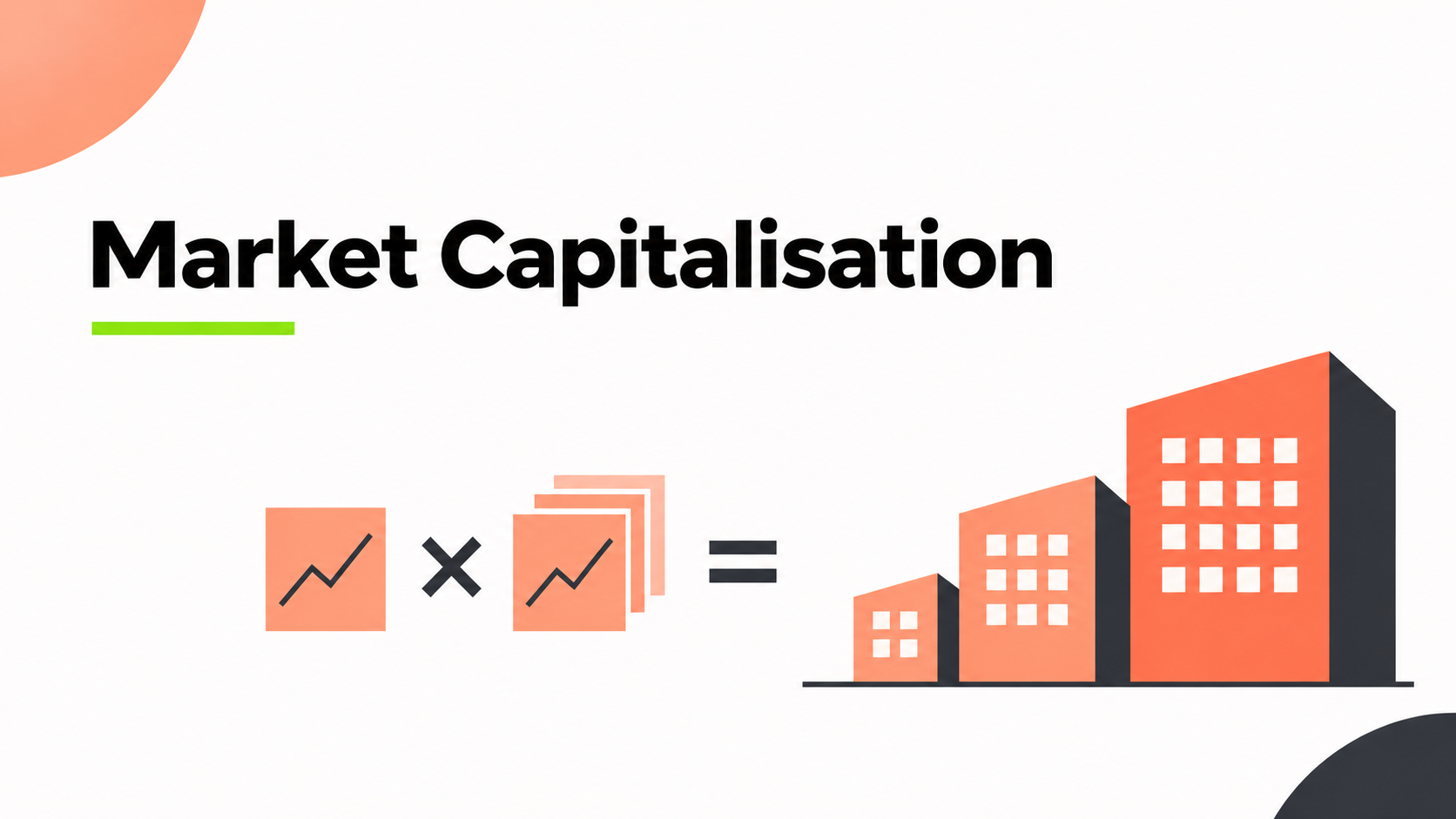
Let us give you a simple explanation first. Market cap is the total value of the company’s outstanding equity shares.
So if you are looking for a formula to calculate any company’s market cap, it’s pretty simple:
Market Capitalisation = Total Outstanding Shares × Current Share Price
Assume that a company has 20 crore shares outstanding. Each trades at ₹150.
Its market capitalisation would be:
20 crore × ₹150 = ₹3,000 crore
Suppose the price now goes up to ₹180. If the number of shares doesn’t change, the market capitalisation will be ₹3,600 crore.
Did the company get an extra ₹600 crore in the bank? No. It was simply a case of the shares getting a higher value in the market.
Why Does Market Cap Change?
The price of the stock may increase or decrease during the day. A business could also buy back or issue more shares, modifying the number of shares outstanding.
However, market cap is not equal to annual revenue, profit or total assets.
A company with revenue of ₹1,000 crore may be valued at less than a company with revenue of ₹500 crore. Investors might have varying expectations about what they can expect in the future.
Free-float market cap
Here’s something worth understanding. A company’s outstanding shares aren’t necessarily available for regular trading.
Promoters, governments and some strategic investors may be the ones holding large stakes. Typically, these holdings are not included in the calculation of free-float market capitalisation.
Free float is the portion that is deemed available to ordinary market investors according to the index methodology.
Let’s say that the market value of a company is ₹10,000 crore. Its promoters and other excluded strategic holders own 60% of it.
The eligible free float is 40%.
Free-Float Market Cap = ₹10,000 crore × 40% = ₹4,000 crore
Thus, the company’s full market cap is ₹10,000 crore, and its free-float market cap is ₹4,000 crore.
Why Is Free Float Used in Stock Indices?
The weights of constituents in indices like Nifty 50 are calculated based on free-float-adjusted market capitalisation. If a company has a high promoter stake, then it contributes based on its eligible market value instead of its total equity valuation.
This is significant for index funds and ETFs, which attempt to track a specific index, such as the Nifty 50.
But be careful not to mistake free float for daily trading volume. Owners of shares may not be engaged in active selling, and yet the shares may be classified as free float.
Market cap vs enterprise value
The market value of a company’s equity shares is revealed by its market capitalisation. Now, what if the company has a significant amount of debt as well?
Suppose there are two businesses with the same market cap of ₹5,000 crore.
Company A has nearly no debt. Company B has outstanding debt of ₹2,000 crore with lenders.
Their stocks are valued exactly the same, but their finances are quite different.
Enterprise value (EV) is a tool that can help investors make sense of that difference.
Enterprise Value Formula
The simplified formula is:
EV = Market Cap + Total Debt − Cash and Cash Equivalents
Adjustments for preferred equity and non-controlling interests may also need to be made, depending on the valuation.
Let’s calculate it.
| Particulars | Company A | Company B |
|---|---|---|
| Market Cap | ₹5,000 crore | ₹5,000 crore |
| Total Debt | ₹500 crore | ₹2,000 crore |
| Cash | ₹1,000 crore | ₹200 crore |
| Enterprise Value | ₹4,500 crore | ₹6,800 crore |
Company B would have a much higher enterprise value because it has higher net debt.
What Would an Investor Use as a Measure?
Market cap is a good way to compare equity values and company sizes. Enterprise value is used to analyse businesses with different cash and debt positions.
For example, EV/EBITDA is frequently employed to compare certain operating businesses. Equity valuation is used in price-to-earnings ratios, however.
Both measures are less than ideal as standalone indicators of company value.
But there is another consideration. Standard comparisons of enterprise value are less meaningful for banks and other financial institutions, whose activities involve debt as a normal part of their business.
Using market cap in stock selection
Now you have two companies in the same industry that you are considering. The value of one is ₹80,000 crore. The other is worth ₹8,000 crore.
Would you automatically select the bigger one?
It depends on your needs.
Market cap provides a measure of the size of the business at the prevailing price per share. It is a good place to start comparing businesses, but there are still other factors to take into account, such as earnings, debt, profitability, management and valuation.
Large Cap, Mid Cap and Small Cap Stocks
In India, the framework for the classification of mutual funds, as provided in SEBI regulations, applies to listed companies based on their full market capitalisation rankings.
| Category | Ranking |
|---|---|
| Large Cap | Top 100 companies |
| Mid Cap | Companies ranked 101–250 |
| Small Cap | Companies ranked 251 onwards |
A company’s relative market capitalisation can change, and thus its category can change as well.
Large-cap stocks tend to have greater share liquidity and may belong to companies with an established base of operations. Mid-cap companies could have room to grow, and smaller companies can provide significant growth potential alongside significant financial and liquidity risks.
However, there are exceptions to everything.
It is not unusual for a big firm with poor management to outperform a small firm with a good finance team.
Market Capitalisation and Stock Prices
The next one is a frequent error. Investors may think that a stock trading at ₹100 per share is less expensive than a stock trading at ₹1,000 per share.
Suppose these are hypothetical businesses:
- Company X: ₹100 per share, with 100 crore outstanding shares.
- Company Y: ₹1,000 per share, with 5 crore outstanding shares.
The market capitalisation of Company X is ₹10,000 crore. The market capitalisation of Company Y is ₹5,000 crore.
So, even though Company X’s share price is lower, the equity valuations of the companies are different.
Is it better to invest in Company Y then? We still don’t know!
Make sure you have compared earnings, cash flows, debt, growth and other relevant valuation ratios before coming to a decision.
India’s largest companies by market cap
This list keeps on changing continuously as the share prices change every minute. But here’s the snapshot of the top listed companies in India on 13 Nov 2026.
| Rank | Company | Market Capitalisation |
|---|---|---|
| 1 | Reliance Industries | ₹18.13 lakh crore |
| 2 | Jio Platforms | ₹12.90 lakh crore |
| 3 | Bharti Airtel | ₹12.84 lakh crore |
| 4 | HDFC Bank | ₹12.39 lakh crore |
| 5 | ICICI Bank | ₹11.38 lakh crore |
| 6 | State Bank of India (SBI) | ₹9.97 lakh crore |
| 7 | Tata Consultancy Services (TCS) | ₹8.72 lakh crore |
FAQs
How is market cap calculated?
The formula is pretty simple, to be honest. All you have to do is multiply any company’s current share price by that company’s total outstanding shares. The resulting number is your final market cap.
Does high market cap mean safe?
Not every time. While large cap stocks are, sometimes, treated as a safer investment option, it’s not a thumb rule! Even large companies face financial hardship, which might negatively impact their share price.
What is free float?
Free float shares are the shares that are available in the public market and are not held by promoters and strategic shareholders.
What is enterprise value?
This is totally different from the company’s market capitalisation. Enterprise value is the sum of the company’s total business value, market cap, debt and other claims on the company. Cash and other related assets are subtracted from this sum to get the final enterprise value.
Conclusion
Market capitalisation is a way to understand any company’s value in the eyes of the stock market. You can use it to compare the sizes of different companies and their index weights. So it could be a helpful tool in finding out a good investment opportunity if used right.
But there is a catch. Market cap changes constantly, and more importantly, it does not offer an insight into a company’s financial strength or profitability.
So you can use it to gauge the company’s current standing in terms of market value, but you cannot use it as a sole indicator for picking a stock.
Now that you understand what market capitalisation is, we hope you will look at it alongside other financial indicators and earnings too.
Disclaimer
The stocks mentioned in this article are not recommendations. Please conduct your own research and due diligence before investing. Investment in securities market are subject to market risks, read all the related documents carefully before investing. Please read the Risk Disclosure documents carefully before investing in Equity Shares, Derivatives, Mutual fund, and/or other instruments traded on the Stock Exchanges. As investments are subject to market risks and price fluctuation risk, there is no assurance or guarantee that the investment objectives shall be achieved. Lemonn (Formerly known as NU Investors Technologies Pvt. Ltd) do not guarantee any assured returns on any investments. Past performance of securities/instruments is not indicative of their future performance.