Large Cap vs Mid Cap vs Small Cap Stocks: Risk and Return Compared
 Written by Prateek Desai
 Reviewed by Gaurav Garg, SEBI-registered Research Analyst
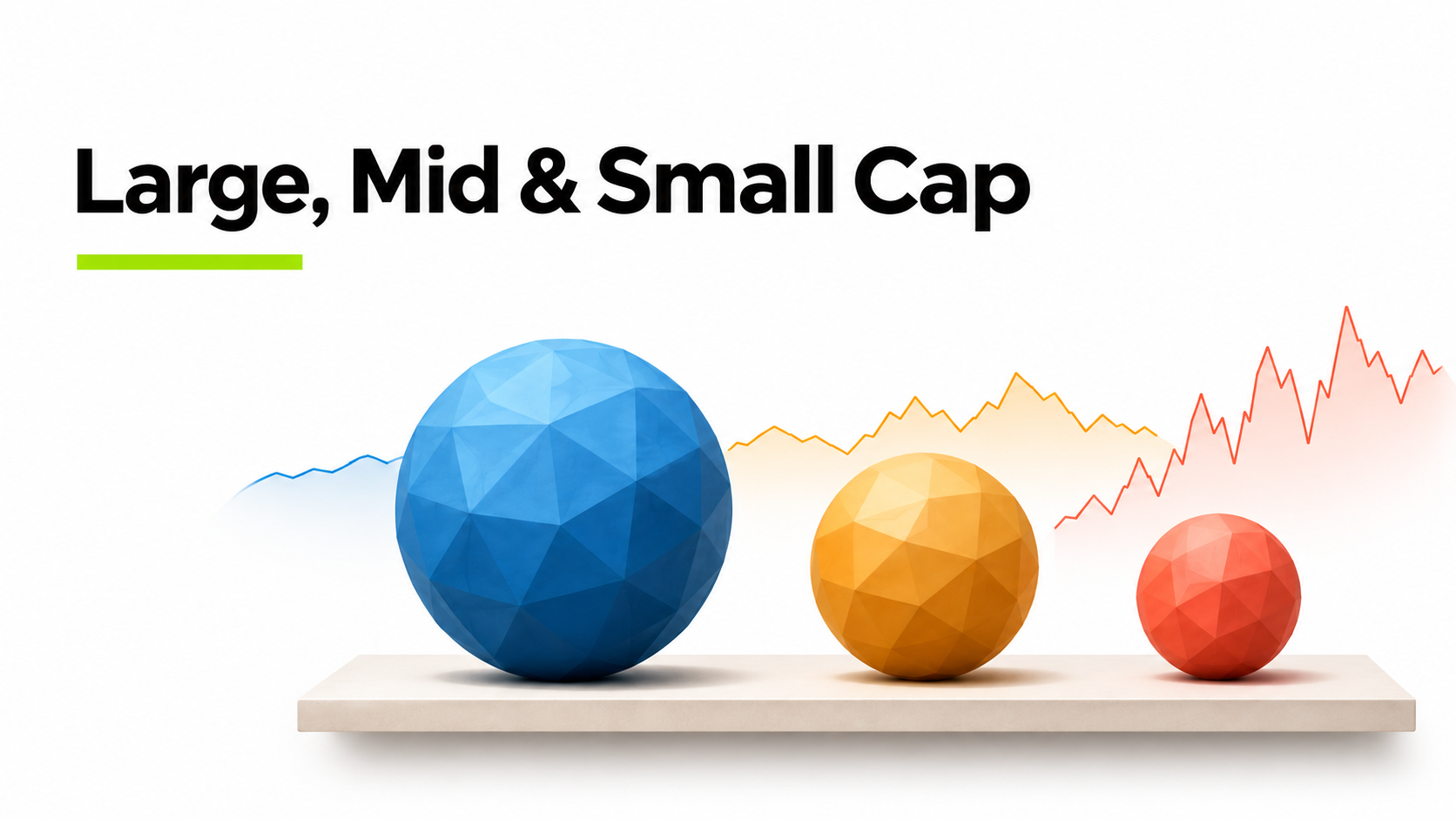
A company with ₹5 lakh crore worth of capital could be listed on the same stock exchange as a company with ₹5,000 crore worth of capital. You can purchase shares in either one, but their businesses, growth prospects and risks could be very different.
Market capitalisation comes into play at that point.
Large cap, mid cap and small cap are the broad classifications of companies based on their market value in India. These categories are used by investors to better comprehend a business and to assess its risks.
Let’s understand what large cap, mid cap and small cap stocks are, how SEBI categorises them and what past market data says about these stocks.
SEBI classification rules
SEBI has defined classification criteria for companies as per their total market cap. This makes it easy for mutual funds to adhere to the same definition when choosing securities for various kinds of equity schemes.
Market capitalisation is just the value of the company’s shares multiplied by the number of shares in circulation.
As everyone knows, the calculation is simple:
Market Capitalisation = Share Price of the Company at the Time of Calculation × Outstanding Shares
Assume that a company has a total of 10 crore shares in circulation at ₹500 each. The market capitalisation will be ₹5,000 crore.
There’s a key point to note, though. SEBI’s classification is based on the ranking of companies among listed companies and not on a fixed rupee value.
How SEBI Classifies Stocks
| Category | Market Capitalisation Ranking |
|---|---|
| Large Cap | Top 100 companies |
| Mid Cap | Companies ranked between 101 and 250 |
| Small Cap | Companies ranked 251 onwards |
The definitions apply to the investment universe of equity mutual fund schemes.
AMFI is an association that develops the classification list by analysing data from the stock exchanges and updates it on a regular basis.
It also implies that at the time of classification, a company may be a mid-cap but later become a large-cap if its market value rises significantly.
The other way around is possible as well.
Characteristics of each
The three types vary in terms of business size, market liquidity, business history and prospects for growth. There will be exceptions in each category, of course.
Large-Cap Stocks
These are the 100 biggest companies in terms of full market capitalisation in India.
Many have established businesses, long financial track records and large operations. They also have a higher probability of attracting more institutional investors.
This is usually helpful for liquidity. Trading a large-cap, widely traded stock may be less difficult than trading a smaller stock that rarely trades.
There are challenges for large companies, however. Competition, regulation, falling profits and expensive valuations can all affect their share prices.
Mid-Cap Stocks
Companies ranked 101 to 250 in the market-cap rankings are considered mid-cap companies.
A number of them already have profitable businesses but still have plenty of room to grow. Others might be in industries with a fast growth rate.
And that’s what attracts investors.
A medium-sized producer entering a new industry, for example, can expand more rapidly than an industry giant.
Small-Cap Stocks
The stocks that fall outside the top 250 are known as small caps.
This can encompass a wide range of businesses at various stages of development. There are some with promising products and increasing earnings. Others face issues with debt, profitability and/or access to capital.
The trading volume for small-cap stocks may also be smaller.
Large Cap vs Mid Cap vs Small Cap
| Factor | Large Cap | Mid Cap | Small Cap |
|---|---|---|---|
| Company size | Largest | Medium | Smaller |
| Liquidity | Generally higher | Moderate | Can be lower |
| Growth potential | Often steady | Can be significant | Can be significant |
| Price volatility | Generally lower | Generally higher | Often the highest |
| Business risk | Varies by company | Varies by company | Can be considerable |
Historical returns and volatility
It’s easier for small companies to grow. It’s a statement that investors often hear.
There is some reason for it, after all.
It may be easier for a company with an annual turnover of ₹100 crore to double its business than for a company with an annual turnover of ₹1 lakh crore.
However, share market returns are not only dependent on business growth. Investors who buy the stock do so at a cost, too.
Let’s look at actual performance based on the indices.
Historical Index Returns
The numbers below are sourced from NSE Indices’ Dashboard as of October 2026. These are total return indices that include reinvested dividends.
| Index | 1-Year Return | 3-Year CAGR | 5-Year CAGR |
|---|---|---|---|
| Nifty 100 | -8.18% | 9.17% | 7.22% |
| Nifty Midcap 150 | -3.90% | 13.73% | 13.84% |
| Nifty Smallcap 250 | -2.61% | 12.39% | 13.11% |
Check the 5-year data.
During the period, the large-cap index returned the lowest, the small-cap index returned the next lowest, and the mid-cap index delivered the highest annualised returns.
However, the picture varies according to the timeframe chosen. A five-year return is for a specific market cycle, encompassing rallies and corrections.
What About Volatility?
The following annualised volatility figures for one year, as of October 2026, are also reported on NSE’s dashboard.
| Index | One-Year Volatility |
|---|---|
| Nifty 100 | 14.17% |
| Nifty Midcap 150 | 16.75% |
| Nifty Smallcap 250 | 18.14% |
The higher the volatility, the more the returns may vary. It doesn’t state what the worst loss could be.
Also, keep in mind that an index is made up of a lot of stocks. Individual small-cap stocks could see significantly bigger drops than their index.
Which suits which investor
There’s no one-size-fits-all category.
If an investor has a goal of saving for retirement over 20 years, they are in a different situation than someone saving for a home purchase scheduled for two years later.
Large-Cap Stocks With Comparatively Lower Equity Risk
Large-cap exposure may be preferred by those who favour established businesses and less volatility in stock prices.
However, during market crashes, even large-cap stocks can experience significant losses.
Those ups and downs can be hard to deal with over a shorter investment timeframe.
Mid Caps for Investors Who Can Handle Some Volatility
Mid-caps could be a better option for investors interested in exposure to smaller businesses and willing to tolerate more risk.
But the choice of a company is a significant factor. Expanding firms can still disappoint investors if bought at an overly high valuation.
Small Caps for Higher Risk Tolerance
Small-caps might be appropriate for investors who have a tolerance for volatility, low liquidity and extended periods of decline.
While a long investment horizon may help investors weather the storms, it doesn’t ensure that they will recover.
When learning about smaller companies, such as biotechnology businesses, it can also be difficult to determine the financial situation of an individual company.
Portfolio allocation examples
Let’s say an investor desires to invest in all three categories.
What should the allocation be?
Well, it is not possible to give a general answer. Financial objectives, age, income security and the ability to cope with losses are factors that determine individual allocation.
However, some hypothetical examples may help in understanding how allocation impacts portfolio exposure.
Illustrative Equity Allocations
| Allocation Style | Large Cap | Mid Cap | Small Cap |
|---|---|---|---|
| Large-cap-focused | 80% | 15% | 5% |
| Balanced across sizes | 60% | 25% | 15% |
| Higher smaller-company exposure | 40% | 35% | 25% |
The examples shown are for the equity portion of a portfolio only. These are not recommended allocations but rather illustrations of what they may achieve.
If you invest the entire ₹1 lakh into stocks with a split of 60:25:15, then you would allocate ₹60,000 to large-caps, ₹25,000 to mid-caps and ₹15,000 to small-caps.
However, this doesn’t imply that the investor has to invest the full amount of ₹1 lakh into equity.
If funds are needed to cover emergencies or near-term expenditure, a different approach might be necessary.
Why Rebalancing Matters
Assume that small-cap stocks perform exceptionally well over the next two years.
This could significantly increase the portion of your portfolio they make up without you putting any more money into them.
The portfolio may now have higher risk than originally envisioned due to greater small-company exposure.
Routine rebalancing does help investors identify that change, but rebalancing may involve selling or switching investments and incurring taxes and transaction fees.
FAQs
What is a large cap stock?
Large-cap stocks are among the top 100 companies as per SEBI’s classification in terms of full market capitalisation.
Are small caps riskier?
Overall, smaller companies tend to have greater volatility, liquidity concerns and business uncertainties. But there is variation in actual risk between companies.
How does SEBI classify market cap?
SEBI categorises the top 100 companies as large-cap, companies ranked 101–250 as mid-cap and companies ranked 251 onwards as small-cap.
What is a good mix for beginners?
There is no specific percentage. There are some factors that beginners should consider when choosing an allocation: their investment time horizon, financial objectives and risk tolerance.
Conclusion
Knowing about large-cap, mid-cap and small-cap stocks will enable investors to compare companies of various sizes.
Large-caps are also indicative of established businesses and are more liquid. Mid-cap stocks can offer better growth potential, and small-cap stocks can move significantly.
There are also differences in historical returns. As indicated above in the data for October 2026, mid-cap and small-cap indices have beaten the large-cap index over the last five years. That can change.
Do your due diligence and check the financials, valuations and risk-reward tolerance of a company before investing.
Disclaimer
The stocks mentioned in this article are not recommendations. Please conduct your own research and due diligence before investing. Investment in securities market are subject to market risks, read all the related documents carefully before investing. Please read the Risk Disclosure documents carefully before investing in Equity Shares, Derivatives, Mutual fund, and/or other instruments traded on the Stock Exchanges. As investments are subject to market risks and price fluctuation risk, there is no assurance or guarantee that the investment objectives shall be achieved. Lemonn (Formerly known as NU Investors Technologies Pvt. Ltd) do not guarantee any assured returns on any investments. Past performance of securities/instruments is not indicative of their future performance.