Demat Account vs Trading Account: Key Differences
 Written by Ipsita Baishya
 Reviewed by Gaurav Garg, SEBI-registered Research Analyst
A Demat account. A trading account. Two terms you’ll hear almost immediately when you decide to invest in the Indian stock market.
Both are important. And both serve different purposes.
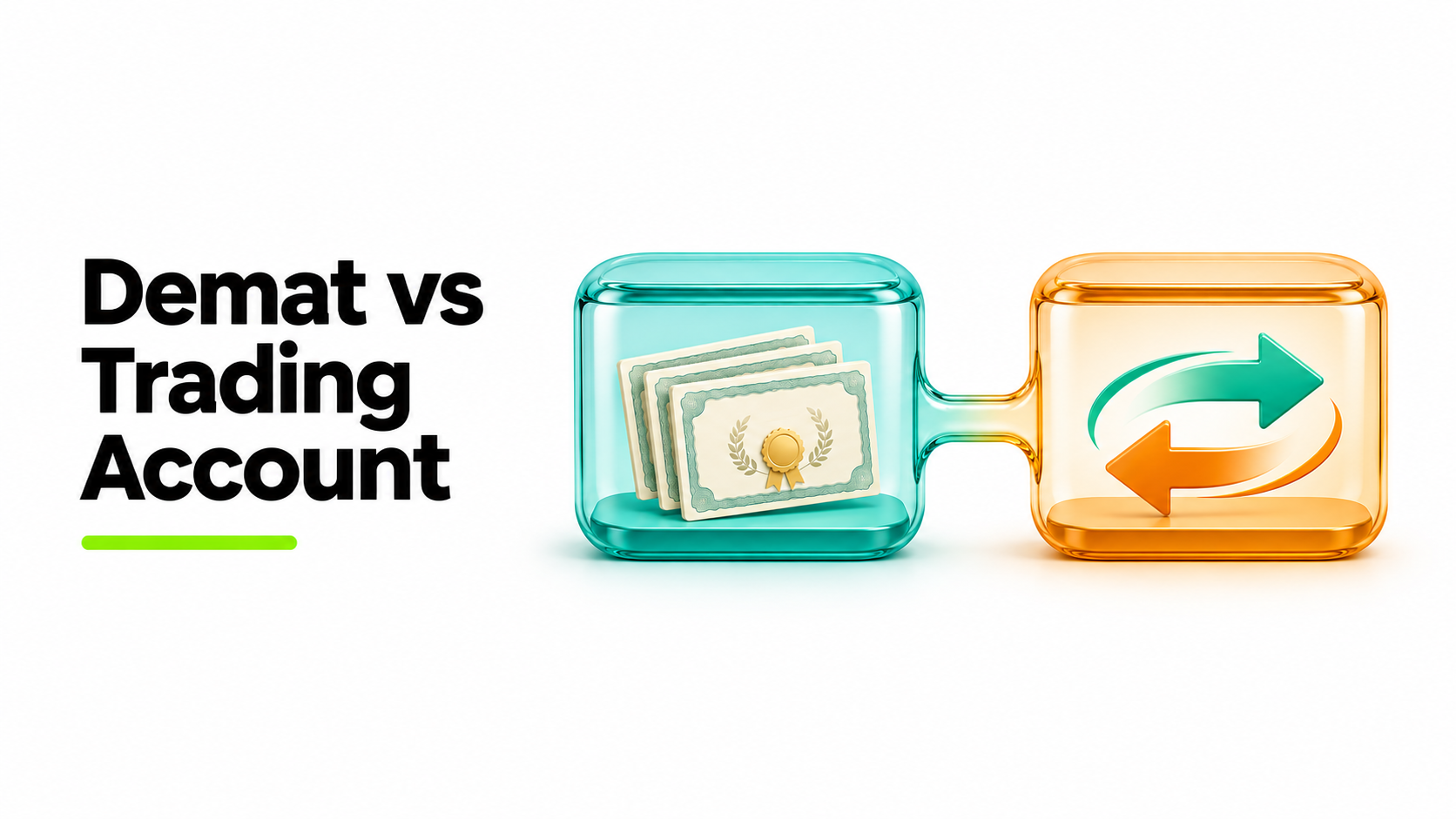
One holds your shares electronically. The other allows you to buy and sell them through stock exchanges such as NSE and BSE.
But do you really need both? Can you open a trading account without a Demat account? What about maintenance fees, brokerage and other charges?
Let’s understand demat vs trading account, how they work and what investors should know before opening one.
Purpose of Each
A lot of new traders wonder why you would need two different accounts? Isn’t one enough to manage the entire trading process?
Well, not exactly!
Let’s start with something simple. When you purchase shares, you place an order. The exchange executes the trade. After settlement, the shares reach your account.
Different functions. Different accounts.
What Is a Demat Account?
Demat is a short form of dematerialisation. A demat account holds all the shares and securities you own in electronic form.
Let’s say you buy 20 shares of a company. Once your trade executes and transactions are settled, your bought shares will reflect in your Demat account.
A Demat account lets you check what you are holding, transfer the eligible securities to other traders and claim corporate benefits (if any).
India has two depositories:
- National Securities Depository Limited (NSDL)
- Central Depository Services (India) Limited (CDSL)
You open a Demat account through a registered Depository Participant (DP).
What Is a Trading Account?
Want to buy 10 shares of a company? Open your trading platform. Search for the stock. Enter the quantity and price. Place the order.
Your broker sends it to the exchange.
That’s what a trading account does. It allows you to place buy and sell orders. And here’s the important part.
Your trading account doesn’t hold the shares after settlement. Your Demat account does.
Demat vs Trading Account: Key Differences
| Feature | Demat Account | Trading Account |
|---|---|---|
| Purpose | Holds securities electronically | Places buy and sell orders |
| Provider | Depository Participant | Registered stockbroker |
| Holds shares? | Yes | No |
| Connected to | NSDL or CDSL | Stock exchanges through a broker |
| Common charges | AMC, DP fees | Brokerage, transaction charges |
| Main function | Holding investments | Executing trades |
How They Work Together
Now, how do these two accounts work during an actual share purchase?
Let’s say you want to buy 50 shares at ₹200 each.
The total purchase value is ₹10,000, excluding charges.
Step 1: Place an Order
You open your trading account, select the company and enter the quantity.
The broker sends your order to the exchange.
Step 2: Order Execution
A matching seller is available.
Your order executes, and the transaction appears in your trading account.
Step 3: Settlement
The clearing and settlement system processes the transaction.
India’s equity cash market generally follows a T+1 settlement cycle. T+0 settlement is also available for eligible securities under the applicable framework.
Step 4: Shares Reach Your Demat Account
After settlement, the 50 shares get credited to your Demat account.
Now you own those shares.
What happens when you sell?
You place a sell order through your trading account. The shares are debited from your Demat account as part of the delivery and settlement process.
That’s the connection.
One account helps execute the transaction. The other maintains your electronic securities holdings.
Charges Compared
Opening an account may be free. Maintaining it? Making transactions? Transferring securities?
Well, this is where you have to pay some charges! And different brokers can have different pricing structures.
If you are just starting your stock market journey, we strongly recommend you pick a reliable and affordable stock broker like Lemonn.
The reason is that initially, it’s better to take trades with small quantities. This helps you keep your losses in check if your trade goes in the wrong direction.
But if your broker is charging you a fortune, even your profitable trade’s profit will get eroded through such exorbitant charges.
So the first thing you should do? Understand these charges.
Demat Account Charges
- Annual Maintenance Charges (AMC): It’s a maintenance charge you have to pay.
- DP Transaction Charges: These are the charges you have to pay when you sell securities.
- Other Charges: Transfers, pledging and certain additional services may carry fees.
Trading Account Charges
- Brokerage: The fee a broker charges for executing trades under its pricing plan.
- Exchange Transaction Charges: Fees associated with exchange transactions.
- Statutory Charges: Applicable STT, stamp duty, GST and other regulatory charges.
What About BSDA?
There’s a facility called the Basic Services Demat Account, or BSDA. The goal of this service is to assist smaller investors in bringing down their Demat maintenance charges.
Under SEBI’s revised framework:
| Value of Holdings | Maximum Annual AMC |
|---|---|
| Up to ₹4 lakh | Nil |
| Above ₹4 lakh and up to ₹10 lakh | ₹100 |
| Above ₹10 lakh | Regular account charges may apply |
Eligibility conditions apply. Other service charges may still be payable.
Here’s something worth remembering. Zero account-opening fees don’t mean zero trading costs.
Before choosing a provider, check its complete schedule of charges.
Do You Need Both?
The answer depends on what you plan to do.
Want to Buy and Hold Shares?
You’ll need both accounts.
The trading account helps you purchase shares. The Demat account holds them electronically after settlement.
A linked bank account handles the funds.
Can You Have Only a Demat Account?
Yes.
You may hold securities without actively trading on stock exchanges. For example, someone may receive shares through inheritance or an eligible off-market transfer.
Those shares can remain in their Demat account.
Can You Have Only a Trading Account?
In some cases, yes. Certain cash-settled derivatives transactions may not require a Demat account.
But there’s a catch.
Broker policies vary. Some brokers require both accounts during onboarding, and stock derivatives can involve physical settlement obligations.
For ordinary delivery-based equity investing, you’ll generally need both.
And one more thing.
Your trading account and Demat account don’t necessarily have to come from the same provider, provided the accounts can be linked under the applicable requirements.
Linked 3-in-1 Accounts
A bank account. A trading account. A Demat account.
Three separate functions.
Now imagine managing all three through one linked arrangement.
That’s a 3-in-1 account.
Certain banks and brokerage partnerships offer this facility.
How Does a 3-in-1 Account Work?
Suppose you want to purchase shares worth ₹15,000.
You place an order through the trading account.
The linked banking arrangement supports the required fund movement. The broker executes the trade, and the purchased shares reach your Demat account after settlement.
The exact process depends on your provider.
What Are the Benefits?
- Linked accounts: Your banking, trading and Demat accounts work together.
- Fund transfers: Integrated payment facilities can make transactions easier.
- Account access: Some providers offer a combined dashboard.
- Records: You may find it easier to track purchases, sales and holdings.
Sounds convenient?
It can be.
But check the brokerage fees. AMC. Bank account conditions. Additional charges.
A 3-in-1 account may make administration easier, but it doesn’t automatically make investing cheaper.
And market risks remain the same.
FAQs
Can I trade without a demat account?
Certain cash-settled derivatives trades may be possible without one, depending on broker requirements. Delivery-based share investing generally requires a Demat account.
Is a trading account mandatory?
For buying and selling listed shares through a stock exchange, you generally need a trading account with a registered broker.
Which one holds my shares?
Your Demat account holds your shares and other eligible securities electronically through the depository system.
What is a 3-in-1 account?
It’s a linked arrangement combining a bank account, trading account and Demat account to support investment transactions.
Conclusion
A Demat account holds your securities. A trading account allows you to buy and sell them.
Simple enough? But once you start investing, a few more things matter.
Brokerage. Annual maintenance charges. DP fees. Settlement requirements. And the features your account provider offers.
Each can affect your investing experience and overall costs.
Now that you understand demat vs trading account, you can compare providers and choose an account arrangement based on your requirements.
Visit our website now and check out the latest features.
Disclaimer: This article is for educational purposes only and does not constitute investment advice. Account features, charges and settlement rules may vary by provider and applicable regulations. Investments in securities markets are subject to market risks. Read all relevant documents carefully before investing.
Disclaimer
The stocks mentioned in this article are not recommendations. Please conduct your own research and due diligence before investing. Investment in securities market are subject to market risks, read all the related documents carefully before investing. Please read the Risk Disclosure documents carefully before investing in Equity Shares, Derivatives, Mutual fund, and/or other instruments traded on the Stock Exchanges. As investments are subject to market risks and price fluctuation risk, there is no assurance or guarantee that the investment objectives shall be achieved. Lemonn (Formerly known as NU Investors Technologies Pvt. Ltd) do not guarantee any assured returns on any investments. Past performance of securities/instruments is not indicative of their future performance.