Option Buying vs Option Selling: Which Is Better?
 Written by Supratim Choudhury
 Reviewed by Gaurav Garg, SEBI-registered Research Analyst
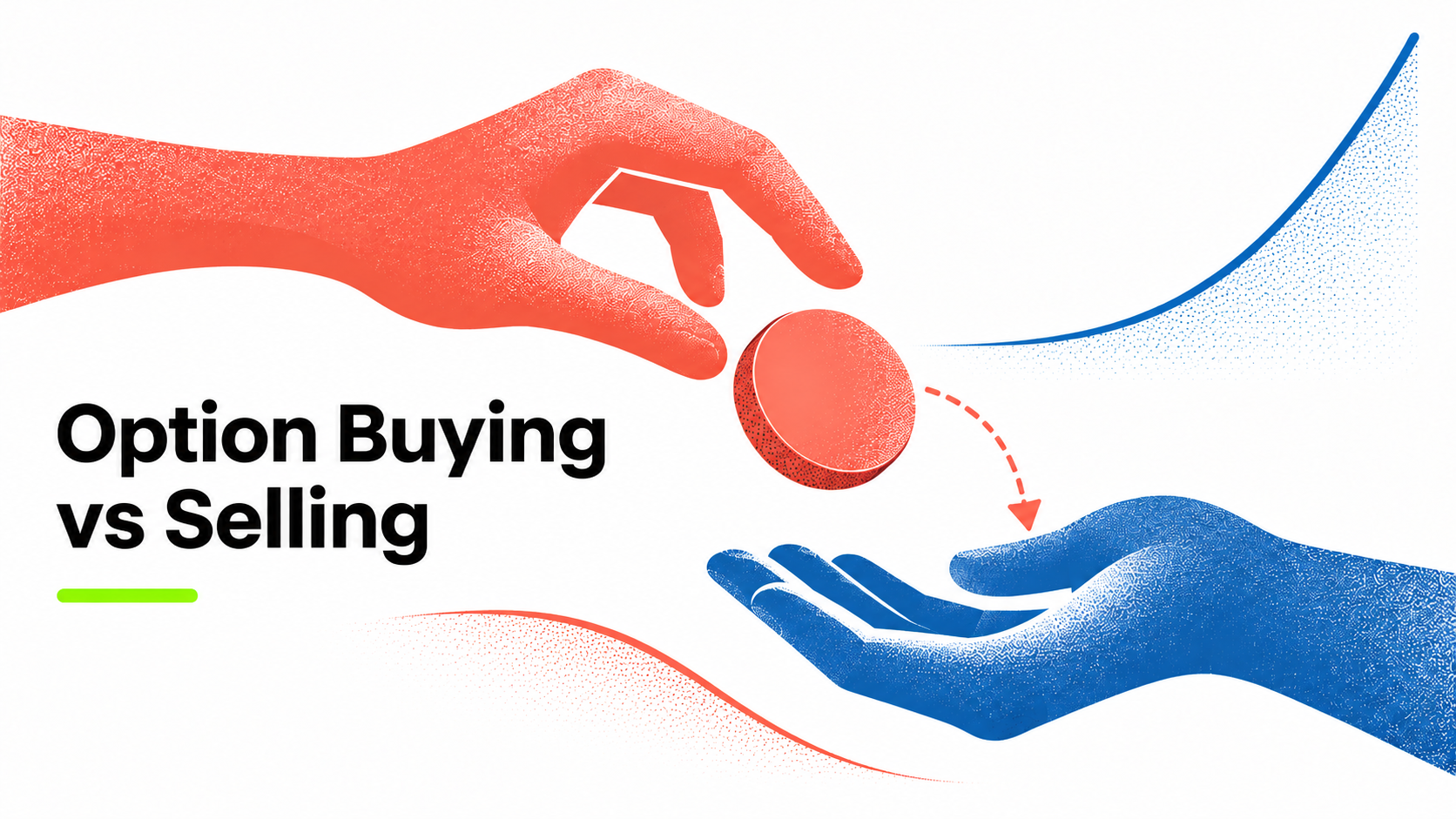
You’re looking at a nice profit as your call option premium goes from ₹100 to ₹140. However, one day you might see the index move very little and realise you’ve lost half your money. Option sellers seem to be getting regular premiums. Why not become an option seller?
This is where option buying vs selling gets interesting. Option buyers and sellers trade the same contracts, but there are differences in the amount of money required, potential losses and reasons for making a profit. This is important to understand.
Payoff profiles
Buying an option requires paying a premium. This means that for a CALL, you have the right to purchase the underlying asset at the specified strike price, and for a PUT, you have the right to sell the underlying asset. In India, index options are cash-settled on exchanges, meaning if you profit or lose money, you will receive or pay the settlement difference.
Sellers receive the premium and have an obligation. If the option goes out of the money or expires with a payout less than the premium received, they will profit.
Potential Profit
- Long Call – Maximum loss is the amount paid for the premium (excluding charges). Potential profit is theoretically unlimited.
- Long Put – Limited loss (premium). However, potential profit is capped due to the underlying not being able to go below zero.
- Naked Short Call – Generally capped profit (premium received). However, potential losses are theoretically unlimited.
- Short Put – Significant risk of losses, but these can’t be infinite due to the underlying not going below zero.
- Covered/Hedged Short – Always consider the whole position.
Probability of profit
It is often said that option sellers will win more often. Whilst this can be true, it’s important to consider the conditions.
Out-of-the-money options can expire worthless. If an option seller is short an option and the market goes slightly against their original view, they can still profit. The buyer needs the underlying to move favourably enough to cover the premium and charges.
However, the probability will depend on the strike price, premium, volatility, time to expiry and strategy taken. If you are short a deep out-of-the-money option, you may receive a small premium regularly but experience a large loss occasionally.
Profitable Traders
If you’ve made ₹1,000 on 9 trades but lost ₹15,000 on 1 trade, you may feel like you’ve won 9 times. However, you’ve actually lost ₹6,000 overall (before charges).
You may lose small amounts of premium on multiple occasions but then make a larger profit on one occasion. This does not guarantee option buying will be better.
When considering average profits, average losses, charges and position sizing, you won’t learn much from a trader claiming they have a 90% success rate.
Studies by SEBI have shown that many retail traders lose money trading equity derivatives.
Capital requirement
One obvious difference in option buying vs selling is the amount of capital your broker will require.
Option buyers generally pay the full premium. If the option is priced at ₹80 per unit and there are 75 units in the lot, that will be ₹6,000 (excluding charges).
However, naked option sellers can require significant amounts of capital to open a position. This is because NSE Clearing calculates the risk of your portfolio using SPAN and adds extra margins such as Extreme Loss Margin.
| Particulars | Option Buyer | Option Seller (Naked) |
|---|---|---|
| Initial Capital | Premium + Charges | Applicable Margin + Charges |
| Max Loss (on its own) | Premium | Significant amount (calls – potentially unlimited) |
| Cash Flow | Negative (Premium paid) | Positive (Premium received), margin blocked |
| Margins | Usually no seller-style margin on a standalone long index option | Can increase depending on risk |
The margin will not necessarily be the same as last month. It can change based on contract size, volatility, positions and broker rules.
Hedging
Buying a protective option can reduce margin due to the limited risk. However, you will have to pay for the option. Some margin benefits may change for spreads towards expiry.
Risk of each
Option buying seems straightforward as you know the maximum amount you can lose on a standalone option. However, it is common to lose the full premium as the option may expire worthless. Near expiry, time decay will work against you. Even if you have the correct directional view, you could still lose out if the underlying doesn’t move in time or enough to cover the premium.
Option selling can be risky as one large move could wipe out multiple small premiums collected earlier. Volatility can spike, causing the option price to rise and margin requirements to increase.
Stop-Loss Orders
Whilst you may think you’ll get the price you want, wider spreads, gaps and low liquidity can cause you to pay a high amount to close your position. Multi-leg positions may mean you only get one order filled.
In India, single-stock options can have physical settlement obligations at expiry. Index options are cash-settled. Make sure to check the contract.
Neither approach will be risk-free, even if you are trading with a small amount of capital. Leverage, frequent trading and poor risk management can cause small losses to become significant.
Who should do which
There is no single answer when it comes to option buying vs selling. Consider your experience, capital, time frame and how much you can afford to lose.
Option buyers should have a good understanding of how to trade directionally, select the right strike price, and understand implied volatility and time decay. Even with less capital, you can still lose the full premium on multiple occasions.
Option sellers should have a good understanding of margin, assignment/settlement, volatility spikes and worst-case scenarios. Naked options can be risky if you don’t have enough funds in reserve.
Considerations
Before you trade, consider:
- What is the maximum amount you could lose on this strategy?
- How much could you lose if the market gaps?
- What if volatility increases or liquidity dries up?
- How will you close your position? How much will it cost?
- Could you afford the loss?
If you can’t answer these questions, then maybe consider watching the market or practising with hypothetical trades.
Your decision to buy or sell should be based on a documented strategy.
Real examples
Below are some simple examples using index options. We will ignore charges and taxes for now. Actual results will depend on settlement and execution.
Example A – Long Call
The index is currently at 24,000. You buy a call option at a strike price of 24,000 for ₹120. At expiry, the index closes at 24,300.
Intrinsic value = ₹300. Profit = ₹180 per unit (before charges) (₹300 – ₹120).
If the index closes at 24,000 or below, the call will expire worthless, and you will lose the ₹120 premium per unit.
Example B – Short Call
You sold the call for ₹120. If the index closes at 24,000, you will make ₹120 per unit (before charges).
However, if it closes at 24,300, you will have to pay ₹300 for the intrinsic value. This means you will lose ₹180 per unit (before charges). If the index closes higher, the loss would be greater for naked short calls.
Example C – Hedged Short
Imagine you short a 24,000 call and buy a 24,300 call with the same expiry. You have limited the maximum loss at expiry for the spread, but you have paid for the protective option, meaning you won’t receive as much net credit.
This shows you can’t just look at the premium when deciding whether to buy or sell. Always calculate the full payoff.
FAQs
Is option selling more profitable?
Not necessarily. Some strategies can give you small, regular profits, but you could face significant losses due to unexpected movements. It depends on your strategy, risk management, premiums, charges and market conditions.
Why do option buyers lose?
They can lose if the underlying doesn’t move enough, moves against them or doesn’t move in time. Time decay, changes in implied volatility and charges can reduce your returns even if your directional view is partially correct.
How much capital for option selling?
It varies. The amount of margin you’ll need will depend on the underlying, contract size, volatility, strike prices and hedges. Use your broker’s margin calculator and have extra funds in reserve.
Is option selling risky?
Yes. Naked options can cause you to lose significantly more than the premium received. Extra margin can also be required. Hedging can limit some of the risk, but it involves costs, and consideration must be given to execution.
Conclusion
Ultimately, option buying vs selling comes down to different risks. Buyers pay a premium for limited-risk positions. Sellers receive a premium but take on obligations that can be costly.
Always know what the payoff, margin, settlement and costs will be. Neither strategy will guarantee regular income.
Ready to put your F&O trading plans into action?
Explore eligible futures and options contracts on Lemonn, check the available contract details and margin requirements, and place your trades through the app. Find the contracts you want to trade and take control of your next move with Lemonn.
Start trading F&O with Lemonn today!
Disclaimer
The stocks mentioned in this article are not recommendations. Please conduct your own research and due diligence before investing. Investment in securities market are subject to market risks, read all the related documents carefully before investing. Please read the Risk Disclosure documents carefully before investing in Equity Shares, Derivatives, Mutual fund, and/or other instruments traded on the Stock Exchanges. As investments are subject to market risks and price fluctuation risk, there is no assurance or guarantee that the investment objectives shall be achieved. Lemonn (Formerly known as NU Investors Technologies Pvt. Ltd) do not guarantee any assured returns on any investments. Past performance of securities/instruments is not indicative of their future performance.