How to Switch From Regular to Direct Mutual Fund Plans
 Written by Supratim Choudhury
 Reviewed by Gaurav Garg, SEBI-registered Research Analyst
Same fund manager. Same portfolio. Same investment strategy. Yet two investors in the same mutual fund scheme can pay different annual costs simply because one holds the regular plan and the other holds the direct plan. On a ₹10 lakh investment, an expense-ratio gap of 0.80 percentage points works out to roughly ₹8,000 a year.
That makes switching from regular to direct sound like an easy decision. The complication is tax: a switch redeems your existing units and buys new ones, potentially bringing forward a capital-gains tax bill even though the money stays invested. The lower annual cost is worth examining, but so is the price of making the move today.
For resident Indian individual investors, this guide puts those savings and costs into rupees, walks through the switching process, and explains when waiting could make more sense. It also separates two decisions that need not happen together: moving the money already invested and directing future systematic investment plan (SIP) instalments to the direct plan.
What Changes When You Move to Direct?
The scheme’s portfolio, fund manager, investment objective, and benchmark remain the same. Direct plans exclude distributor commissions and consequently have a lower total expense ratio (TER), the annual cost charged to the scheme’s assets.
Expenses are reflected in the net asset value (NAV), or value per unit. Less money goes towards expenses, leaving more invested.
Direct and regular plans have different NAVs. Switching therefore changes your unit count; it does not provide you the same number of units at a cheaper fee. A higher direct-plan NAV does not make that plan more expensive to buy.
You also take responsibility for decisions and administration previously supported by a distributor, unless you arrange separate help. Include any advice or platform fees when comparing costs.
Putting a Rupee Value on the Saving
Check the current TER of both plans on the fund house’s website, using the same disclosure date.
Approximate annual saving = holding value × difference in TER.
Consider a hypothetical ₹10 lakh holding:
| Item | Illustration |
| Regular-plan TER | 1.60% |
| Direct-plan TER | 0.80% |
| Annual expense difference | 0.80 percentage points |
| Approximate first-year saving | ₹8,000 |
This estimate assumes the holding stays around ₹10 lakh and the expense gap remains unchanged. Actual savings vary with daily asset values and changing expenses.
To illustrate compounding, suppose ₹10 lakh grows at 10% annually after expenses in the regular plan and 10.8% in the direct plan. After ten years, the values would be approximately ₹25.94 lakh and ₹27.89 lakh: a difference of ₹1.95 lakh.
These are assumed returns, not forecasts. The comparison excludes switching costs, tax, withdrawals, and separately paid advice. It shows why a modest annual cost difference can matter over a long holding period.
Check Tax and Other Costs Before Switching
Exit load: the same-scheme exemption
An exit load is a fee some mutual funds charge when you redeem or switch out units before a specified holding period ends. The Securities and Exchange Board of India’s (SEBI’s) March 2026 Master Circular, paragraph 11.7.3, states that exit load must not be charged on switches between regular and direct plans of the same scheme.
This means the scheme’s usual early-redemption fee does not apply to a same-scheme regular-to-direct switch. However, redeeming into your bank account or moving to another scheme may attract an exit load, depending on the scheme’s rules and how long you have held the units.
Capital gains tax: calculate by purchase lot
A voluntary regular-to-direct switch realises gains or losses on the units switched out. Reinvestment does not automatically exempt the gain.
The broad position for switches during tax year 2026–27 is:
| Holding Being Switched | Broad Tax Treatment of Gains |
| Equity-oriented fund units held for 12 months or less | Short-term capital gains taxed at 20% |
| Equity-oriented fund units held for more than 12 months | Long-term capital gains taxed at 12.5% above the shared annual ₹1.25 lakh threshold for eligible equity gains |
| Specified debt-oriented fund units acquired on or after 1 April 2023 | Gains treated as short-term and taxed at applicable slab rates, irrespective of holding period |
| Other non-equity units outside that specified-fund rule | Generally, slab rates for short-term gains; 12.5% without indexation for long-term gains. The threshold is more than 24 months for unlisted units, or more than 12 months for listed units |
Applicable surcharge and 4% health and education cess are additional. The ₹1.25 lakh threshold is shared across eligible equity gains, including shares; it is not a separate allowance for each scheme. The equity rates assume the applicable securities transaction tax conditions are met. Your income, available exemptions, and eligible losses can affect the final calculation.
Verify the scheme’s tax classification rather than assuming all hybrid, gold, or international funds follow equity rules. Specified debt-oriented funds broadly include funds investing more than 65% in debt and money-market instruments and qualifying funds investing in those funds. Pre-April 2023 debt holdings need separate attention: switching replaces them with newly acquired units.
Each SIP instalment has its own purchase date. Redemptions and switches generally use first-in, first-out, meaning older units go first. Download a capital-gains statement rather than judging the whole holding by the date your SIP began.
For resident investors, capital-gains tax is generally not deducted by the fund house on redemption. Nevertheless, the transaction must be included in your tax calculation, with advance tax considered where applicable. A taxable switch does not mean the tax is collected that day.
Smaller transaction costs
Stamp duty of 0.005% applies to newly issued units, including switch-ins: approximately ₹50 on ₹10 lakh. Securities transaction tax can also apply when equity-oriented units are redeemed. Check the transaction statement and any separately charged platform fees.
A worked tax-versus-saving example
Assume your equity-oriented regular-plan holding is worth ₹10 lakh, cost ₹8 lakh, and all units have been held for more than 12 months. Assume no other eligible equity gains, losses, surcharge, or basic-exemption adjustment.
- Gain realised: ₹2 lakh.
- Gain above the annual ₹1.25 lakh threshold: ₹75,000.
- Tax at 12.5%: ₹9,375.
- Including 4% cess: ₹9,750.
- Same-scheme switching exit load: ₹0.
Against the earlier ₹8,000 annual saving, ₹9,750 equals roughly 15 months of savings, before smaller charges.
This is a cash-flow comparison, not a precise break-even calculation. Some tax may have been payable on a later sale anyway. Switching brings it forward, changes your acquisition cost, and sacrifices potential growth on money used to pay tax. A proper comparison considers eventual after-tax proceeds under both choices.
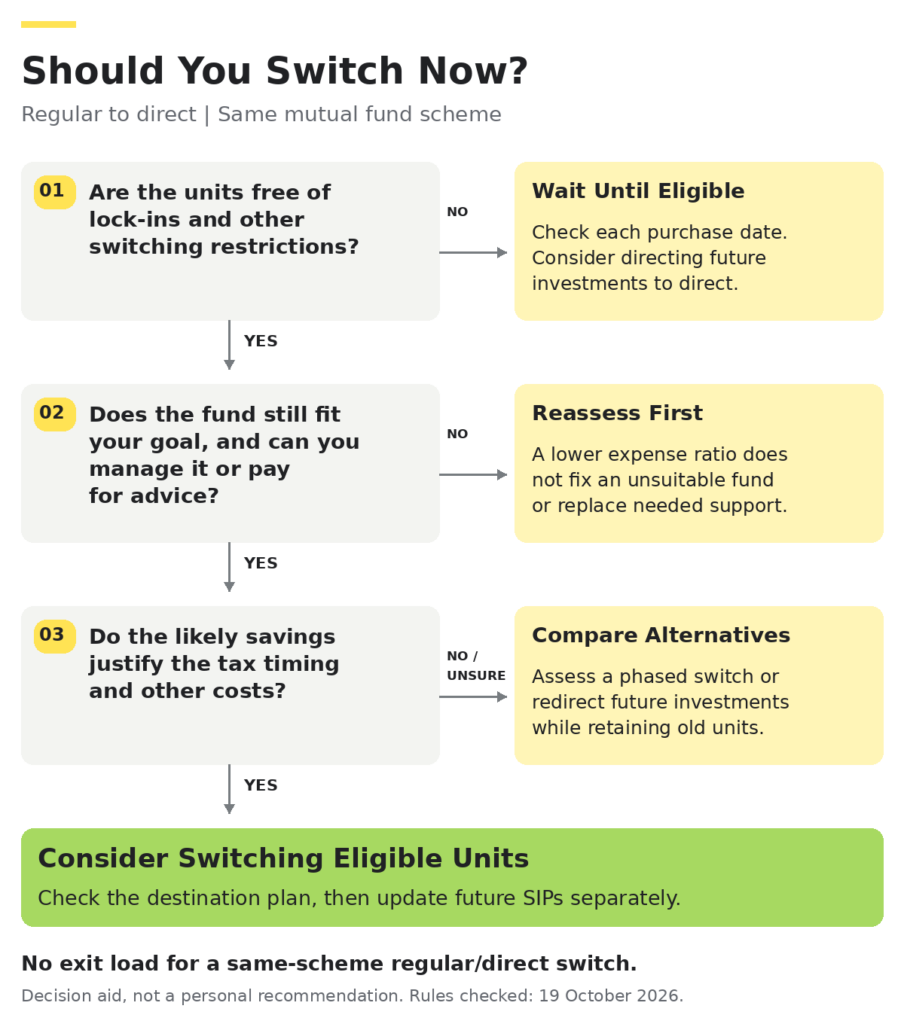
Check eligibility, suitability, and the tax-versus-saving trade-off before submitting a switch.
How to Switch From Regular to Direct
1. Gather your holding details
Find the folio number, full scheme name, plan, investment option, unit balance, and purchase history. Confirm that your identity verification and registered contact details allow transactions. Check lock-ins, pledged units, and other restrictions.
2. Choose a supported transaction route
Use the fund house’s investor portal, its registrar’s supported service, or another platform that supports the required switch. You can also submit the prescribed switch form through an authorised service centre.
If your current app does not offer switching, ask the fund house or registrar which route supports your holding. For dematerialised holdings, confirm the process with your broker or depository participant before proceeding.
3. Select the source and destination carefully
Choose the regular plan as the source and the direct plan of the same scheme as the destination. Retain the same investment option if only the plan is changing, for example, Growth to Growth.
Check the complete destination name. Changing the distributor code or importing a holding into another app does not, by itself, convert existing regular units into direct units.
4. Choose all units or a partial switch
Enter the amount or units, or select all eligible units. Review minimum transaction and residual-balance requirements. For a partial switch, estimate the gain on the units that will actually be redeemed.
5. Review, authenticate, and track
Check the summary, complete the required authentication, and save the reference number. Follow the platform’s current cut-off and processing rules; do not assume submission means immediate allotment.
Once processed, verify the switch-out, direct-plan allotment, NAVs, charges, and remaining regular-plan units. Retain both transaction and capital-gains statements. CAMS’ facility supports amount-based and unit-based switch requests.
6. Redirect future SIP instalments separately
Check whether the existing regular-plan SIP must be cancelled and a new direct-plan SIP registered. Do not assume switching the accumulated balance changes future instructions.
Coordinate cancellation and registration dates to avoid unintended duplicate debits or missed instalments. Confirm the name of the next investment plan.
When Switching Now May Be the Wrong Move
You are close to a better tax outcome. For equity units approaching long-term status, compare the tax difference with the saving forgone by waiting. Eligible investors can also assess spreading switches across tax years, considering other gains and market movements.
You need the money soon. A short remaining investment period leaves less time to benefit. Review the planned withdrawal and fund suitability before making an intermediate switch.
You hold older debt units. Pre-April 2023 units may have a different tax treatment from the new units you would buy. Compare both the immediate liability and future taxation.
You still need support. A lower TER is useful, but unsuitable decisions can outweigh the saving. Compare the distributor’s service with the cost and availability of separate advice.
The units are locked in. An exit-load exemption does not remove a lock-in. Redirecting future investments can be considered separately while existing units remain untouched.
Final Thoughts
Before you submit the witch request, confirm the current expense gap, eligible unit balance, estimated tax, and time left before your goal. Also, check that the destination is the same scheme’s direct plan with the intended option, and decide how future SIPs will run.
If moving existing units is not appealing today, consider directing future investments to the direct plan while reviewing older holdings at a later time. Lower costs matter most when the transaction also fits your tax position, support needs, and investment horizon.
Frequently Asked Questions (FAQs)
Q: Do I need my distributor’s permission to switch?
A: You generally submit the request as the unit holder without distributor consent. The fund house’s authentication and applicable joint-holder authorisation requirements still apply.
Q: Can I switch only part of my regular-plan holding?
A: Yes, subject to eligible units and scheme minimums. Check which purchase lots will be redeemed and estimate their gains before choosing the amount.
Q: Will my existing Systematic Investment Plan (SIP) automatically convert to a direct plan?
A: Do not assume so. Moving existing units and changing a systematic investment plan are separate tasks. Confirm the cancellation or modification requirements and register the direct-plan instruction as necessary.
Q: Will I receive the same number of direct-plan units?
A: Usually not. Your eligible switch will purchase units at the applicable direct-plan net asset value, after relevant deductions are made. Compare invested value and charges rather than unit count alone.
Q: Can I switch locked-in tax-saving units?
A: Equity-linked savings scheme units cannot be switched out during their three-year lock-in; each instalment has its own lock-in period. After eligibility, switching into direct-plan units creates a fresh investment with a new three-year lock-in and a new tax holding period.