F&O vs. Intraday vs. Swing Trading in India: Pros, Cons & How to Choose (2026)
 Written by Supratim Choudhury
 Reviewed by Gaurav Garg, SEBI-registered Research Analyst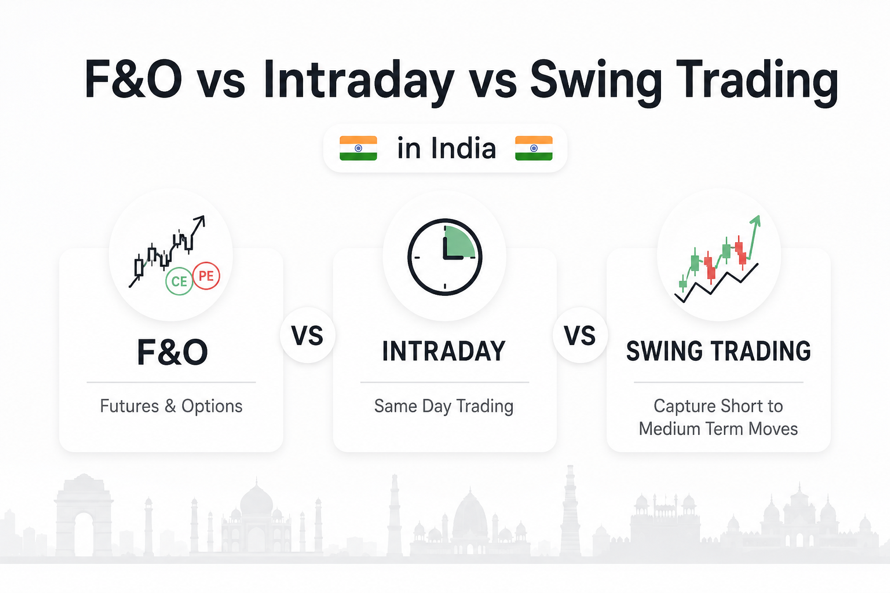
If you have just opened a demat account in India and are wondering whether to trade Futures & Options (F&O), do intraday trades, or hold swing positions for a few days, you are not alone. Each style has different risk, capital, and time requirements, and choosing one that does not fit your risk capacity can lead to large losses.
This guide compares F&O, intraday equity, and swing trading head-to-head, with a focus on Indian retail beginners using the National Stock Exchange of India (NSE) and BSE Limited through brokers like Lemonn and other Indian online broking platforms.
What each trading style actually means
Before comparing pros and cons, let us define the three styles clearly.
Intraday trading means buying and selling the same stock on the same trading day. Your broker may refer to an intraday product as Margin Intraday Square-off (MIS). Auto-square-off cut-offs vary by broker, so check current timings.
Swing trading means holding stocks for several days to a few weeks to capture short-to-medium-term price moves. You usually take delivery, sometimes labelled Cash and Carry (CNC), so the stock sits in your demat account.
F&O are derivatives whose value depends on an underlying asset such as the Nifty 50, Nifty Bank, or a stock. Futures traders post margin; option buyers pay a premium, while option sellers post applicable margin. The resulting leverage can magnify gains and losses.
Quick comparison table
| Factor | Intraday | Swing trading | F&O |
| Holding period | Same trading day | Several days to a few weeks | Until exit or contract expiry |
| Starting capital | Depends on share price, position size, and margin | Enough cash for the intended delivery position | Option premium or applicable futures/option-selling margin |
| Leverage | Broker- and stock-dependent | None if fully paid delivery | Built in; varies by contract and strategy |
| Time needed | Usually active monitoring during the session | Periodic monitoring, often once or twice a day | Can require close monitoring |
| Complexity | High | Lower than intraday and F&O | Advanced |
| Loss profile | Fast same-day losses are possible | Market and overnight gap risk | Long options: premium at risk; futures and short options can lose more than posted margin |
| Securities Transaction Tax (STT) | 0.025% on the sell side for non-delivery equity | 0.1% on purchase and 0.1% on sale for delivery equity | Futures: 0.05% on sale; options: 0.15% on sale premium, or intrinsic value when exercised |
| Typical tax treatment | Speculative business income | Capital gains when shares are held as investments | Generally non-speculative business income |
“Start investing with confidence! Explore
option trading
and grow your wealth.”
Intraday trading: Pros and Cons
Intraday is the style many beginners are drawn to because of immediate results and relatively low entry capital. However, it has its drawbacks.
Pros of intraday trading
- Quick feedback loop: you know if you made or lost money the same day.
- Some brokers provide intraday exposure, although leverage varies by stock and broker.
- No overnight price-gap risk from news released after you close the position.
- Many large-cap stocks are liquid, although spreads still vary.
Cons of intraday trading
- Loss rates are high. A 2024 Securities and Exchange Board of India (SEBI) study found that 7 out of 10 individual intraday traders in the equity cash segment made losses.
- Brokerage, STT, exchange charges, and other costs can eat into thin profit margins.
- Active intraday trading requires screen time and may be difficult to combine with a full-time job.
- Broker auto-square-off cut-offs vary, and forced exits can occur at unfavourable prices.
- Emotional overtrading and revenge trading can turn small losses into larger ones.
Before trying intraday trading, learn order types, position sizing, and your broker’s margin and square-off rules. Paper trading helps with the process, but not real-money slippage or emotions.
Swing trading: Pros and Cons
Swing trading sits between intraday and long-term investing, with positions held for days or weeks.
Pros of swing trading
- It usually requires less continuous screen time than intraday trading.
- It can fit around a job, college, or a busy household schedule.
- Fewer transactions can mean lower trading costs.
- It lets you target multi-day moves without using leverage if you buy shares with full cash.
- Decisions are usually less rushed than in intraday trading.
Cons of swing trading
- You face overnight gap risk from results, corporate news, or global moves.
- Capital can remain committed for days or weeks.
- Qualifying short-term gains on listed delivery shares held as investments are generally taxed at 20%.
- Trade opportunities may be infrequent, so patience matters.
For many beginners, unleveraged delivery-based swing trading is easier to size and monitor than intraday or F&O, but it is not risk-free.
F&O: Pros and Cons
Futures & Options offer leverage, hedging, and strategies for rising, falling, or range-bound markets. They are also the most complex. SEBI’s latest study found that 87.7% of individual equity-derivatives traders incurred losses in the financial year 2025-26 (FY26).
Pros of F&O
- Futures & Options can provide capital-efficient market exposure, although leverage magnifies losses as well as gains.
- Futures & Options allow investors to take bearish positions without owning the underlying asset, subject to market rules.
- Protective puts, covered calls, and defined-risk spreads can create structured payoffs.
- NSE offers weekly Nifty 50 options, while Nifty Bank options are on monthly and quarterly cycles.
- Multi-leg strategies can define maximum loss when constructed correctly.
Cons of F&O
- Contract sizes are large. The current Nifty 50 market lot is 65 units, while the cash or margin required depends on the contract and strategy.
- Time decay, also known as theta, reduces the extrinsic value of long options as the expiry date approaches, assuming all other factors remain constant.
- Futures and naked short-option positions can produce very large losses. A naked short call has theoretically unlimited loss.
- SEBI’s FY26 data shows that losses remain widespread even among experienced individual traders.
- Options Greeks such as delta, gamma, theta, and vega add complexity.
- F&O is generally treated as non-speculative business income, bringing tax-return, record-keeping, and possible audit obligations.
SEBI requires brokers to show standardised risk disclosures to clients trading in derivatives. These warnings are meant to clarify the risks, but they do not provide a real-time display of your personal trading losses.
Do not move into F&O simply because you have traded for a set number of months. Before risking money, understand maximum loss, margin, expiry, and settlement. Prefer defined-risk structures over naked short options.
Lemonn supports multi-leg basket orders such as iron condors. They simplify order entry but do not guarantee fills or reduce market risk.
Capital and risk side-by-side
Capital needs and risk work differently across intraday, swing trading, and F&O.
- Intraday: With ₹50,000 of capital, a 1% to 2% risk limit would mean risking about ₹500 to ₹1,000 on a trade. Position size should be based on how much you are willing to lose, not on the maximum exposure your broker allows.
- Swing trading: You usually need enough cash to take delivery of shares. Because positions are held overnight, allow for the possibility of price gaps that can move beyond your planned stop-loss.
- F&O: Leverage can create much larger gains or losses from a relatively small price move. For example, with the current 65-unit Nifty 50 futures lot, a 50-point move changes the position’s profit or loss by ₹3,250 before costs. Options may require less upfront cash than futures, but a bought option can expire worthless and lose the entire premium.
A common risk-management guideline is to limit the amount at risk on any one trade to around 1% to 2% of your trading capital. This is a rule of thumb, not a SEBI mandate or a safeguard against losses.
Taxation: a hidden differentiator
Tax treatment can materially change net returns.
- Intraday equity: Non-delivery equity trading is generally treated as speculative business income and taxed at the applicable slab rate. Speculation losses can generally be set off only against speculation profits and carried forward for up to four tax years, subject to filing conditions.
- Swing trading: Where delivery shares are held as investments, listed-equity gains are short-term if the holding period is 12 months or less and long-term if it exceeds 12 months. Qualifying short-term capital gains are generally taxed at 20%. Qualifying long-term capital gains are generally taxed at 12.5% above the aggregate annual ₹1.25 lakh threshold.
- F&O: Eligible derivatives transactions on a recognised stock exchange are not treated as speculative transactions for tax purposes and are generally reported as business income. Legitimate business expenses may be deductible, subject to tax rules.
Not every F&O trader files the same income-tax return or needs a tax audit. Return, book-keeping, and audit requirements depend on income, turnover, payment modes, and other conditions. Consult a chartered accountant.
Which style should you start with?
For most Indian retail beginners, use readiness rather than a fixed calendar:
- Learn the basics: Understand orders, margin, costs, taxes, stop-losses, and position sizing.
- Start with unleveraged delivery: Use small positions, keep a journal, and focus on risk.
- Add intraday trading only if it fits your schedule: Use a tested plan, predefine rupee risk, and avoid maximum leverage.
- Consider F&O only when you understand the instrument: Know the pay-off, maximum loss, margin, expiry, and settlement.
Time served is not proof of readiness. SEBI’s FY26 derivatives study found that loss rates remained high across experience levels and that several consecutive years of participation were not associated with improved profitability.
The biggest mistake beginners make is skipping straight to F&O because of social-media success stories. The regulator’s loss data is a better baseline than a highlight reel.
Final thoughts
F&O is not “better” than swing trading, and intraday is not “smarter” than F&O. Each suits a different capital base, risk tolerance, and time commitment. For many beginners, unleveraged delivery-based swing trading is the simpler first live-trading format. Build a repeatable risk process before moving to faster or more leveraged products. You never have to “graduate” to F&O.
Before your first trade, read your broker’s current risk disclosure, tariff, margin policy, auto-square-off policy, and contract specifications. These details can change.
Ready to start? Lemonn currently advertises ₹0 account opening and ₹0 annual maintenance charges, with paperless Know Your Customer (KYC) onboarding. Check current terms, then compare brokers in our demat account comparison guide.
Ready to start? Open a free demat account with Lemonn with ₹0 account-opening and maintenance fees, subject to current terms. Lemonn also supports paperless Know Your Customer (KYC) onboarding.
Frequently Asked Questions (FAQs)
Q: Is intraday trading better than F&O for beginners?
A: Intraday equity is simpler than F&O, but it is not low-risk. SEBI found that 7 out of 10 individual intraday equity traders lost money in its 2024 study, while 87.7% of individual equity-derivatives traders incurred losses in FY26. Many beginners may find unleveraged delivery-based swing trading easier to size and monitor.
Q: How much money do I need to start swing trading in India?
A: There is no fixed regulatory minimum. You need enough cash to buy shares while keeping positions small enough for sensible risk control and diversification.
Q: Can I do F&O part-time while having a full-time job?
A: Yes, but margin changes, expiry, sharp price moves, and settlement can require attention. NSE offers weekly Nifty 50 options, while Bank Nifty no longer offers weekly options.
Q: What is the tax on intraday vs swing trading profits?
A: Intraday equity is generally speculative business income taxed at the applicable slab rate. For listed delivery shares held as investments, qualifying short-term capital gains are generally taxed at 20%, while qualifying long-term capital gains are generally taxed at 12.5% above the annual ₹1.25 lakh threshold.
Q: Which is most profitable: intraday, swing, or F&O?
A: None is inherently most profitable. F&O can amplify gains and losses, and SEBI’s retail data shows a high loss rate. Choose the style whose risk, time, and complexity you can manage after costs and taxes.
Disclaimer
The stocks mentioned in this article are not recommendations. Please conduct your own research and due diligence before investing. Investment in securities market are subject to market risks, read all the related documents carefully before investing. Please read the Risk Disclosure documents carefully before investing in Equity Shares, Derivatives, Mutual fund, and/or other instruments traded on the Stock Exchanges. As investments are subject to market risks and price fluctuation risk, there is no assurance or guarantee that the investment objectives shall be achieved. Lemonn (Formerly known as NU Investors Technologies Pvt. Ltd) do not guarantee any assured returns on any investments. Past performance of securities/instruments is not indicative of their future performance.
Related Posts


Download Lemonn
Download my app for option trading, IPO, 0 demat account, stocks, and dive into the stock market.