Futures and Options (F&O) Explained for Beginners
 Written by Prateek Desai
 Reviewed by Gaurav Garg, SEBI-registered Research Analyst
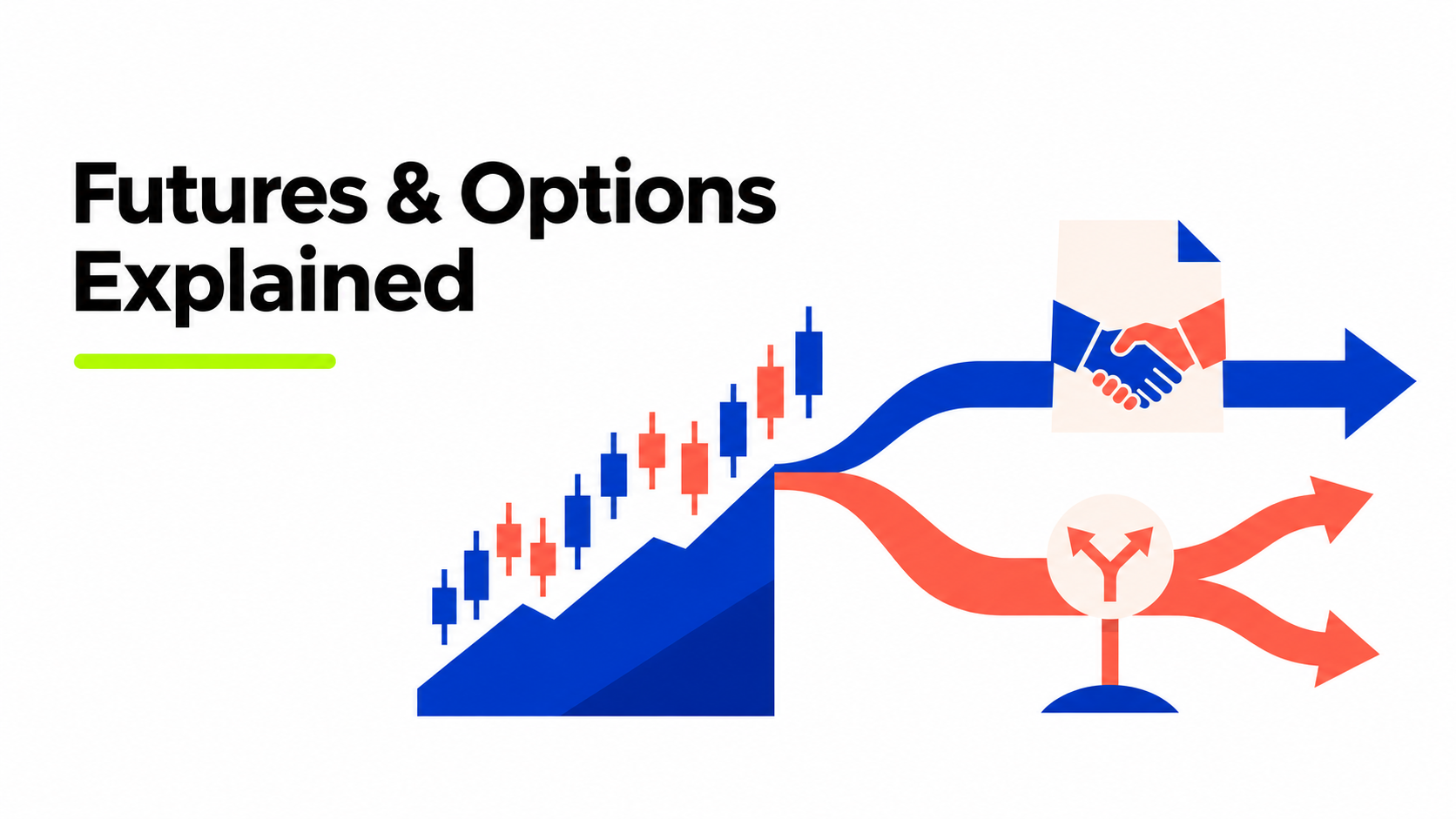
Futures and Options (F&O) are derivative contracts. These contracts allow traders to take certain positions based on potential future price movements. They can be used for multiple asset classes like stocks, indices and more.
But how do futures and options actually work, and what makes them different? That’s what we’ll explore in this blog, along with practical examples and the risks involved.
What Derivatives Are
A derivative draws its value from another asset.
A stock. An index. A currency. Even a commodity.
The underlying asset determines much of the contract’s value, although other pricing factors can also influence the result.
Consider Nifty 50.
Its value changes throughout the trading day as the prices of its constituent stocks move. A Nifty derivatives contract responds to these movements according to its contract terms.
India’s equity derivatives market mainly offers two instruments: futures and options.
Why do people use them?
- Hedging
- Speculation
- Arbitrage
Picture an investor with a ₹20 lakh equity portfolio.
A market correction could reduce its value. The investor may use index derivatives to hedge some of that exposure.
A speculative trader may enter the very same contract with no underlying portfolio.
Different objectives. Different financial circumstances. The same market instrument.
That’s the starting point for understanding what futures and options trading is.
“Start investing with confidence! Explore
option trading
and grow your wealth.”
Futures Explained With Example
A futures contract creates an agreement between two parties at a specified price for settlement at a future date.
First, the buyer takes a long position. At the same time, some seller takes a short position. This means both have a contractual obligation from now on until the positions are closed.
How Does a Futures Contract Work?
Let’s take an example to understand this.
| Particulars | Value |
|---|---|
| Futures price | 24,000 |
| Lot size | 50 units |
| Contract value | ₹12,00,000 |
| Expiry | One month |
Now a trader buys one lot at 24,000, and the futures price rises to 24,200. Now the trader closes the position.
Gross profit:
(24,200 − 24,000) × 50 = ₹10,000
Now suppose the futures price falls to 23,800.
Gross loss:
(24,000 − 23,800) × 50 = ₹10,000
Just 200 points.
And a ₹10,000 difference in the outcome.
What Happens Before Expiry?
Here’s a detail many beginners overlook. Futures contracts involve daily mark-to-market adjustments.
Suppose your position loses money today. You may need additional funds to maintain it, even if you expect the market to recover tomorrow.
The clearing process accounts for daily gains and losses.
You can generally close a futures position before expiry. Hold it until expiry, and the relevant settlement rules take effect.
Index futures settle in cash.
Stock futures in India involve physical delivery at expiry.
The distinction matters. So does the margin requirement.
Your initial margin does not represent the maximum amount you can lose.
A sharp market move can create losses greater than the funds you initially committed.
Options Explained With Example
Options introduce a different contract structure.
The buyer pays a premium for a specified right. The seller receives the premium and accepts the corresponding obligation.
Two types of options dominate the market.
Call Option
It’s a type of option that gives the buyer a right to buy the underlying asset at a pre-fixed strike price. Traders generally buy this option when they feel that the price of that asset might go up.
Put Option
This is the opposite of the call option in layman’s terms. It gives the put buyer the right to sell the underlying asset at a pre-fixed strike price.
Traders generally purchase puts when they anticipate a fall.
Indian exchange-traded equity options follow European-style exercise rules, with exercise at expiry.
How Does an Options Trade Work?
Consider a hypothetical Nifty call option.
| Particulars | Value |
|---|---|
| Strike price | 24,100 |
| Premium | ₹120 |
| Lot size | 50 |
| Total premium | ₹6,000 |
A trader purchases one lot for ₹6,000, excluding charges.
At expiry, Nifty closes at 24,400.
The option has an intrinsic value of 300 points.
The trader paid 120 points as premium.
Gross profit:
(300 − 120) × 50 = ₹9,000
Now change the closing level.
Nifty ends at 24,000.
The call expires worthless. The trader loses the entire ₹6,000 premium, plus applicable charges.
For a standalone purchased index option, the premium generally limits the contractual trading loss.
For option sellers, the situation can be far more dangerous. Losses can substantially exceed the premium received.
Why Can an Option Lose Value Even When the Market Rises?
A trader buys a call option.
Nifty moves up.
The option premium falls.
Strange? Only until you examine how options get their prices.
Several factors influence the premium:
- Underlying price
- Strike price
- Time to expiry
- Implied volatility
- Interest rates
Index vs Stock F&O
An index represents several companies. A stock represents one. That difference changes the behaviour of the derivatives contract.
Index F&O
Index derivatives follow benchmarks such as Nifty 50.
The index generally moves based on the movements of the companies that are in that particular index.
Economic data, foreign investment flows, monetary policy, and global developments can affect index prices too.
A single company may influence the index considerably if it carries a large weight.
Stock F&O
Stock derivatives follow an individual eligible company. Now imagine a company announces disappointing quarterly results. Its stock falls sharply at the next market opening.
The corresponding derivatives contracts may experience substantial price changes. Company-specific developments can create sudden and sizeable movements.
Index vs Stock F&O
| Feature | Index F&O | Stock F&O |
|---|---|---|
| Underlying | Market index | Individual stock |
| Main influences | Broader market factors | Company and market developments |
| Exposure | Several constituent companies | One company |
| Expiry settlement | Cash | Physical delivery |
| Particular risk | Market-wide volatility | Company-specific price shocks |
Margin and Lot Size
A futures contract worth ₹12 lakh.
An initial margin requirement of ₹1.8 lakh.
At first glance, the difference looks attractive.
But the trader still faces market exposure linked to the full contract value.
What Is Margin?
Margin is the minimum amount of collateral that you must mandatorily have to create certain derivative positions.
Let’s take an example.
- Contract value: ₹12,00,000
- Required margin: ₹1,80,000
- Adverse market movement: 2%
The gross loss equals ₹24,000.
That is roughly 13.3% of the assumed initial margin.
What Is Lot Size?
A lot is the standard number of units in a futures or options contract.
Suppose a hypothetical option has 50 units per lot.
Its premium is ₹100 per unit.
The cost of one purchased lot:
50 × ₹100 = ₹5,000
Transaction charges apply separately.
Lot sizes vary across indices and stocks. Exchanges can revise them, too.
Never rely on an old contract specification.
| Feature | Futures | Options |
|---|---|---|
| Buyer obligation | Yes | Specified right |
| Seller obligation | Yes | Yes |
| Initial requirement | Margin | Premium for buyers |
| Main price factors | Futures price movement | Price, volatility, time and other factors |
| Expiry | Fixed | Fixed |
When you examine what futures and options capital exposure is, look beyond the upfront payment.
Risks of F&O Trading (SEBI F&O Study)
The numbers are difficult to ignore.
Nearly 91% of individual traders incurred net losses in India’s equity derivatives segment during FY 2024–25.
SEBI published those findings in July 2025. And the most important thing to notice is, the net losses reached approximately ₹1.06 lakh crore.
The study found losses among an overwhelming majority of individual participants in equity derivatives.
Why Do F&O Traders Lose Money?
Leverage
Small movements can create large financial consequences relative to the initial capital.
Time Decay
Purchased options lose time value as expiry approaches, all else being equal.
Liquidity
Some contracts have few active buyers and sellers. Wide bid-ask spreads may increase the cost of an exit.
Expiry Obligations
Stock derivatives can create physical delivery requirements and substantial financial commitments.
Poor Position Control
A large position can magnify losses. Repeated attempts to recover those losses may expose even more capital.
And then there’s a common mistake.
A trader sees an option premium of ₹20 and assumes the trade is inexpensive.
But the total premium depends on lot size. The contract also carries expiry risk and the possibility of losing the full premium.
FAQs
Is F&O trading risky?
Yes. Leverage, volatility, and expiry can cause substantial losses. SEBI reported net losses among nearly 91% of individual equity derivatives traders in FY25.
What is the minimum capital for F&O?
There is no fixed amount. The minimum capital depends on the contract, lot size, premium and multiple other factors.
What is lot size?
Lot size is the standard number of units in one futures or options contract, as specified by the exchange.
Can beginners trade options?
Eligible beginners can trade options. But it’s a risky move and hence it’s very important to take care of time decay and expiry.
Conclusion
Futures and options allow traders and investors to take positions linked to stocks and market indices.
Futures create obligations for both parties. Options give buyers contractual rights after payment of a premium.
Then come the details that shape the financial outcome.
Lot size. Margin. Volatility. Time decay. Expiry. Settlement.
Each matters.
If you are interested in taking the leap after learning the concepts of derivatives, Lemonn can be a great platform to start with. Explore securities and derivative trading with Lemonn today.
Till then, happy and safe trading!
Disclaimer
The stocks mentioned in this article are not recommendations. Please conduct your own research and due diligence before investing. Investment in securities market are subject to market risks, read all the related documents carefully before investing. Please read the Risk Disclosure documents carefully before investing in Equity Shares, Derivatives, Mutual fund, and/or other instruments traded on the Stock Exchanges. As investments are subject to market risks and price fluctuation risk, there is no assurance or guarantee that the investment objectives shall be achieved. Lemonn (Formerly known as NU Investors Technologies Pvt. Ltd) do not guarantee any assured returns on any investments. Past performance of securities/instruments is not indicative of their future performance.
Related Posts


Download Lemonn
Download my app for option trading, IPO, 0 demat account, stocks, and dive into the stock market.