Upper Circuit and Lower Circuit in Share Market Explained
 Written by Ipsita Baishya
 Reviewed by Gaurav Garg, SEBI-registered Research Analyst
Let’s say you are buying a stock. You bought it for ₹100 in the morning. But by lunchtime, the price has jumped to ₹110. You want to buy some more, but your order just isn’t going through. You see “Upper Circuit”.
Alternatively, the opposite can happen. The stock plunges and hits its lower circuit. Now there are plenty of sellers, but very few buyers. You decide to sell, but nothing is happening.
Understanding what is circuitous in the share market will help you understand why these scenarios happen. Circuit limits are put in place by the stock exchanges in India. They can affect the execution of your orders but won’t stop you from losing out as an investor.
What circuit limits are
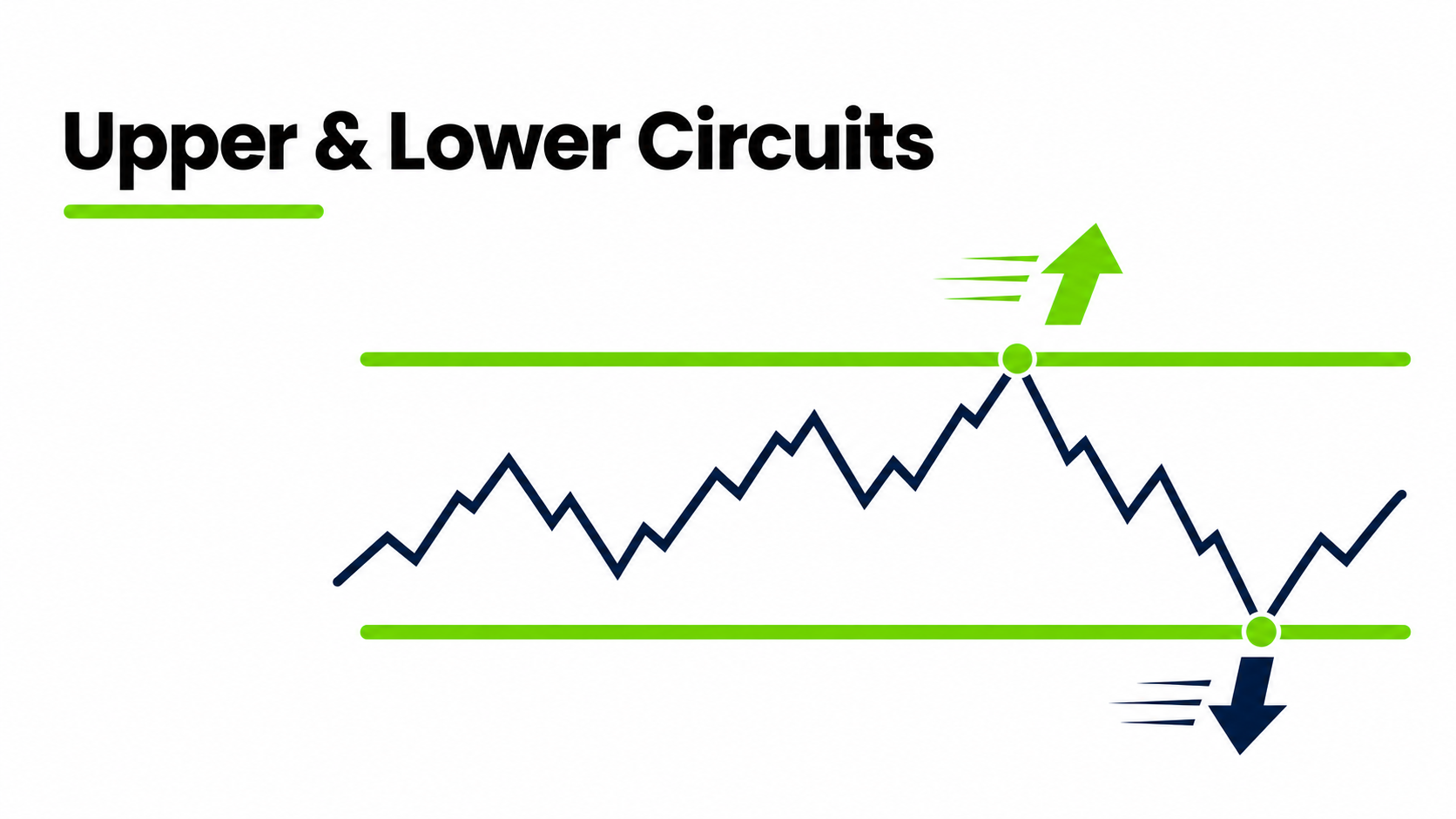
Circuit limits are price limits set by the stock exchanges.
- Upper Circuit – This means the stock can’t go higher than the maximum price in its relevant daily band.
- Lower Circuit – This means the stock can’t go lower than the minimum price in its relevant daily band.
Let’s say the stock closed last night at ₹100 and has a 10% band.
The maximum price it could hit is ₹110.
The minimum price it could hit is ₹90.
If buyers push the price up to ₹110, it won’t be able to go higher than this price (the upper limit). If sellers push the price down to ₹90, it can’t go lower than this.
However, if a stock hits a circuit, it doesn’t mean there won’t be any trades. If there are buyers and sellers, then orders will go through at the circuit price. However, if there are plenty of orders on one side, you’ll see what is known as a ‘locked circuit’.
These limits are put in place as a safeguard, but they don’t tell you anything about the value of the stock.
Stock vs index circuit breakers
There are two types of circuit breakers that are often confused.
Stock Circuits
Price bands are set by the stock exchanges. Certain stocks will have a percentage band. For example, one company’s stock may have a 5% band, whereas another company’s stock may have a larger 20% band. Once the stock hits either the upper or lower band of this price range, it will not be able to trade above or below the respective limit.
However, stocks that have exchange-traded derivatives generally won’t have a fixed range. Instead, they will have a dynamic range that can be relaxed as per the rules.
Index Circuits
When either the Nifty 50 or BSE Sensex has moved by 10%, 15% or 20% from its previous close, there is an index circuit. This will result in a freeze of the equity and equity derivative markets across the country, depending on the threshold and timing.
General Rule:
| Circuit Level | What Happens |
|---|---|
| 10% | Will result in a temporary freeze if hit early enough. |
| 15% | Will result in a longer freeze or closure, depending on when it’s hit. |
| 20% | Trading will cease for the rest of the day. |
For example, if it hits 10% early enough (before 1 pm), trading will freeze for 45 minutes. After this, there will be a 15-minute pre-open auction. If it hits 10% at or after 2:30 pm, there will be no freeze.
Circuit bands (2%,5%,10%,20%)
You may notice some stocks have different circuit percentages. This isn’t decided by the company.
For stocks with fixed bands, the stock exchange will put a band on the stock. This could be 2%, 5%, 10% or 20%. This is decided by the stock exchange according to its rules. These bands will be reviewed by the exchange.
Let’s say the stock closed last night at ₹250.
| Daily Band | Upper Limit | Lower Limit |
|---|---|---|
| 2% | ₹255 | ₹245 |
| 5% | ₹262.50 | ₹237.50 |
| 10% | ₹275 | ₹225 |
| 20% | ₹300 | ₹200 |
These are just examples and do not account for rounding by the stock exchange.
A smaller band (2%) means there won’t be much movement in a single session, whereas a larger band (20%) will allow for much more movement. However, a smaller band doesn’t mean the stock is any safer. The stock could hit the lower circuit multiple times over a few days.
The stock exchange may also change the band. This can be affected by corporate actions, surveillance and other factors. Always check what the current band is.
For F&O stocks, remember that the dynamic range doesn’t mean there will be a hard upper/lower limit.
Can the circuit change overnight?
Yes! A stock may have a 10% band today, but later on, after the stock exchange has conducted surveillance, the band may change. The price limits will be recalculated based on the relevant price. When placing orders, always double-check what the numbers are. Don’t rely on old screenshots. Check the stock exchange website or the live quote on your broker’s site.
Why stocks hit circuits
There is rarely just one reason why stocks hit a circuit.
Strong Demand
If the company has had good news (positive earnings), a large order, positive business news or unexpected news in the industry, there may be lots of buyers. This could cause the stock to hit the upper band due to a lack of sellers.
Sometimes, there can be some speculation involved.
Heavy Selling
If the company has had poor results, regulatory news, debt concerns or bad news, there could be heavy selling. If there are no buyers, the stock could hit its lower limit.
Panic can cause this to get worse. People see the price going down and try to sell, adding to the queue.
Low Liquidity
Stocks with low liquidity can move rapidly. Even if there are small amounts of orders, they can cause large movements. Rumours and coordinated trading can also cause unusual demand/supply.
Investors should always check what the company is actually saying, how much trading volume it’s getting and what its financials are like.
Trading stocks in circuit
Let’s say a stock is locked in the Upper Circuit. There are lots of buyers, but very few sellers. Can I buy?
Yes, you can place an eligible order at the circuit price. However, your order will depend on whether there are sellers to match your order. Your order may not go through.
If the stock is in the Lower Circuit and you want to sell your 100 shares, but there are lots of sellers and very few buyers…
You can place an order at the circuit price, but it may not go through.
What Should Investors Consider?
Check the market depth. Is there anyone buying/selling at the circuit price? If there are large amounts of orders outstanding, this can show there is an imbalance. However, this can change quickly.
Read up on the latest announcements from the stock exchange. Is there any news from the company causing the movement, or is it due to speculation?
Don’t assume an upper circuit means you’ll make gains tomorrow. The stock could go the other way.
Remember that stop-loss orders aren’t guaranteed. If there are no buyers to match your order, your order may not go through.
This can cause extra risk for those who are trading intraday or on margin. You may be unable to exit as you expected.
FAQs
What happens in upper circuit?
This means the stock has hit the maximum price in its relevant fixed daily band. Buyers may see their orders outstanding as there are no sellers to match them. Orders can be placed at the circuit price.
Can I sell in lower circuit?
Yes, you can place an order during lower circuit, but it will only go through if there are buyers. You may find yourself waiting to sell.
Who sets circuit limits?
The price bands are decided by the stock exchanges. They can be changed as per the relevant rules. SEBI provides the regulatory framework. Check the NSE or BSE for the current limit.
What is market-wide circuit breaker?
This freezes the equity and equity derivative markets across the country. This happens when either the Nifty 50 or Sensex hits the relevant movement threshold. The freeze will depend on how much movement there is and when it happens.
Conclusion
Now that you understand what is circuit in share market, the next time your trading app shows a stock in Upper/Lower Circuit, look past the percentage.
Check what the relevant band is. Check what orders are available and why the price is moving. Remember that circuit limits can affect execution but won’t stop you from losing money. The stock may keep falling on the following days.
Want to invest in the Indian stock market with a reliable trading platform? Lemonn offers an immersive UI, competitive charges and 24×7 assistance for traders and investors.
Start with us today.
Disclaimer: This article is for educational purposes only. Investments in the stock market carry risks. There is never any guarantee that your orders will go through.
Disclaimer
The stocks mentioned in this article are not recommendations. Please conduct your own research and due diligence before investing. Investment in securities market are subject to market risks, read all the related documents carefully before investing. Please read the Risk Disclosure documents carefully before investing in Equity Shares, Derivatives, Mutual fund, and/or other instruments traded on the Stock Exchanges. As investments are subject to market risks and price fluctuation risk, there is no assurance or guarantee that the investment objectives shall be achieved. Lemonn (Formerly known as NU Investors Technologies Pvt. Ltd) do not guarantee any assured returns on any investments. Past performance of securities/instruments is not indicative of their future performance.