What Is Sensex? Meaning, History and How It Is Calculated
 Written by Ipsita Baishya
 Reviewed by Gaurav Garg, SEBI-registered Research Analyst
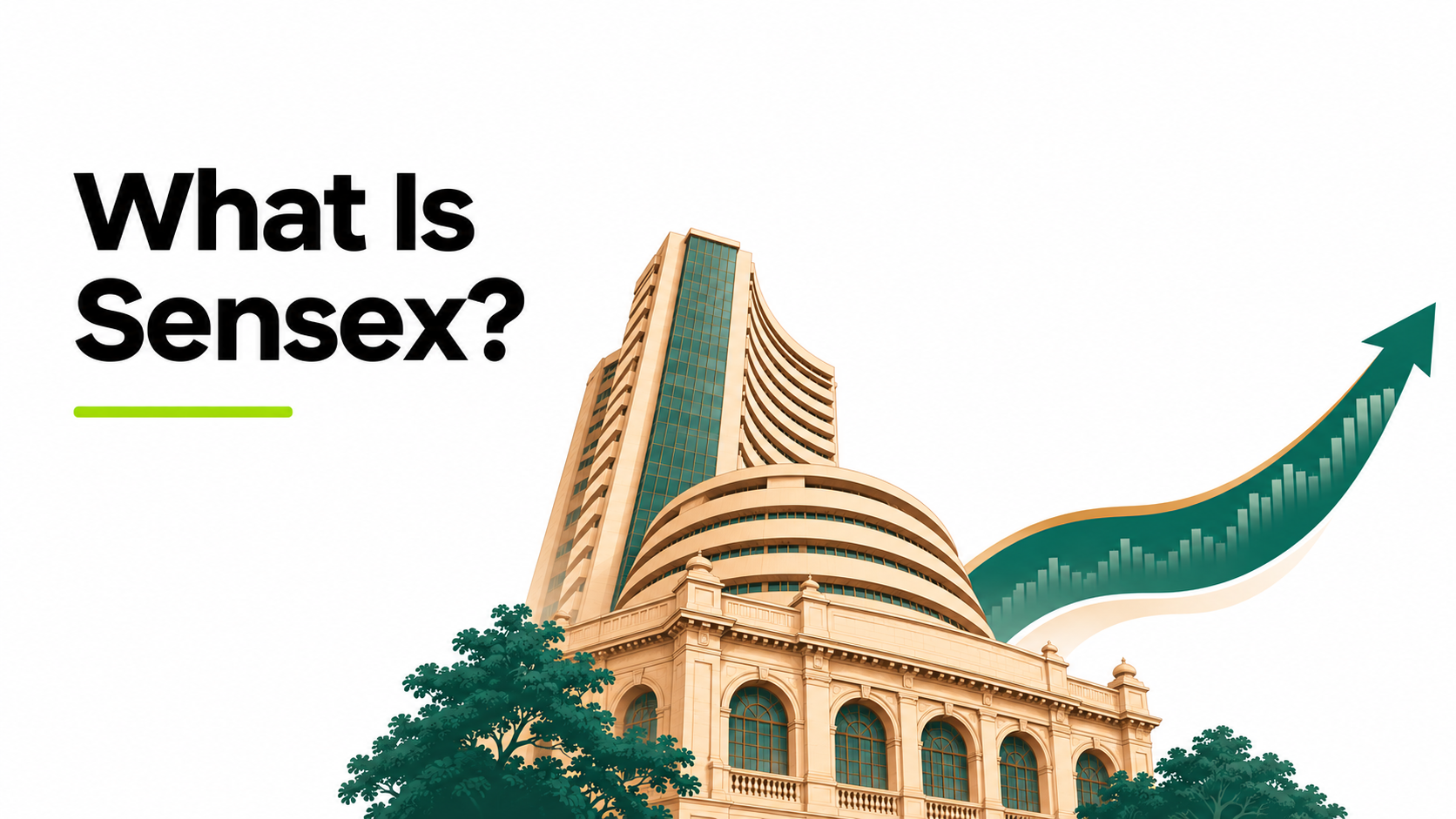
Sensex is the most heard term in the Indian stock market. It is so popular that even the people who have never purchased a single share know this name!
You’ll always here financial news and other media channels talking about Sensex every now and then. So what exactly the Sensex is? How does it relate to the stock market? Let’s find out!
Sensex Meaning
Sensex is the short form of Sensitive Index. It is the benchmark equity index of the BSE. It tracks 30 large companies listed on the BSE from almost all the major sectors of the Indian economy.
The index helps investors follow the performance of these companies through a single number.
Say Sensex rises 1% during a trading session. Some of its constituent stocks may have gained 3%, a few may have fallen, and others might have remained almost unchanged. The index combines their movements according to their respective weights.
And that’s where things get interesting.
A 2% rise in a company with a 12% index weight affects Sensex more than a similar rise in a company with a 1% weight.
What Does Sensex Tell Investors?
- Market direction: The combined performance of 30 major Indian stocks.
- Market sentiment: How investors are reacting to developments affecting these companies.
- Performance comparison: A benchmark for comparing certain equity portfolio returns.
- Economic developments: How major stocks respond to earnings, policy changes and global events.
Of course, Sensex cannot represent every listed company. There may be days when Sensex rises while hundreds of smaller stocks decline.
History and Milestones
BSE was established in 1875. Sensex came more than a century later, in 1986.
The index uses 1978–79 as its base period, with a base value of 100.
Now imagine following the index during its early years. In 1990, Sensex crossed 1,000 points. By 2006, it had reached 10,000. The next 10,000 points came considerably faster.
And the milestones kept coming.
Major Sensex Milestones
| Year | Milestone |
|---|---|
| 1986 | Sensex launched |
| 1990 | Crossed 1,000 points |
| 1999 | Crossed 5,000 points |
| 2006 | Crossed 10,000 points |
| 2007 | Crossed 20,000 points |
| 2017 | Crossed 30,000 points |
| 2019 | Crossed 40,000 points |
| 2021 | Crossed 50,000 and 60,000 points |
| 2023 | Crossed 70,000 points |
| 2024 | Crossed 80,000 points |
| 2025 | Reached 86,159.02 intraday |
On 1 December 2025, Sensex touched 86,159.02, its highest recorded intraday level as of 8 November 2026.
Quite a rise from the original base of 100.
But look at what happened along the way. It’s important to take note of sudden market corrections. For example, the Sensex fell sharply during 2008’s global market meltdown. It also corrected a lot during the COVID-19 pandemic in 2020.
As an investor, you should understand that the market might deliver good returns over a longer period, but it can experience heavy corrections in between.
Calculation Method
Calculating the value of Sensex is a bit complex. Some shares are expensive in terms of price per share while others are cheaper. For example, one trades at ₹200 per share while another trades at ₹3,000.
But this doesn’t mean the first share has lesser weightage in the Sensex as compared to the second one. The reason is that the Sensex uses free-float market capitalisation to calculate the index.
What Is Free-Float Market Capitalisation?
First, let’s take a hypothetical company that has 100 crore outstanding shares. And each of those shares trades at ₹200.
Its total market capitalisation would be:
100 crore × ₹200 = ₹20,000 crore
Now let’s say promoters and other strategic shareholders hold 60% of those shares. And the remaining 40% shares are free-floating shares.
The calculation changes.
₹20,000 crore × 40% = ₹8,000 crore
This means the company’s free-float market capitalization is ₹8,000.
This is a basic idea of how Sensex determines the weightage and influence of the constituents of the index.
Sensex Calculation Formula
The simplified formula is:
Sensex = (Current total free-float market capitalisation ÷ Adjusted base market capitalisation) × 100
It’s important to note that actual calculation also includes corporate actions and other events that impact index continuity.
Sensex 30 Composition
Which companies make up Sensex?
You’ll find familiar names. HDFC Bank, Reliance Industries, Infosys, Bharti Airtel, Tata Steel and several others.
But their presence in Sensex depends on index selection requirements. Companies can enter or leave during periodic reviews, and their weights fluctuate with market values.
Sensex 30 Stock List
| Sector / Industry | Companies |
|---|---|
| Banking and Financial Services | HDFC Bank, ICICI Bank, SBI, Axis Bank, Kotak Mahindra Bank, Bajaj Finance, Bajaj Finserv |
| Information Technology | TCS, Infosys, HCL Technologies, Tech Mahindra |
| Automobile | Maruti Suzuki, Mahindra & Mahindra |
| Energy and Power | Reliance Industries, NTPC, Power Grid |
| FMCG | Hindustan Unilever, ITC |
| Healthcare | Sun Pharmaceutical Industries |
| Telecom | Bharti Airtel |
| Infrastructure and Engineering | Larsen & Toubro, Bharat Electronics |
| Metals | Tata Steel |
| Consumer Businesses | Titan, Asian Paints, Trent, Eternal |
| Cement | UltraTech Cement |
| Transport and Logistics | Adani Ports, InterGlobe Aviation |
Do All 30 Companies Carry Equal Weight?
We’ve already seen how free-float market capitalisation works.
Now consider its practical impact.
Reliance Industries, HDFC Bank and ICICI Bank are among the major index constituents by weight. A sharp move in any of these stocks can influence the overall Sensex reading considerably.
But the weights are never fixed permanently. If a company’s eligible market value grows faster than the others, its contribution can increase.
The constituent list changes too. A company may qualify for inclusion during one review and leave during a later review.
Thirty companies. A composition that evolves with the market.
Sensex vs Nifty
Financial news reports Sensex and Nifty together so frequently that beginners sometimes assume they’re almost identical.
They do share several constituent companies. But the two indices have very different weightage of the constituent shares.
Sensex vs Nifty: Key Differences
| Feature | Sensex | Nifty 50 |
|---|---|---|
| Exchange | BSE | NSE |
| Number of companies | 30 | 50 |
| Launch year | 1986 | 1996 |
| Base value | 100 | 1,000 |
| Calculation | Free-float market capitalisation | Free-float market capitalisation |
| Coverage | Selected major BSE-listed companies | Selected major NSE-listed companies |
Sometimes, it happens that the gain or loss in the Sensex and Nifty might be different. This is due to the difference in constituents and their weightage.
That difference may come from the performance and relative weights of their constituent stocks. So the best way to compare them both is to compare their percentage returns over a period.
How to Invest in Sensex
You can purchase shares of Reliance Industries or HDFC Bank. You can also buy units of a mutual fund.
But can you purchase Sensex itself?
Sensex is an index, so investors generally gain exposure through products that track its performance.
Sensex Index Funds
These mutual funds are designed to follow the Sensex. They do so by holding the same stocks present in the Sensex in almost the same proportions.
You can either invest via an SIP or do a lump-sum investment.
Sensex ETFs
Exchange-Traded Funds also track Sensex. Their units trade on stock exchanges during market hours.
You’ll generally need a Demat and trading account to buy ETF units through an exchange.
Buying Individual Stocks
Another approach is to purchase Sensex companies individually.
But buying ten stocks won’t replicate the index’s complete performance. Matching all 30 constituents and their respective weights requires additional capital and regular adjustments.
What Should Investors Check?
Before choosing an index fund or ETF, consider:
- Expense ratio and transaction charges
- Tracking difference and tracking error
- Minimum investment requirements
- ETF trading liquidity
- Your financial goals and risk tolerance
One more thing. Index funds can fall in value when the underlying market declines. The index may recover eventually, but there’s no guarantee about when that will happen.
FAQs
How many companies are in Sensex?
There are 30 companies in the Sensex index and all of them have to be listed on the BSE. Over time, the constituents and their weightage keep on changing.
Who calculates Sensex?
BSE Index Services Pvt. Ltd., a BSE subsidiary, manages and calculates Sensex according to its index methodology.
What is the highest Sensex level?
As of 8 November 2026, Sensex’s highest recorded intraday level was 86,159.02, reached on 1 December 2025.
Can I invest in Sensex?
You can invest through Sensex index funds, ETFs or by purchasing constituent stocks separately. The index itself cannot be purchased directly.
Conclusion
Sensex has been part of India’s financial markets for four decades. It started with a base value of 100 and has since crossed 80,000 points, with major crashes and corrections along the way.
Today, it tracks 30 companies, each with its own weight. Their combined performance provides a useful reference for investors who want to follow India’s large-cap stock market.
Now that you understand what the Sensex is, its calculation and composition, you can examine the companies behind the index and the products that track it.
Interested in trading in stocks and other assets? Explore Lemonn today for more information and details.
Till then, happy and safe investing!
Disclaimer
The stocks mentioned in this article are not recommendations. Please conduct your own research and due diligence before investing. Investment in securities market are subject to market risks, read all the related documents carefully before investing. Please read the Risk Disclosure documents carefully before investing in Equity Shares, Derivatives, Mutual fund, and/or other instruments traded on the Stock Exchanges. As investments are subject to market risks and price fluctuation risk, there is no assurance or guarantee that the investment objectives shall be achieved. Lemonn (Formerly known as NU Investors Technologies Pvt. Ltd) do not guarantee any assured returns on any investments. Past performance of securities/instruments is not indicative of their future performance.