NSE vs BSE: Differences Every Investor Should Know
 Written by Prateek Desai
 Reviewed by Gaurav Garg, SEBI-registered Research Analyst
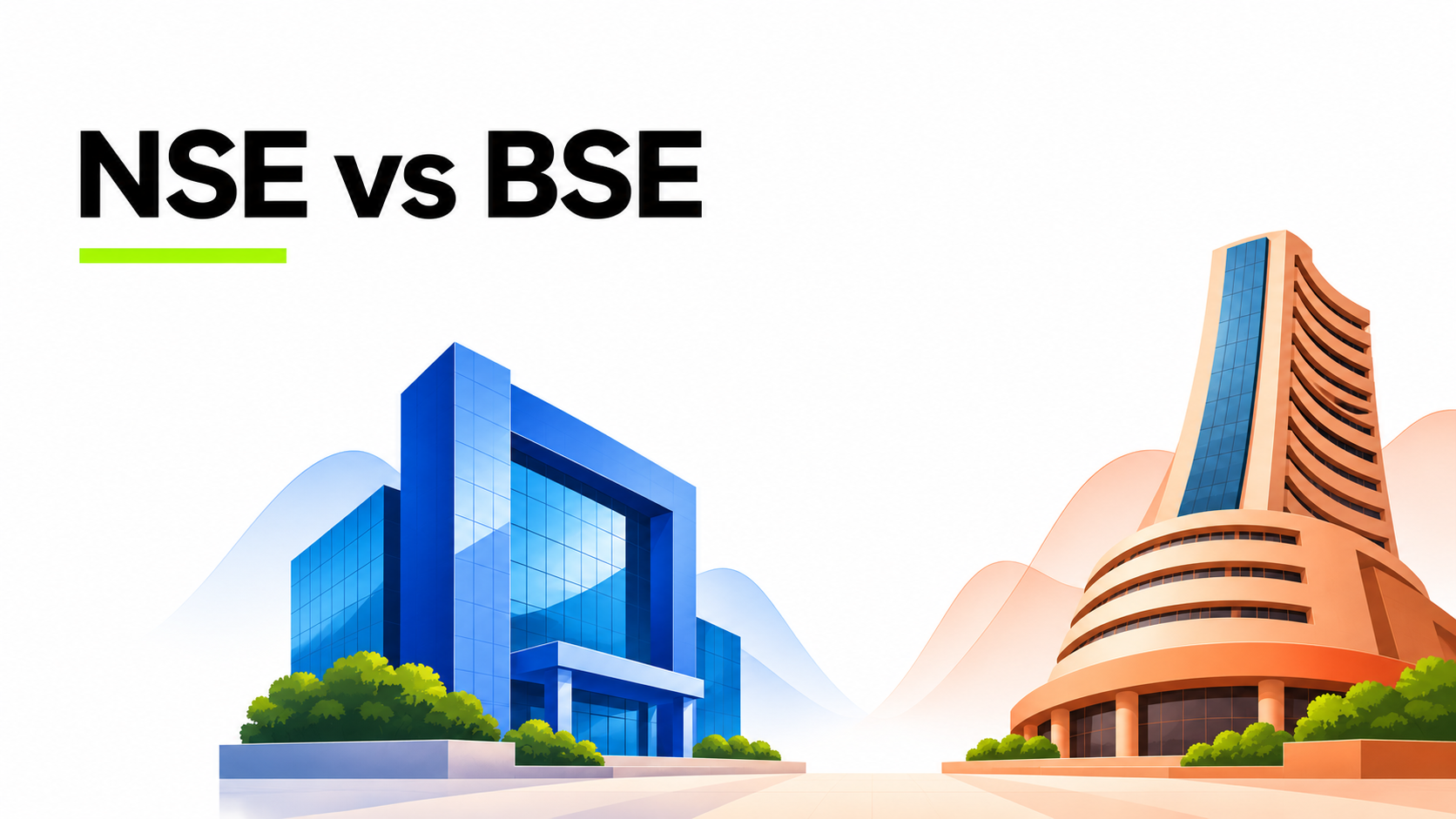
NSE and BSE. You’ve probably heard these names hundreds of times, especially if you follow the Indian stock market.
Both are stock exchanges. Both allow investors to buy and sell shares. And many companies have their shares listed on both.
But here’s something interesting.
The same stock may trade at slightly different prices on NSE and BSE. Trading volumes can vary considerably, too. Sometimes, a company is available on one exchange and absent from the other.
So, what’s the difference between NSE vs BSE? Which exchange offers better liquidity? And does choosing one over the other actually affect your investment?
Let’s dive deeper.
History of Both Exchanges
BSE is much older than NSE. More than a century older, in fact. But both have played an important role in India’s stock market.
Bombay Stock Exchange (BSE)
BSE is Asia’s oldest stock exchange. It was established in 1875. When it began its journey, it was named Native Share and Stock Brokers’ Association. It was started in Mumbai.
When the BSE began its journey, the brokers used to gather physically and trade shares manually. There was a lot of paperwork involved, along with face-to-face price negotiations!
Today, this feels extremely amusing, given how we trade stocks today! Today, BSE operates electronic trading platforms for equities, derivatives, debt instruments and other securities.
National Stock Exchange (NSE)
NSE is very young as compared to BSE. It began its journey in 1992 when it was incorporated. But equity trading on NSE began only in 1994.
The most astonishing feature of NSE was that it was a national stock exchange and it supported screen-based trading. This ensured more number of traders could participate in stock trading.
Within a few years, NSE became a major trading venue. Today, it dominates India’s equity cash trading volumes.
NSE vs BSE: Quick Comparison
| Feature | NSE | BSE |
|---|---|---|
| Full name | National Stock Exchange | Bombay Stock Exchange |
| Established | 1992 | 1875 |
| Equity trading began | 1994 | 19th century |
| Benchmark index | Nifty 50 | Sensex |
| Equity cash volumes | Generally higher | Generally lower |
| Regulator | SEBI | SEBI |
Nifty vs Sensex
A lot of traders have this confusion! They wonder what the difference between them is. So let’s understand it.
Nifty and Sensex both are stock market indices. The idea behind designing such an index was simple: to help traders and investors gauge the performance of the overall market.
They do so by tracking the performance of selected major companies listed on the respective exchanges.
But the most important thing about both exchanges is that their composition is different.
What Is Nifty 50?
Nifty 50 is NSE’s benchmark equity index. It tracks 50 large, liquid companies across important sectors of the Indian economy.
This includes sectors like Banking, IT, Energy, Automobiles and Consumer goods.
The index uses free-float market capitalisation to calculate its value.
What Is Sensex?
Well, Sensex is BSE’s benchmark index. It tracks 30 major companies listed on BSE. It was introduced in 1986, and even today it remains the most followed Indian benchmark index.
Here’s a quick comparison between them:
Nifty vs Sensex
| Feature | Nifty 50 | Sensex |
|---|---|---|
| Exchange | NSE | BSE |
| Number of stocks | 50 | 30 |
| Introduced | 1996 | 1986 |
| Weighting | Free-float market capitalisation | Free-float market capitalisation |
Here’s something beginners should remember.
If Sensex rises 1%, every company in the index hasn’t necessarily gained 1%. Some shares may rise sharply. Others may fall. The index reflects their combined weighted performance.
Liquidity and Volumes
Suppose you want to purchase 500 shares of a company.
On NSE, thousands of shares trade every minute. On BSE, the same stock sees relatively few transactions.
Does that matter?
Absolutely.
What Is Liquidity?
Liquidity indicates how easily you can buy or sell shares at available prices.
A stock with high liquidity generally has more active buyers and sellers.
That can make order execution easier.
How Do Volumes Affect Trading?
Consider this hypothetical comparison.
| Factor | NSE | BSE |
|---|---|---|
| Daily trading volume | 10,00,000 shares | 25,000 shares |
| Best buying price | ₹500 | ₹499.50 |
| Best selling price | ₹500.10 | ₹500.80 |
Notice the difference?
The gap between the best buying and selling prices is called the bid-ask spread.
A wider spread can increase transaction costs.
NSE generally has higher equity cash trading volumes. However, liquidity varies from stock to stock.
A particular share may offer a better available price on BSE.
So, check the actual quotes and order depth before trading.
Listing Differences
Are all NSE-listed companies also listed on BSE?
No. Generally, the large Indian companies have their shares listed on both NSE and BSE. But then there are smaller companies that have their shares listed only on either of the two exchanges.
Mainboard Listings
Any company can get their shares listed on either NSE, BSE or both if they meet certain listing criteria.
For investors, if the company has a dual listing, it’s better! They get a chance to trade the same shares on two different exchanges.
SME Listings
Both exchanges also operate platforms for small and medium enterprises.
- NSE EMERGE: It is NSE’s dedicated SME listing platform.
- BSE SME: It’s BSE’s platform, specially designed for eligible smaller companies.
These platforms are extremely useful for businesses that want to raise capital via the public market. They, of course, have to fulfil certain criteria to raise the capital, though.
If you are planning to invest in such SME companies, it might turn out to be a good investment opportunity. But SME shares carry special risks. So be aware of that.
What Should You Check?
The first thing you should check is the company’s exchange listing. Also check their trading series and available volume.
You should also check if that particular stock is tradable on the mainboard or an SME platform.
A listing tells you where the shares trade. It doesn’t tell you whether the company is financially strong.
That requires research.
Which Exchange to Choose When Buying
Now comes the practical part. You’ve selected a company. Your trading app shows two options.
NSE and BSE.
Which one should you pick? Start with the price and compare Available Quotes. Suppose you want to buy 20 shares.
The available selling prices are:
- NSE: ₹800.20
- BSE: ₹800.10
At first glance, BSE looks cheaper.
But there’s a catch.
What if only five shares are available at ₹800.10?
Your remaining order may execute at higher prices or stay unfilled, depending on the order type.
That’s why traders also examine market depth.
Things to Compare
- Liquidity
- Bid-ask spread
- Order depth
- Charges
For actively traded stocks, the difference may be tiny.
Still, a quick comparison can help you understand the available execution conditions.
Price Differences and Arbitrage
A share trades at ₹1,000 on NSE. At the same moment, BSE shows ₹1,002.
Same company. Two prices.
How is that possible?
Because NSE and BSE maintain separate order books. Buyers and sellers place orders independently on each exchange. That creates occasional price differences.
What Is Arbitrage?
Arbitrage involves attempting to benefit from price differences for the same asset across markets.
Let’s take an example.
A trader purchases 100 shares on NSE at ₹1,000 and sells 100 shares on BSE at ₹1,002.
The gross difference:
(₹1,002 − ₹1,000) × 100 = ₹200
Sounds easy?
Now consider the execution.
Both trades must happen at the expected prices. Brokerage, taxes and other charges reduce the potential profit.
There’s also the question of settlement obligations.
And prices can change before the second order executes.
A ₹2 difference on the screen doesn’t automatically mean ₹2 profit per share.
Can You Buy on NSE and Sell on BSE?
Yes, if the shares are eligible and listed on both exchanges.
Suppose you already hold settled shares in your Demat account.
You can generally sell them through either exchange, subject to broker support and applicable rules.
FAQs
Which is better, NSE or BSE?
Both are SEBI-regulated exchanges. So they both are safe. In general, stocks on NSE have higher volume but higher prices. On the contrary, stock prices on BSE are generally lower, with lower volume.
Can I buy on NSE and sell on BSE?
Of course you can. You can buy eligible shares on one exchange and sell on another. But it’s important that the broker you use supports such transactions. If you are using Lemonn, you can definitely do so.
Why do prices differ on NSE and BSE?
The reason is pretty simple. Both exchanges have different demand, supply and liquidity for a particular stock. While the difference is not massive, the variation in the above factors leads to varied prices on both the exchanges.
Is Sensex part of NSE?
No, this is where new traders and investors get confused. Sensex is the benchmark index of BSE. NSE’s benchmark index is Nifty 50.
Conclusion
NSE and BSE are India’s two largest stock exchanges in every aspect. But BSE is very old, with decades of history. NSE is new, but it handles high equity cash trading volumes.
As we discussed earlier, both have different benchmark indices. So if you want to gauge what’s going on in BSE, you should take a look at the Sensex. And if you want to understand what’s going on in NSE, you must analyse Nifty 50.
We hope this simple explanation has cleared all your doubts about NSE and BSE. If you are just kicking off your stock market journey, feel free to explore our website.
Lemonn is amongst India’s leading stock trading platforms with numerous features specially designed for beginners as well as experienced traders.
Start your journey now.
Disclaimer
The stocks mentioned in this article are not recommendations. Please conduct your own research and due diligence before investing. Investment in securities market are subject to market risks, read all the related documents carefully before investing. Please read the Risk Disclosure documents carefully before investing in Equity Shares, Derivatives, Mutual fund, and/or other instruments traded on the Stock Exchanges. As investments are subject to market risks and price fluctuation risk, there is no assurance or guarantee that the investment objectives shall be achieved. Lemonn (Formerly known as NU Investors Technologies Pvt. Ltd) do not guarantee any assured returns on any investments. Past performance of securities/instruments is not indicative of their future performance.