How to Invest in the Share Market: Step-by-Step for Beginners
 Written by Ipsita Baishya
 Reviewed by Gaurav Garg, SEBI-registered Research Analyst
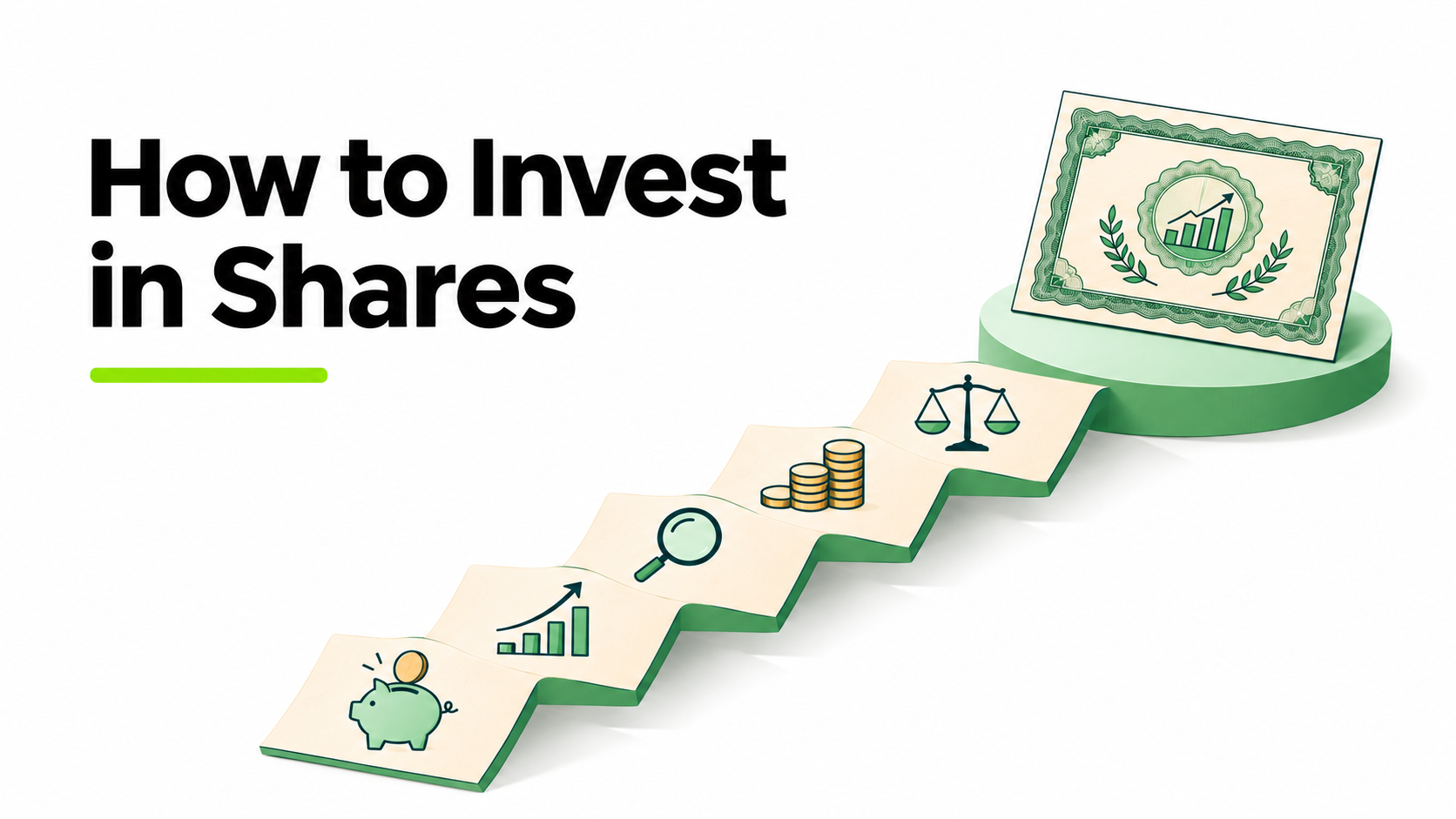
Buying shares in India has become much easier. You can open an account online, transfer money, search for a company and purchase its shares through simple steps.
Opening an account is only the beginning.
You also need to know which stocks to choose, how money to invest, what charges apply and when to review your investments.
So how to invest in the share market for the time? What documents do you need? How do you make your first purchase?
That’s what we’ll explain in this blog along with examples and common mistakes to avoid.
Set Your Goals
Before you purchase your share, decide why you want to invest.
Retirement? Long-term wealth? Your child’s education? A financial goal ten years from now?
The answer matters because every goal has a different time horizon.
Suppose you want to purchase a car this year. You have saved ₹2 lakh for the payment.
Now imagine investing that money in shares. What happens if the market falls 20% just before you need it?
Your ₹2 lakh investment would be worth ₹1.6 lakh.
That’s why your investment goals should determine how much risk you take.
Three Things to Consider
- Investment horizon
- Risk tolerance
- Investment amount
One more thing. You don’t need an amount to begin. A small affordable investment can help you understand the process.
Open a Demat and Trading Account
You’ve decided to invest. Now comes the paperwork.
To buy listed shares in India, you generally need three accounts.
Demat Account
A Demat account holds your shares electronically.
Suppose you purchase 20 shares of a company. After settlement, those shares appear in your Demat account.
India has two depositories: NSDL and CDSL. You open the account through a Depository Participant.
Trading Account
A trading account allows you to place buy and sell orders on stock exchanges such as NSE and BSE.
You select the company, quantity and order type. The broker sends your order to the exchange.
Bank Account
You need a bank account to transfer funds and receive payments.
Documents Required
You’ll generally need:
- PAN
- Identity. Address details
- Bank account information
- Number and email address
- Additional documents, where applicable
You must also complete Know Your Customer (KYC) verification.
The process may involve identity checks and other verification requirements.
Before opening an account, check brokerage, annual maintenance charges and other applicable fees.
A low account-opening cost doesn’t necessarily mean every future transaction will be free.
Fund Your Account
Your accounts are ready.
What’s next? You need funds to purchase shares.
Most trading platforms provide supported payment methods to transfer money from your registered bank account.
The available methods and transfer limits depend on the platform and applicable banking arrangements.
How Much Should You Add?
Suppose you want to purchase five shares at ₹400 each.
The purchase value comes to:
5 × ₹400 = ₹2,000
You’ll also need to account for charges.
The amount required may change if the share price moves before your order executes. Make sure you pick a good platform like Lemonn that levies minimal charges. This will ensure you get to keep more money with you for every single trade.
Important Things to Remember
Always check the registered payment details before transferring money.
Use approved payment channels. Avoid sending investment funds to unknown individuals or personal accounts.
Keep records of transactions.
Don’t transfer your entire savings simply because your account is active.
For someone learning how to invest in the share market, the first deposit should be an amount they can afford to expose to market risk.
Research Stocks
There are thousands of listed companies in India. Some have operated for decades. Others entered the market recently.
Every company has a different financial position. So how do you decide which stock deserves your money? Start with the business itself.
The first thing to analyse is, how that company earns money. Let’s say it’s a manufacturing company. So identify what it manufactures and analyse its current and future demand in the market.
Then you should ask questions like: Who purchases its products? Is demand increasing? Does it depend heavily on a customer?
When you get answers to these questions, you get an idea about the business model. Then check the company’s revenue, profits, debt and cash flow.
But that too has to be done with a wider view! A company may report sales while its profits decline.
Why?
Well, the company might sell more products but raw material costs increased, or the company borrowed heavily to fund expansion.
So look beyond one quarter.
Examine Valuation
Valuation is extremely important when you are investing in a company. And valuation does not mean the stock price! A company with a ₹80 share price might be more valuable than Company B that trades at ₹1,500!
The valuation of a company depends on factors like price-to-earnings ratio and market capitalisation.
Check Management and Risks
Read reports and stock exchange announcements.
Look for debt obligations, legal disputes, corporate governance concerns and changes in business conditions.
Basic Stock Research Checklist
| Factor | What to Examine |
|---|---|
| Business | Products, customers and revenue sources |
| Revenue | Sales performance over time |
| Profitability | Earnings and profit margins |
| Debt | Borrowings and repayment obligations |
| Valuation | Price relative to earnings and other measures |
| Risks | Industry, financial and management concerns |
Place Your First Order
You’ve researched a company and decided to purchase its shares. Now let’s understand the transaction.
Suppose the stock trades at ₹500. You want to buy 10 shares. The approximate purchase value is ₹5,000 excluding charges.
Step 1: Search for the Stock
Open your trading account and search for the company.
Check its trading symbol and the exchange on which you want to place the order.
Step 2: Select the Quantity
Enter how many shares you want to buy.
For this example, select 10.
Step 3: Choose an Order Type
Two used order types are:
Market Order
A market order attempts to execute at the available market price.
The final execution price may differ from the displayed price, especially during volatile conditions.
Limit Order
A limit order specifies the price you’re willing to pay.
Suppose the stock trades at ₹500. You place a buy limit order at ₹495.
The order can execute at ₹495 or lower if a matching seller is available.
It may remain unexecuted if the market never reaches your limit.
Step 4: Review and Confirm
Check the stock name, quantity, price and estimated charges.
Then submit the order.
Step 5: Check the Order Status
An order may be executed, rejected or remain pending.
After execution and settlement, the shares reach your Demat account according to the settlement process.
That’s your first share purchase.
Track and Review Your Portfolio
Buying shares takes minutes. Following the businesses you own requires attention over time.
Suppose you invest in five companies. After six months, three have gained value while two have declined.
Should you immediately sell the losing stocks?
That depends on why their prices fell and whether your original investment assumptions still hold. Here are some important parameters that you should review before taking any step:
- Company Results
- Business Developments
- Portfolio Allocation
- Your Investment Goals
Understanding Portfolio Returns
Suppose you invest ₹10,000.
A year later, your holdings are worth ₹11,500.
Your unrealised gain is ₹1,500 or 15% before costs and taxes.
If their value falls to ₹8,500 you have an unrealised loss of 15%.
These fluctuations are part of equity investing.
Also, diversification can reduce dependence on one company. It cannot eliminate market risk.
Mistakes to Avoid
- Don’t rely on fancy stock tips from unknown or unreliable sources.
- Keep your emergency fund secured and don’t invest that fund in the stock market.
- Don’t buy a stock simply because its share price looks cheap.
- Make sure you diversify your investment instead of buying a single stock in a large quantity.
- Take into account brokerage, taxes and other charges before calculating potential returns.
- Don’t invest in the stock market for quick returns because your funds might get stuck for a long.
FAQs
How much money do I need to start?
There’s no minimum. You need enough to purchase the chosen shares and cover charges.
Can I invest with ₹100?
Of course you can. There are a lot of shares that have prices lower than ₹100, so you can invest in them.
Which stocks should a beginner buy?
If you are just getting started, it’s better to pick blue-chip stocks. Blue-chip companies are companies that have well-established businesses, transparent reporting and good valuation.
Is investing better than saving?
Both serve purposes. Savings support liquidity and capital preservation while investments offer growth with the possibility of losses.
Conclusion
The process of share market investment is fairly straightforward.
Set a goal. Open the required accounts. Add funds. Research. Place your first order.
Then comes the part that requires patience.
Follow business developments. Review your holdings. Understand your risks. Avoid decisions based on short-term excitement.
Ready to explore the share market?
Lemonn can help you get started. Explore listed stocks and start investing with us today.
Till then, safe investing!
Disclaimer
The stocks mentioned in this article are not recommendations. Please conduct your own research and due diligence before investing. Investment in securities market are subject to market risks, read all the related documents carefully before investing. Please read the Risk Disclosure documents carefully before investing in Equity Shares, Derivatives, Mutual fund, and/or other instruments traded on the Stock Exchanges. As investments are subject to market risks and price fluctuation risk, there is no assurance or guarantee that the investment objectives shall be achieved. Lemonn (Formerly known as NU Investors Technologies Pvt. Ltd) do not guarantee any assured returns on any investments. Past performance of securities/instruments is not indicative of their future performance.